Dr. Ondřej Ježil | Forcing Reading Group
Keywords
Summary
130 words
Critical Evaluation
Value of the Information & Strength of the Argument
The information is highly valuable for those studying proof theory and model theory, as it provides a structured recap of a forcing construction that yields models with controlled induction properties. The argumentation is rigorous: the speaker systematically defines concepts, proves key lemmas (e.g., locality, forcing equivalence), and clarifies subtle points such as the difference between inductive and least number principles. The collaborative discussion strengthens the logical derivation, as questions from the audience prompt explicit justifications. The value lies in its pedagogical clarity and the depth of technical reasoning, making it a resourceful reference for graduate-level logic.
Scientific Rigor, Source Quality, Title Accuracy
The scientific rigor is evident: the presentation builds on established results in model theory and forcing, and the arguments are presented with precision. While no external literature is explicitly cited within the talk, the context implies familiarity with Paris-Wilkie forcing and related concepts; the description provides links to the institute’s seminar page, which serves as a formal source. The title accurately matches the content—an advanced reading group on forcing—and the technical depth is consistent with the intended audience. There is no misrepresentation, and the content adheres to the standards expected of an INI seminar.
205 words
Title / Content Match
The title accurately describes the content as a forcing reading group session; the video indeed features a focused discussion on forcing methods and related logic.
Quality & Reliability
9/10
The content is presented by a researcher from a renowned institution (INI) and demonstrates deep technical command. The discussion is rigorous, with careful logical development and audience interaction. The topic is specialised and addressed at an advanced level, ensuring accuracy and reliability.
Key Moments
Markers derived by PSI from the transcript: the creator did not define chapters.
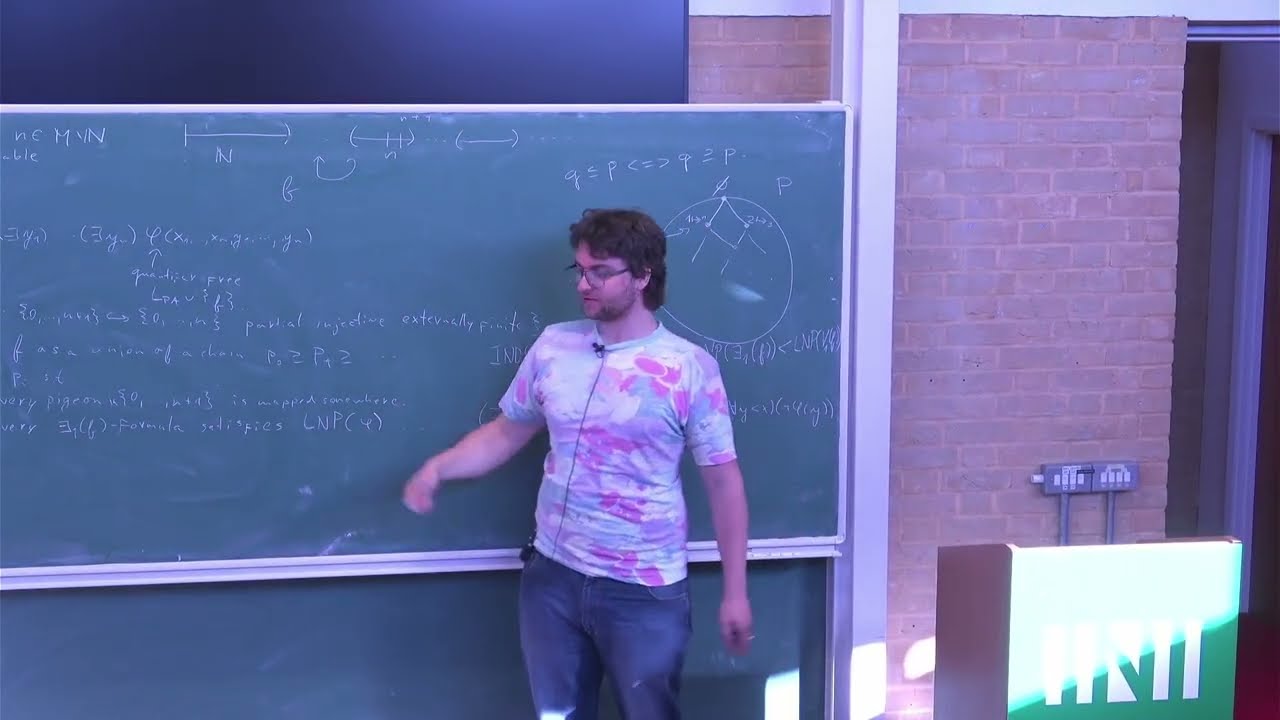
- Introduction and recap of previous forcing sessions; goal to finish first forcing proof and explain construction.
- Definition of poset P of externally finite partial injective functions and plan to build function f as union of chain.
- Introduction of forcing relation for quantifier-free formulas, with emphasis on locality lemma and semantic interpretation.
- Extension of forcing to existential formulas; discussion on crude definition and its implications for least number principle.
- Audience questions about Paris forcing, propositional interpretations, and relationship to algebraic constructions.
Cited Sources
- Isaac Newton Institute for Mathematical Sciences — Main website of the institute hosting the seminar.
- Seminar page: (LFC) Logical foundations of complexity theory — Official seminar page with details of the event and associated programme.
Contribution & Novelties
The video offers a concise, self-contained recap of a forcing construction that preserves existential induction while violating the pigeonhole principle. Its originality lies in the clear exposition of the forcing relation and the live interaction on subtle points, such as the difference between induction and least number principle. This serves as a valuable pedagogical tool for advanced logic audiences.
Pour aller plus loin :
- Forcing (set theory) — Foundational technique used here; essential background.
- Paris–Harrington theorem — Related to non-standard arithmetic and independence results.
- Pigeonhole principle — The combinatorial principle that is intentionally violated in the model.
- Non-standard model of arithmetic — Models with infinite natural numbers, central to the construction.
111 words
Radar Profile
The radar profile shows very high scores across all dimensions, with technical level and quantitative information leading. This reflects a dense, expert-level lecture that is both detailed and rigorous, while the slightly lower quality of information (though still high) may be due to the informal, interactive style. The balance indicates a highly informative and reliable source for specialists.