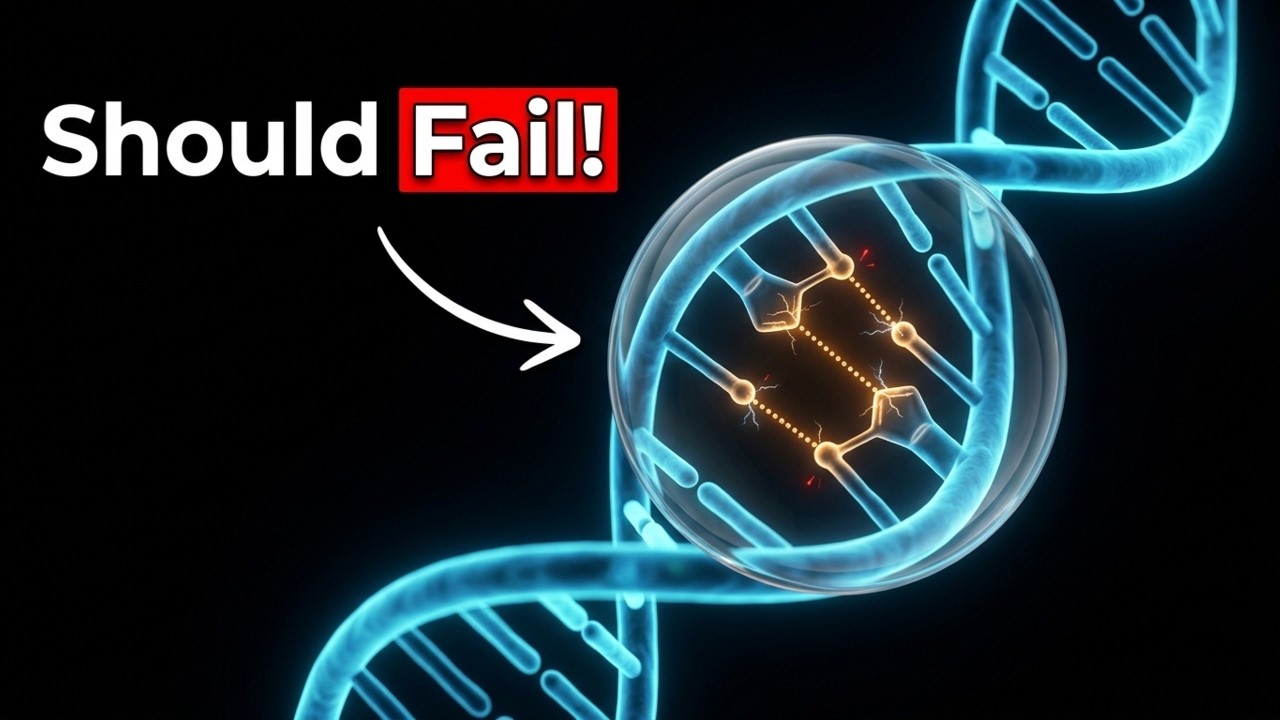
The Molecule That Should Not Exist But Holds Your DNA Together!
Title history
- The Molecule That Should Not Exist But Holds Your DNA Together! — observed on 20261031-2326 UTC (YouTube)
Keywords
Summary
172 words
Critical Evaluation
Value of the Information & Strength of the Argument
The video delivers substantial value by reframing the perceived weakness of hydrogen bonds as a critical functional advantage. The argumentation is solid, building logically from the boiling-point anomaly to the physical chemistry of hydrogen bonds, then to cooperativity and its biological implications. The use of the Velcro analogy effectively communicates the concept of collective strength. The historical narrative about Pauling and the DNA race adds depth and humanizes the science. The explanation of why covalent bonds would be unsuitable for DNA is clear and convincing. The video avoids oversimplification by acknowledging open questions about DNA breathing, enhancing its credibility.
Scientific Rigor, Source Quality, Title Accuracy
The scientific content is rigorous, citing foundational papers (Latimer & Rodebush 1920, Pauling 1939, Watson & Crick 1953). The description lists these references, and the video accurately represents their contributions. The title matches the content, highlighting the paradoxical nature of hydrogen bonds. The video’s educational quality is high, with accurate chemistry and biology. However, some simplifications (e.g., the exact number of bond breaks per second) are presented without caveats, but they are illustrative rather than misleading. No major errors were detected. The video’s reliance on historical context is well-founded, and the tribute to Franklin’s work is appropriate. Overall, the scientific rigor is impressive for a popular science video.
222 words
Title / Content Match
The title is engaging and accurately reflects the central paradox about weak hydrogen bonds holding DNA together.
Quality & Reliability
8/10
The video presents a scientifically accurate explanation of hydrogen bonds in DNA, referencing key historical studies (Latimer & Rodebush 1920, Pauling 1939, Watson & Crick 1953) and correctly explains cooperativity. Minor simplifications are acceptable for popular science.
Key Moments
Markers derived by PSI from the transcript: the creator did not define chapters.
- Introduction: the paradox of weak hydrogen bonds holding DNA
- Latimer and Rodebush's 1920 discovery of hydrogen bonds to explain water's boiling point
- Comparison of bond energies: hydrogen bonds vs covalent bonds
- Physical explanation of hydrogen bonds as electrostatic attractions
- Cooperativity: how many weak bonds create stability (Velcro analogy)
- Why weakness is essential for DNA replication and gene expression
- Linus Pauling: alpha helix success and DNA model failure
- Rosalind Franklin, Chargaff, and Watson & Crick: solving DNA structure
- Conclusion and reflection on the beauty of weak bonds
Cited Sources
- Polarity and Ionization from the Standpoint of the Lewis Theory of Valence — Latimer & Rodebush (1920) introduced the concept of the hydrogen bond to explain water's anomalous boiling point.
- The Nature of the Chemical Bond — Linus Pauling (1939) formalized hydrogen bonding and applied it to protein structure.
- Molecular Structure of Nucleic Acids — Watson & Crick (1953) described the double helix, using hydrogen bonding for base pairing.
Concurring Sources
- DNA Structure and Function — General overview consistent with the video's description of base pairing and hydrogen bonds.
Contribution & Novelties
This video adds value by clearly articulating the concept of cooperativity as the key to understanding why DNA’s fragility is advantageous. It debunks the naive view that strong bonds are always better, using an accessible analogy and historical context. The narrative of Pauling’s mistake humanizes science and illustrates the importance of correct hydrogen bonding geometry. The video also highlights ongoing research on DNA ‘breathing’, encouraging curiosity.
Pour aller plus loin :
- Hydrogen bond — Foundational concept explained.
- Cooperativity — Key mechanism for collective strength.
- DNA replication — Explains the role of helicase and unzipping.
- Linus Pauling — Biographical context of his contributions and errors.
104 words
Radar Profile
The radar profile suggests a balanced video with high information quality and technical depth, while maintaining accessibility. The relatively lower 'quantite_information' score (8) is offset by excellent clarity and reliability. 'Fiabilite_globale' is strong, indicating trustworthy content.