Scaling Data Movement For Physical AI
Keywords
Summary
160 words
Critical Evaluation
Value of the Information & Strength of the Argument
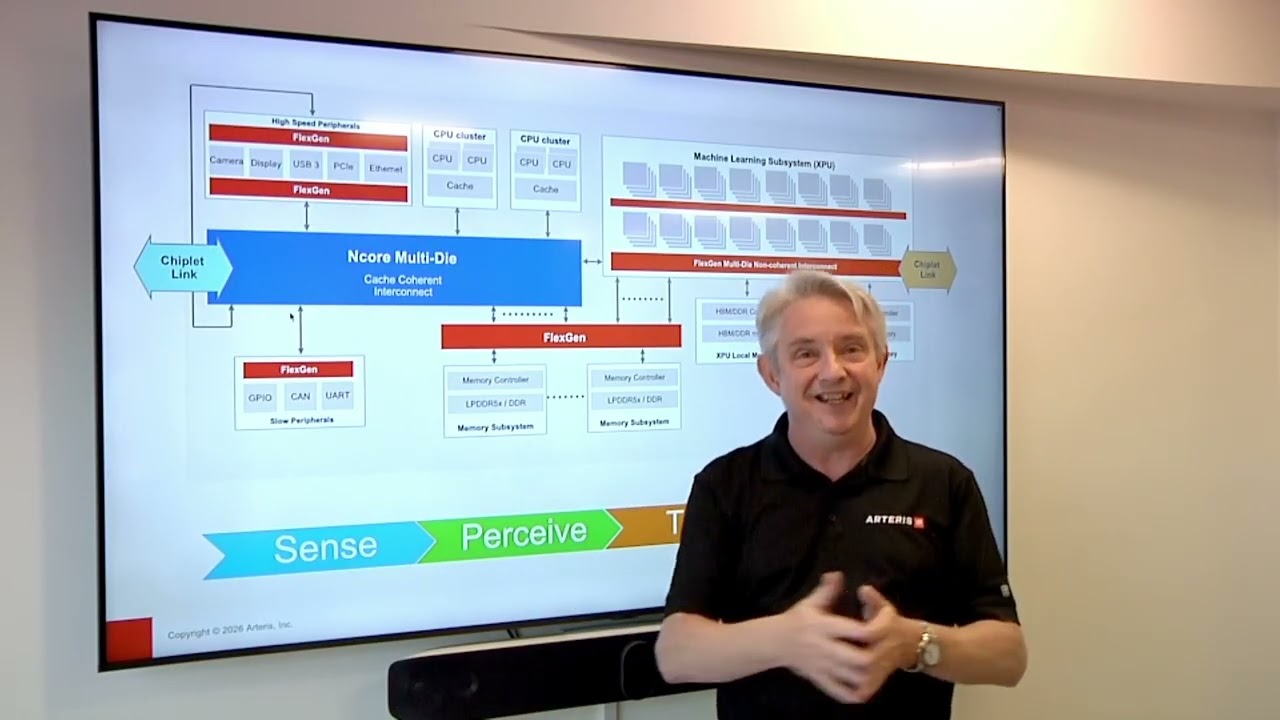
The interview provides valuable insights into the design trade-offs between coherent and non-coherent interconnects, emphasizing data movement efficiency in physical AI systems. Stevens’ argumentation is logical and well-structured, using a clear visual diagram to illustrate the architecture. He effectively explains how heterogeneous workloads (CPU-centric vs accelerator-centric) benefit from distinct interconnect strategies, and highlights the importance of quality of service and real-time predictability. The discussion on the safety check in the act stage adds a nuanced perspective on handling non-deterministic AI decisions. The arguments are persuasive due to their practical grounding in semiconductor engineering.
Scientific Rigor, Source Quality, Title Accuracy
The video relies on the speaker’s industrial expertise rather than external citations, which is typical for expert interviews. No specific studies or papers are referenced, but the technical content is presented accurately and aligns with known concepts in chip design. The title ‘Scaling Data Movement For Physical AI’ accurately summarizes the core theme, and the content stays on topic. No public comments were provided, so no community feedback is analyzed.
178 words
Title / Content Match
Title accurately reflects the content, focusing on data movement scaling in physical AI systems.
Quality & Reliability
8/10
High-quality expert discussion with clear explanations, but lacks peer-reviewed sources and depth.
Key Moments
Markers derived by PSI from the transcript: the creator did not define chapters.
- Introduction: challenges of multi-die systems for data movement in physical AI.
- Explanation of coherent vs non-coherent interconnects and their appropriate use cases.
- Diagram of a homogeneous physical AI system with CPU and accelerator subsystems, and the role of the chiplet link.
- Data flow stages: sense, preprocess, perceive, think, act, with a safety check in the act stage.
- Future direction: chiplet ecosystems and heterogeneous integration, and advice for engineers to design top-down.
Contribution & Novelties
This video offers a clear, practitioner-oriented explanation of how data movement scaling is handled in physical AI systems, distinguishing between coherent and non-coherent interconnect needs. It highlights the importance of data partitioning and quality of service for real-time performance. The concept of a safety island to validate non-deterministic AI decisions before actuation is a useful design pattern.
Pour aller plus loin:
- Chiplet — While not cited in the video, chiplets are central to the discussed multi-die architecture.
- Cache coherence — Relevant to the coherent interconnect discussion for CPU subsystems.
- Network on a chip — Provides background on efficient data movement within chips.
102 words
Radar Profile
The tone is moderately balanced across quantity, quality, technical depth, and reliability, reflecting a focused expert discussion that is informative but not exhaustive. The technical level is high, and reliability is strong due to the speaker's direct experience, but the lack of external references slightly reduces the overall confidence score.