Energia fal grawitacyjnych według Trautmana i Bondi'ego
Energy of gravitational waves according to Trautman and Bondi
Title history
- Energia fal grawitacyjnych według Trautmana i Bondi'ego — observed on 20261030-1104 UTC (YouTube)
Keywords
Summary
191 words
Critical Evaluation
Value of the Information & Strength of the Argument
The lecture provides exceptional value through a clear conceptual progression from puzzle to solution. Kijowski demonstrates the challenges of separating true radiative degrees of freedom from coordinate artifacts, using explicit mathematical examples. His argumentation is solid: he derives results for the scalar field sketch and extends them by analogy to gravity, relying on known mathematical transformations. He also clarifies terminological issues (Trautman-Bondi vs Bondi energy) and offers a pedagogical geometry. The presentation is logically coherent and accessible to an audience familiar with advanced calculus.
Scientific Rigor, Source Quality, Title Accuracy
Rigour is high: Kijowski cites specific works (Nurowski & Hill in Bull. AMS, Trautman, Bondi, Penrose) and clearly states his own contributions. However, the lecture lacks direct citations or links to the literature, which slightly constrains immediate source verification. The video description contains no references. The title perfectly matches the content; it neither over- nor understates the scope. The audience’s level is assumed to be advanced, but the analysis itself stands on its merits without resorting to hand-waving.
177 words
Title / Content Match
The title accurately reflects the content: the lecture focuses on the energy of gravitational waves as formulated by Trautman and Bondi.
Quality & Reliability
9/10
Lecture by a leading physicist at the Institute of Physics PAS, based on published work and mathematical proofs. The content is technically rigorous and well-structured, but the video provides no direct links to sources, limiting immediate verification.
Key Moments
Markers derived by PSI from the transcript: the creator did not define chapters.
- Opening: introduction to gravitational waves and Einstein's quadrupole formula
- Discussion of Einstein's doubts, the 1937 paper, and the counterexample from Nurowski & Hill
- Illustration of a fictitious wave due to gauge transformation
- Trautman's 1958 work: asymptotic flatness and boundary conditions
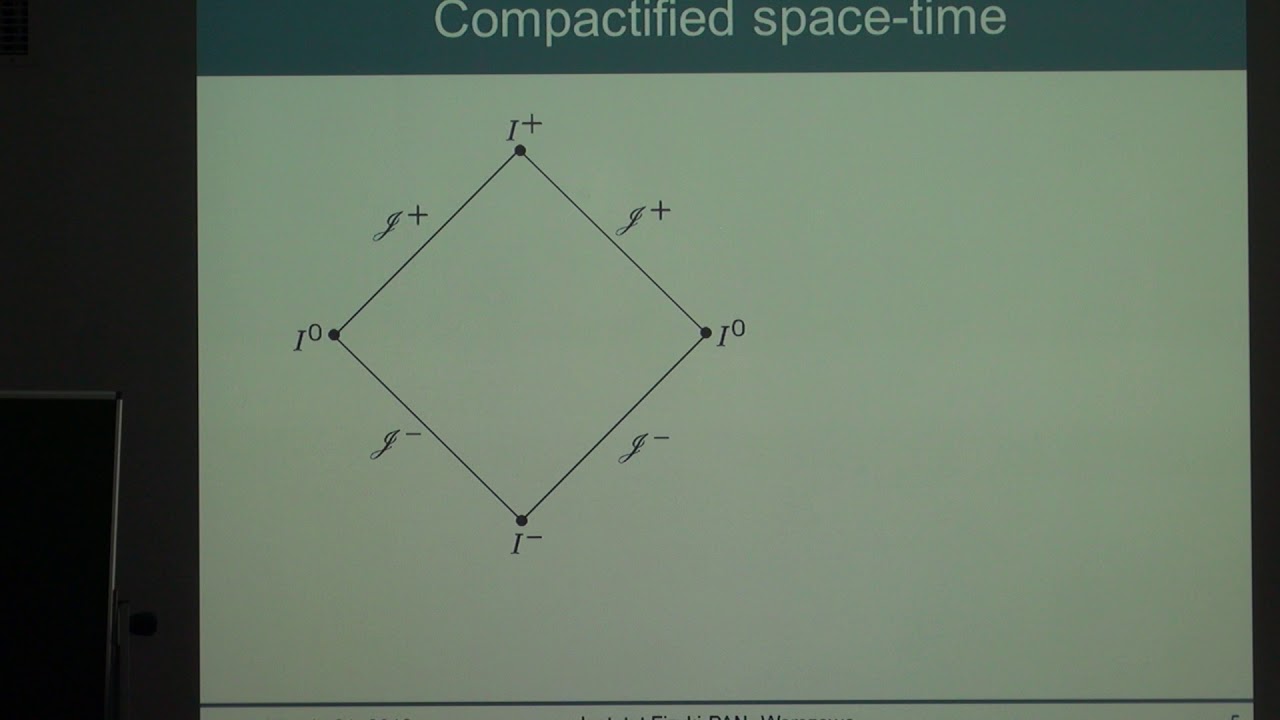
- Penrose conformal compactification and the structure of null infinity
- Definition and interpretation of Bondi (Trautman-Bondi) energy
- Reduction to scalar wave equation and Huygens' principle
- Parameterization of radiative data via Radon transform and symplectic structure
- Lorentz invariance of the formalism and concluding remarks
Cited Sources
- Article by Pawel Nurowski and Benny Hill, Bulletin of the American Mathematical Society — Mentioned as source of counterexamples to gravitational wave definition
- Work by Andrzej Trautman (1958) — Foundation of asymptotic flatness and energy definition
- Work by Hermann Bondi — Definition of energy at null infinity
- Penrose's conformal compactification — Geometric framework for asymptotic structure
Contribution & Novelties
The lecture clarifies the relationship between Trautman’s and Bondi’s formulations, explaining why the name ‘Trautman-Bondi energy’ is justified. It also demonstrates that radiation in gravitational theory is asymptotically analogous to scalar and electromagnetic radiation, reducing to two wave equations. Kijowski’s pedagogical approach using the scalar wave equation and Radon transform provides a transparent way to handle radiative data. He also stresses the interpretive point that points on null infinity represent null hypersurfaces, not individual light rays.
Pour aller plus loin :
- Bondi energy (Wikipedia) — Provides context on the concept of energy in general relativity, directly related to the video’s core topic.
- Penrose diagram (Wikipedia) — Illustrates the conformal compactification technique used for representing null infinity.
- Huygens–Fresnel principle (Wikipedia) — Underpins the wave propagation discussion in the lecture.
- Radon transform (Wikipedia) — Mathematical tool mentioned in the parameterization of radiative data.
141 words
Radar Profile
The radar profile shows balanced high scores across information quantity, quality, technical level, and reliability, with technical level being the highest - indicative of a dense, advanced physics lecture.