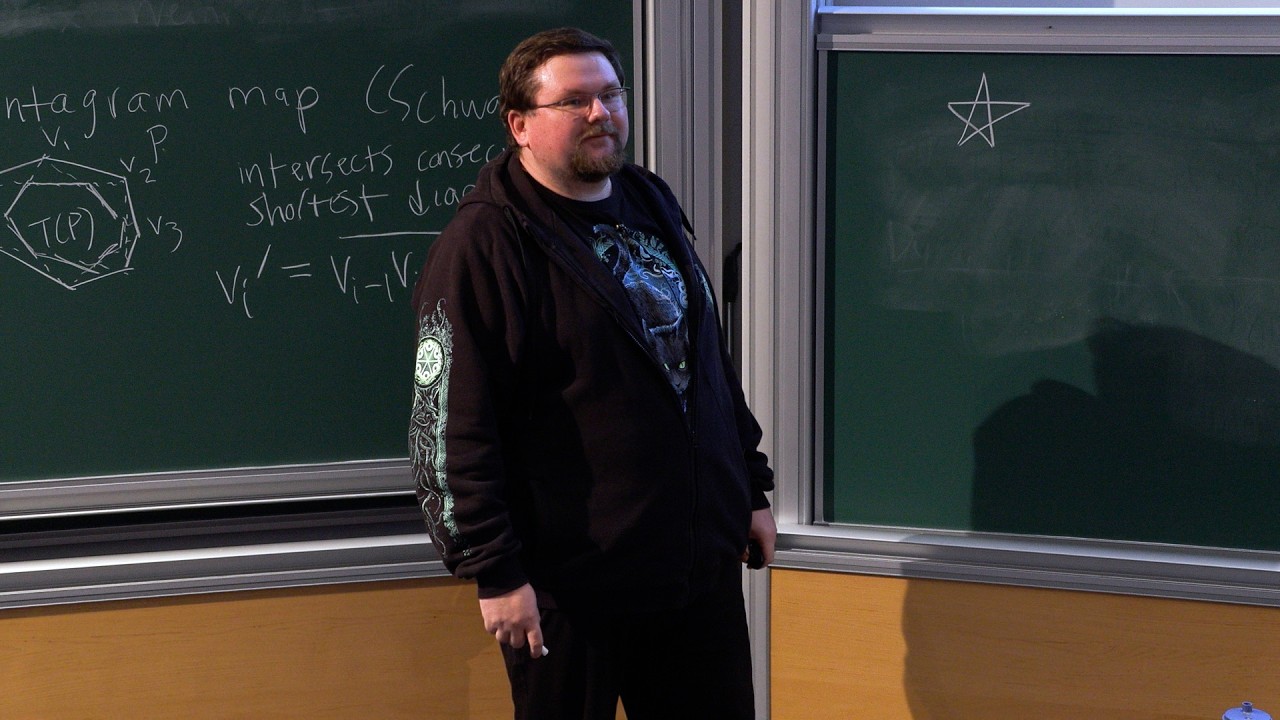
Michal Zwierzynski - Area-Normalized Pentagram Map
Keywords
Summary
163 words
Critical Evaluation
Value of the Information & Strength of the Argument
The presentation offers significant insight into a longstanding problem: the asymptotic behavior of the pentagram map under area normalization. The speaker combines classical projective geometry with modern spectral analysis to obtain precise asymptotics for a wide class of polygons. The argumentation is rigorous: each step is motivated and derived, with explicit formulas and conditions. For instance, the derivation of the spectrum from the determinant of Glick’s operator is transparent, and the classification of behaviors based on real vs non-real eigenvalues is well explained. The richness of examples, including non-convex cases and Poncelet polygons, demonstrates the generality of the results. The speaker also acknowledges prior work (e.g., by Richard Schwartz) and builds on it, showing intellectual honesty. However, the talk is dense and assumes a strong background in projective geometry and spectral theory, which may limit its accessibility, but that does not undermine its scientific value.
Scientific Rigor, Source Quality, Title Accuracy
The scientific rigor is high: the talk is delivered at a leading research institute, and the mathematical derivations appear meticulous. The main limitation is the lack of explicit references to published sources; the speaker mentions ‘Rich’s paper’ and Glick’s operator without formal citation, and only a link to the carmin.tv platform is provided in the description. This makes independent verification difficult. The title is accurate and precise, matching the content exactly. The talk does not contain advertising or sponsorship segments.
240 words
Title / Content Match
The title accurately reflects the central topic: the area-normalized pentagram map and its asymptotic behavior via spectral properties.
Quality & Reliability
8/10
The talk presents original mathematical research with detailed derivations and engages with expert audience. However, it is based on unpublished work and lacks explicit citations to the literature beyond general references, reducing the ability to verify claims independently.
Key Moments
Markers derived by PSI from the transcript: the creator did not define chapters.
- Introduction to pentagram and personal anecdote about the Halmos symbol.
- Discussion of Vigner caustic and center symmetry set, with animations.
- Definition of the pentagram map and its area-normalized version.
- Introduction of Glick's operator and the projective invariant kappa.
- Main theorem for convex pentagons: asymptotic flattening to a line.
- Behavior for hexagons: two classes - flattening or approaching ellipses.
- Generalization to projectively periodic polygons and examples with multiple ellipse families.
- Poncelet polygons and spectral computations using elliptic integrals.
Cited Sources
- Carmin TV - scientific video platform — The talk is hosted on this platform and the link is provided in the video description.
Contribution & Novelties
This work provides a unified spectral framework for understanding the area-normalized pentagram map, extending previous results to general projectively periodic polygons. The main novelty is the explicit connection between the asymptotics and the spectrum of Glick’s operator, yielding concrete criteria for flattening vs. elliptic behavior.
Pour aller plus loin :
- Pentagram map — Foundational concept for this talk.
- Poncelet porism — Relevant to the treatment of Poncelet polygons in the talk.
- Spectral theory — The general mathematical framework used for the operator analysis.
- Glick’s operator — Mentioned without URL, as it is a specialized object in the field of integrable systems.
101 words
Radar Profile
The radar profile shows a very high technical level (10) with strong information quality (9) and quantity (8), but slightly lower global reliability (8) due to the lack of direct citations. This indicates a talk that is deep and original but requires expert knowledge and would benefit from published references.