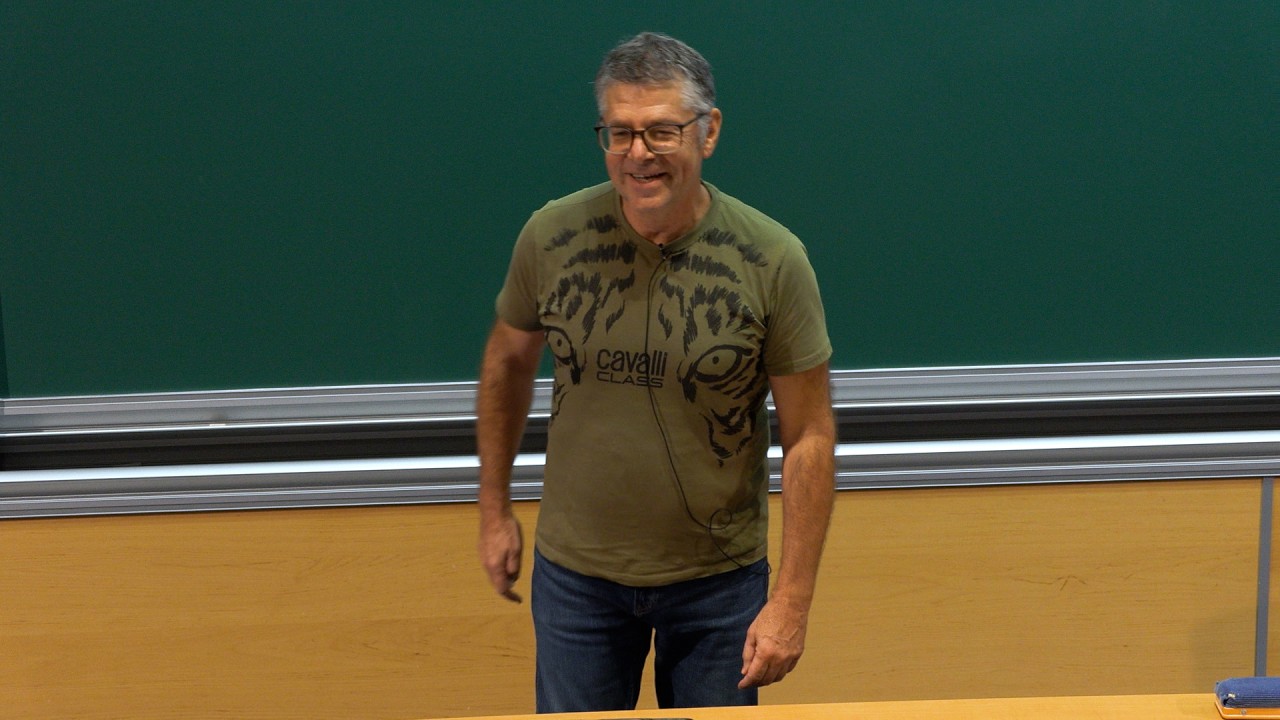
Misha Gekhtman - Cluster Structures via Birational Poisson Maps
Keywords
Summary
129 words
Critical Evaluation
Value of the Information & Strength of the Argument
The value lies in providing a systematic framework to construct exotic cluster structures from standard ones, thus unifying and generalizing known examples. The argumentation is solid, based on explicit algebraic constructions and theorems with proofs sketched. The speaker effectively motivates each step, linking classical objects like Gauss factorization and twist maps to the modern theory of cluster algebras.
Scientific Rigor, Source Quality, Title Accuracy
The scientific rigor is high: the presentation relies on established theories (Poisson-Lie groups, Belavin-Drinfeld classification) and presents original results. The talk is self-contained but references prior work clearly. The title precisely matches the content, which is centered on birational Poisson maps and cluster structures. No comments are available for analysis.
123 words
Title / Content Match
The title accurately reflects the content: the talk describes how birational Poisson maps are used to construct cluster structures.
Quality & Reliability
8/10
Expert presentation at IHES based on joint research, but limited external verification within the talk itself.
Key Moments
Markers derived by PSI from the transcript: the creator did not define chapters.
- Introduction and motivation: linking birational Poisson maps to cluster structure construction.
- Explanation of log-canonical coordinate charts and role of initial seeds.
- Presentation of the R-matrix and the Poisson bracket formula on matrix groups.
- Definition and classification of Belavin-Drinfeld triples for R-matrices.
- Standard cluster structure on GL(n) using maximal dense minors.
- Construction of birational maps via Gauss factorization and twist maps.
Cited Sources
- carmin.tv - Video platform for mathematics — Description link providing access to the recorded lecture and related scientific videos.
Contribution & Novelties
The original contribution is a general method to obtain initial seeds for cluster structures on reductive groups by using birational Poisson maps that intertwine various Poisson structures. This approach streamlines the construction of exotic cluster structures, previously done ad hoc, and provides a conceptual bridge between classical factorization techniques and modern cluster theory.
Pour aller plus loin :
- Cluster algebra - Background theory of cluster algebras and their mutations.
- Poisson–Lie group - Foundational concept for the Poisson structures discussed.
- Classical Yang–Baxter equation - Equation governing the R-matrix solutions used in the talk.
92 words
Radar Profile
The profile shows high technical level and good reliability, with balanced information quality and quantity, indicating a specialized yet rigorous mathematical presentation.