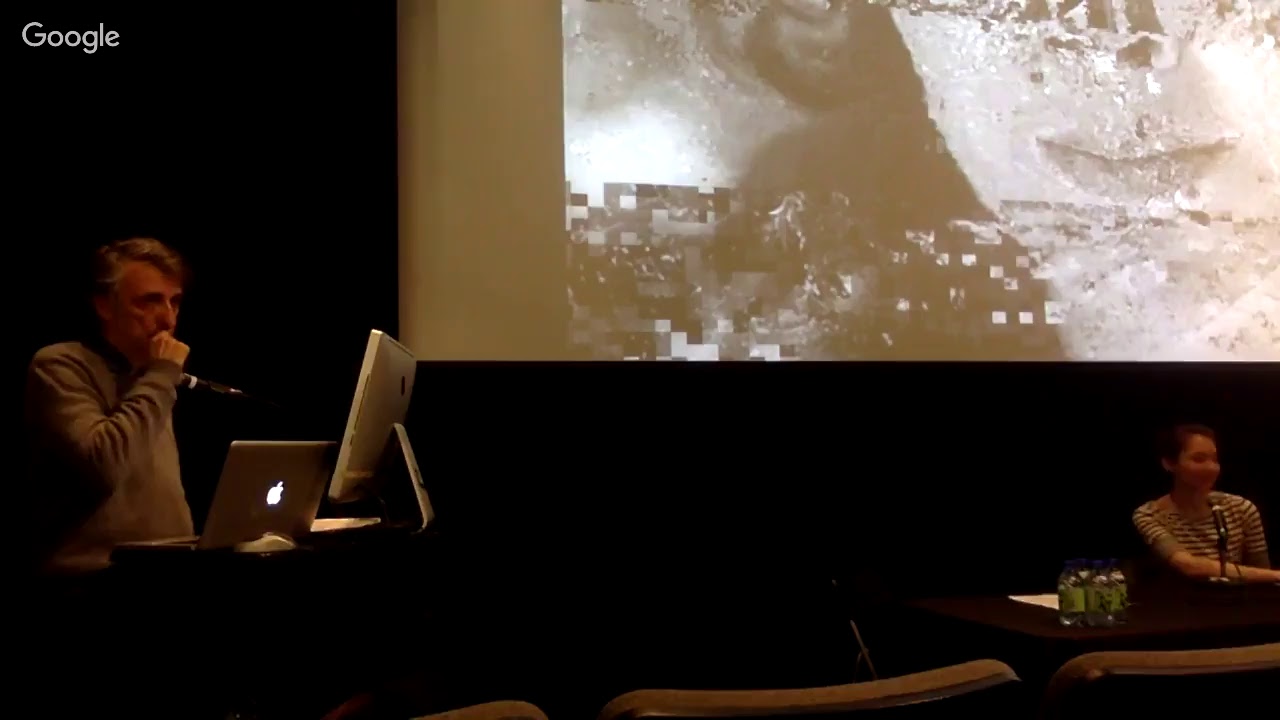
Colloque L'invention littéraire des médias - Conférence plénière d’Éric Rondepierre
Colloquium The Literary Invention of the Media - Plenary Conference by Éric Rondepierre
Title history
- Colloque L'invention littéraire des médias - Conférence plénière d’Éric Rondepierre — observed on 20261030-1104 UTC (YouTube)
Keywords
Summary
174 words
Critical Evaluation
Value of the Information & Strength of the Argument
The talk’s value lies in its direct presentation of an artist’s methodology and conceptual framework. Rondepierre offers a rich, dense argumentation, weaving personal history (his teenage film, his time at Montreal’s Cinémathèque) with theoretical references (Barthes, Bazin, Dubois, Ginzburg’s ‘indicial paradigm’). He argues persuasively that his photograms, as ‘unseen’ images, constitute a form of counter-reading or ‘anti-regard’ (Thierry Lenain), shifting focus from the film’s narrative to its material accidents. The argumentation is supported by concrete visual examples, though dependent on the audience seeing the images. The lecture is coherent and intellectually engaged, though some may find the reference to Conan Doyle somewhat extended.
Scientific Rigor, Source Quality, Title Accuracy
The rigor is evident in the explicit referencing of several critical and theoretical texts: Barthes’ ‘Camera Lucida’, Bazin’s question ‘What is cinema?’, Philippe Dubois’ essay ‘Entre la trame et la tâche’ (1993), and Michel Poirier’s ‘La maladie des images’. The artist also mentions Jacques Rancière’s text on his work. He evokes Carlo Ginzburg’s ‘indicial paradigm’ and Thierry Lenain’s concept of ‘anti-regard’. While these references are accurate, they are not systematically cited with publication details, but they are credible for a scholarly context. The title ‘Par la bande’ is fully consistent with the content, which repeatedly plays on the double meaning of ‘bande’ (strip or group) and the ‘speckled band’ of Conan Doyle. The description of the video (provided) seems incomplete, but the title and the talk’s content match.
246 words
Title / Content Match
Title aligns with content: a keynote within a conference on literary invention of media, focusing on the artist's practice with film photograms.
Quality & Reliability
7/10
Source primary and direct: artist's own conference, with references to critical texts (Barthes, Bazin, Dubois) and specific works. However, no transcript or detailed description, so independent verification of claims is limited.
Key Moments
Markers derived by PSI from the transcript: the creator did not define chapters.
- Introduction by the chair, presentation of Éric Rondepierre and his work.
- Rondepierre begins his talk, defining his interest in cinema as a 'landscape after the battle' and his focus on photograms.
- Discussion of his 1998 book, with an anecdote about a film he made at 15 (Sherlock Holmes adaptation).
- Analysis of 'The Speckled Band' title, linking 'speckle' to stains, specks, and the fly, as a metaphor for the intrusive detail.
- Presentation of series 'Annonces' (trailers) where text overlays create white blobs, and 'Excedents' with black frames.
- Discussion of the 'filthy' images from 'Décompositions' series, highlighting the stains and damage as aesthetic material.
- Introduction of Barthes' concepts of studium and punctum, applied to the practice of photogram extraction.
- Return to 'band', discussing its meanings (group, circle, snake) and the dialectic of inside/outside in Conan Doyle's story.
- Concluding remarks on the film as a 'long ribbon' and the artist's role in revealing its hidden aspects.
Cited Sources
- Roland Barthes, Camera Lucida — Cited for the concepts of studium and punctum.
- André Bazin, Qu'est-ce que le cinéma? — Cited as a foundational question about cinema.
- Philippe Dubois, Entre la trame et la tâche — Essay on Rondepierre's work, 1993.
- Michel Poirier, La maladie des images — Text on Rondepierre's work.
- Jacques Rancière — Mentioned as having written a recent text on Rondepierre's work.
- Carlo Ginzburg, paradigme indiciaire — Referenced for the method of clue-based analysis.
- Thierry Lenain — Concept of 'anti-regard'.
Concurring Sources
- Roland Barthes, Camera Lucida (1980) — Provides the studium/punctum theory cited by the artist.
Dissenting Sources
- None explicitly discordant — The talk does not engage in controversy; no discordant sources mentioned.
Contribution & Novelties
This conference contributes a first-person perspective on the practice of ‘photogrammie’ as a literary and artistic method. Rondepierre’s originality lies in bridging cinema, photography, and literature through the concept of the ‘bande’ (strip), treating the film reel as a textual ribbon with hidden ‘stains’ that become the artist’s material. He redefines the photogram as an ‘unseen’ image, shifting focus from the film’s narrative to its material accidents. The talk also proposes a new reading of Conan Doyle’s ‘The Speckled Band’ as an allegory of projection and secret openings, relevant to media studies.
Pour aller plus loin :
- Photogram (film) — The base material of Rondepierre’s work, individual frames of film.
- Punctum (Barthes) — The concept from Barthes that Rondepierre applies to his practice.
- Intermediality — The intersection of media characteristic of Rondepierre’s approach.
- Archival art — The use of archives as an artistic strategy, relevant to his ‘champ de fouilles’.
150 words
Radar Profile
The profile shows high 'quantité d'information' (long, dense presentation) and moderate 'qualité d'information' and 'niveau technique', indicating a rich but accessible lecture. 'Fiabilité globale' is high due to direct artist testimony and references.