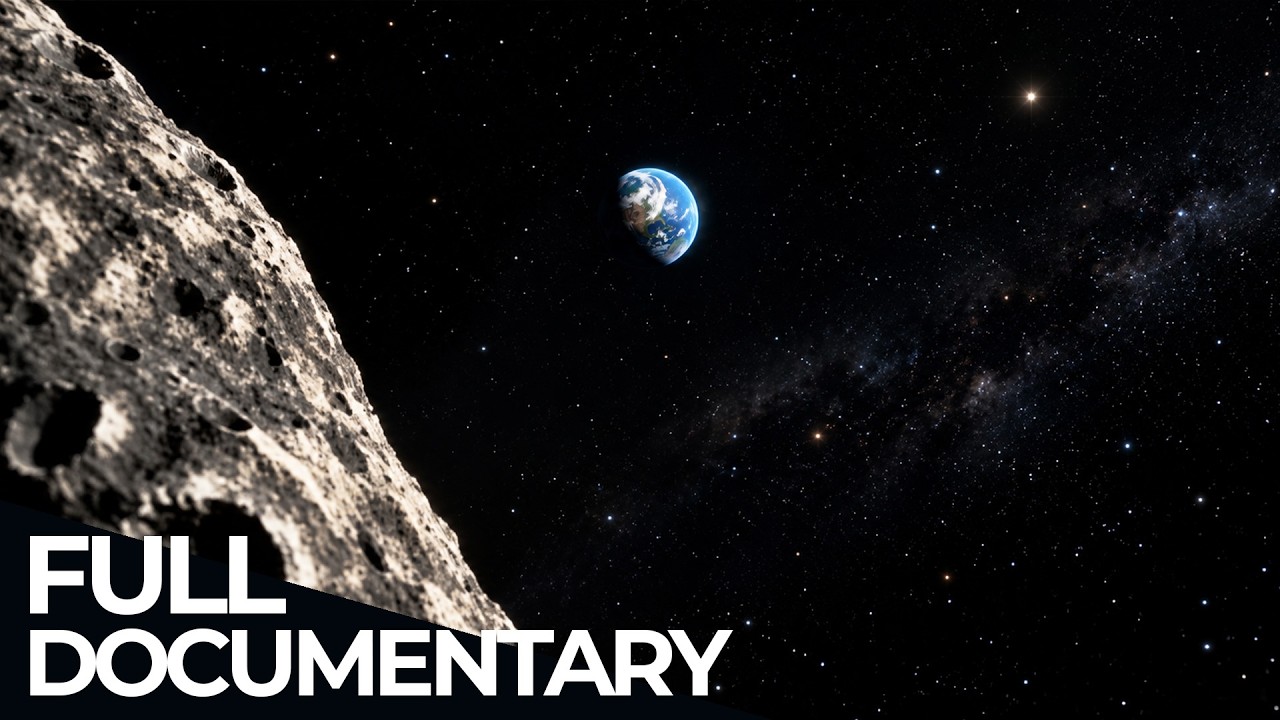
Asteroids: Cosmic Killers or Goldmines? | Strip the Cosmos | Free Documentary Space
Keywords
Summary
177 words
Critical Evaluation
Value of the Information & Strength of the Argument
The documentary presents a well-rounded overview, alternating between threat and opportunity. It uses concrete examples such as the Chelyabinsk event, the Chicxulub crater, and the upcoming Bennu mission to ground its claims. Expert interviews (astronomers, engineers, and researchers) add credibility, while lab simulations (e.g., impact experiments and laser deflection tests) provide a scientific basis for the discussion. The argumentation is coherent: it establishes the danger, explains detection efforts, then pivots to resource potential, culminating in the idea of asteroids as stepping stones for space exploration. The balance between fear and hope is maintained without sensationalism, and each point is supported by visual evidence or expert testimony.
Scientific Rigor, Source Quality, Title Accuracy
The documentary relies on expert interviews and references to NASA missions, though it does not cite specific publications. The production quality is high, with clear visuals and accurate terminology (e.g., Chelyabinsk meteor, Chicxulub crater, OSIRIS-REx). The title accurately captures the central dichotomy. The content is consistent with current scientific understanding, though some simplifications are made for a general audience. The lack of explicit source citations is typical for documentaries, but the involvement of researchers and mention of missions like OSIRIS-REx and the Catalina Sky Survey provide implicit credibility. The adéquation between title and content is excellent, as the film delivers on both aspects.
224 words
Title / Content Match
The title accurately reflects the content, which explores asteroids both as threats and as potential resources.
Quality & Reliability
7/10
The documentary features interviews with experts and uses accurate scientific data, but simplifies some concepts for a general audience. The information is generally reliable, though not up to peer-reviewed standards.
Key Moments
Markers derived by PSI from the transcript: the creator did not define chapters.
- Chelyabinsk meteor explosion: how a 60-foot asteroid injured 1,500 people
- Catalina Sky Survey: dedicated asteroid monitoring and planetary defense
- The asteroid belt: composition, origin, and Jupiter's gravitational influence
- Chicxulub impact 65 million years ago: shallow-angle strike and mass extinction
- Lab simulations of asteroid impacts using a vertical gun
- Lunar craters as a record of past impacts and their significance
- OSIRIS-REx mission to asteroid Bennu: objectives and engineering challenges
- Jupiter's gravity as a main driver of asteroid orbits and disruptions
- Laser ablation concept for deflecting asteroids, tested in a vacuum chamber
- Ceres: water-rich asteroid as potential fuel source for deep space missions
Cited Sources
- Free Documentary - Space (YouTube channel) — Official channel hosting the documentary
- Free Documentary Instagram — Social media presence for series updates
- Free Documentary Facebook — Social media page with related content
- Free Documentary Twitter — Social media feed for the channel
Contribution & Novelties
The documentary synthesizes existing knowledge about asteroids, presenting both threats and opportunities in an accessible visual format. It emphasizes the dual role of asteroids as civilization killers and potential resource hubs, with a strong focus on planetary defense and future space exploration. The inclusion of current missions (OSIRIS-REx, SLS) and research (laser deflection) provides up-to-date information for the general public. The original contribution lies in its balanced narrative and clear visualization of scientific concepts.
Pour aller plus loin :
- Chicxulub crater — The impact structure linked to dinosaur extinction; pertinent for understanding mass extinction events.
- OSIRIS-REx — NASA mission to Bennu that returned samples; directly relevant to the asteroid sample return discussion.
- Ceres (dwarf planet) — Water-rich asteroid that could serve as a fuel source; central to the ‘gas station’ concept.
- Chelyabinsk meteor — The 2013 event used as a case study for impact threat.
- Planetary defense — Overview of mitigation strategies, including laser ablation and gravity tractors.
158 words
Radar Profile
The radar profile shows a strong quantity of information (8) but moderate technical depth (6) and reliability (7). This indicates a broad, accessible documentary that prioritizes coverage over exhaustive technical detail. The quality score (7) reflects expert interviews and accurate visuals, while the overall balance suggests a reliable general audience resource rather than a peer-reviewed source.