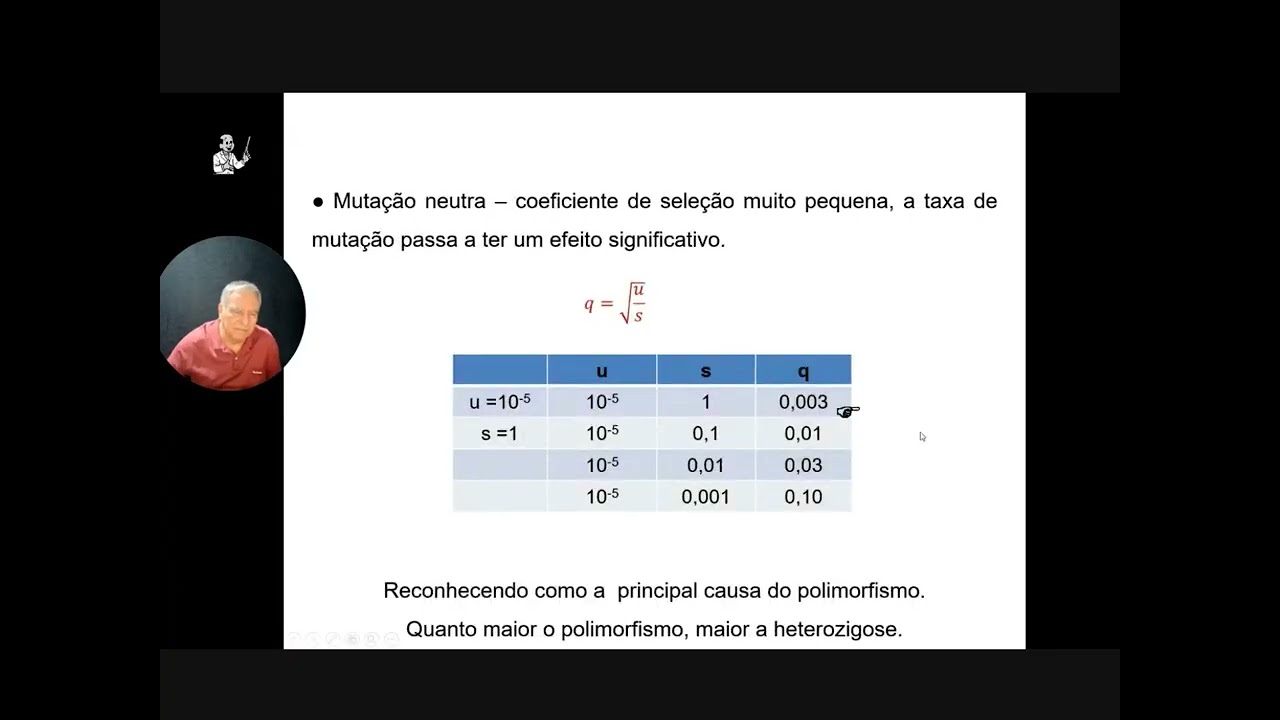
MGV3702 - Genética de Populações: Aula9
MGV3702 - Population Genetics: Class 9
Title history
- MGV3702 - Genética de Populações: Aula9 — observed on 20261025-1506 UTC (YouTube)
Keywords
Summary
158 words
Critical Evaluation
Value of the Information & Strength of the Argument
The lecture provides a solid conceptual foundation in population genetics, clearly explaining the definition and causes of polymorphism. The instructor systematically builds from theory to practical measurement, making the content valuable for students and professionals. The argumentation is coherent, with examples such as the ABO blood group and F2 populations that illustrate key points. However, the lecture is primarily explanatory rather than critical; it does not evaluate competing theories deeply or present recent research findings.
Scientific Rigor, Source Quality, Title Accuracy
The scientific rigor is moderate: the instructor presents well-established principles without citing specific studies or data sources. No references are given in the video description, and the lecture relies on the instructor’s expertise. The title is appropriate and matches the content, accurately describing the session as a class on population genetics. The lack of citations limits the verifiability of the information, but the concepts themselves are standard in genetics education.
160 words
Title / Content Match
The title accurately reflects the content: a class on population genetics covering polymorphism, heterozygosity, and PIC.
Quality & Reliability
7/10
The lecture presents standard concepts in population genetics with clear examples, but relies on verbal explanation without citing sources or providing references.
Key Moments
Markers derived by PSI from the transcript: the creator did not define chapters.
- Introduction to selection and the concept of polymorphism, using the ABO blood group as an example.
- Discussion of theories explaining polymorphism: selectionist and neutralist perspectives.
- Definition and calculation of heterozygosity and its relationship to allele frequencies.
- Introduction of PIC (polymorphic information content) and its interpretation for molecular markers.
- Practical examples of calculating PIC and comparing loci with different allele numbers.
Contribution & Novelties
This lecture offers a comprehensive educational overview of polymorphism and its quantitative measurement, particularly valuable for students in genetics and breeding. It clarifies common misconceptions about allele frequencies and heterozygosity. The practical guidance on interpreting PIC values in marker selection is useful for applied researchers.
Pour aller plus loin :
- Hardy–Weinberg principle — Foundation for allele frequency equilibrium and the basis for calculating expected heterozygosity.
- Polymorphism (biology) — General definition and examples of polymorphism in biology.
- F-statistics — Measures of population differentiation and inbreeding, related to heterozygosity comparisons.
- Genetic drift — A key evolutionary force that can affect allele frequencies, relevant to the discussion of population dynamics.
107 words
Radar Profile
The radar profile shows high values for information quantity and technical level, with slightly lower scores for source reliability due to lack of cited references. The content is informative and technically sound but not heavily supported by external sources.