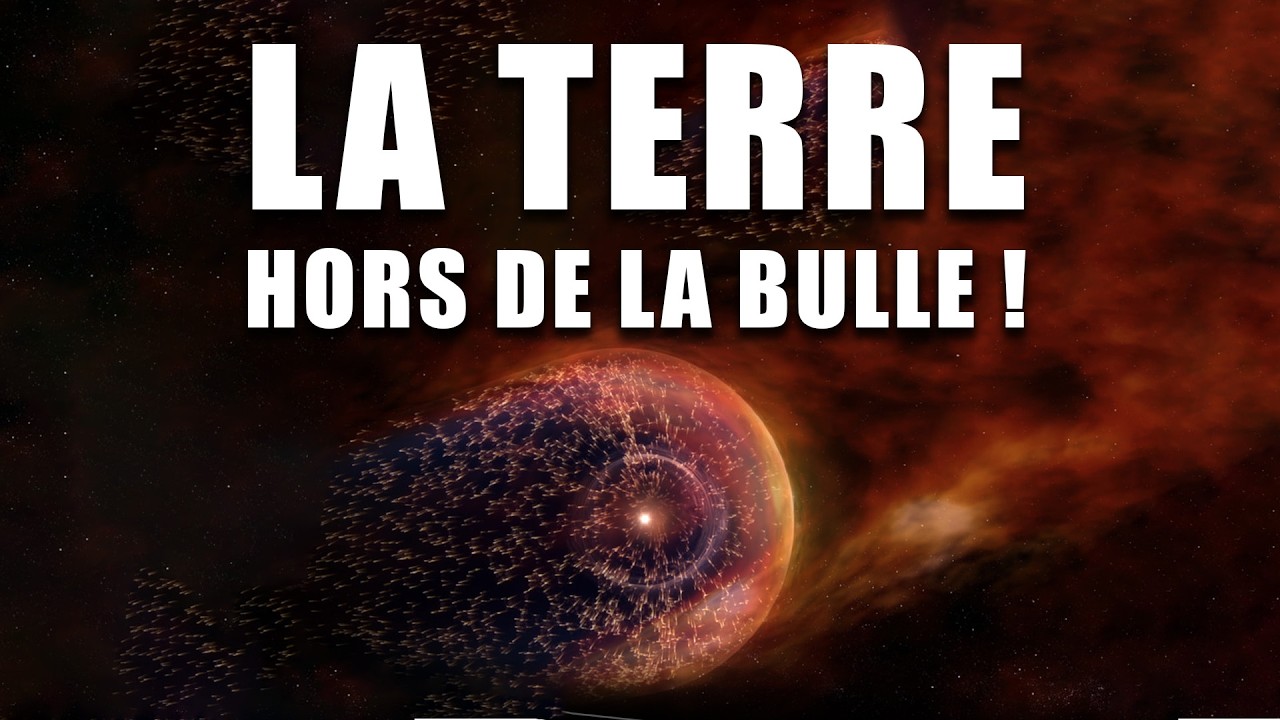
Incroyable ! La Terre a peut-être déjà été exposée à l’espace interstellaire !
Incredible! Earth may have already been exposed to interstellar space!
Title history
- Incroyable ! La Terre a peut-être déjà été exposée à l’espace interstellaire ! — observed on 20261023-0858 UTC (YouTube)
Keywords
Summary
236 words
Critical Evaluation
Value of the Information & Strength of the Argument
The video provides substantial value by synthesizing recent scientific papers into an accessible narrative. It explains complex concepts like the heliosphere, the interstellar medium, and cosmic rays with clear analogies and visual aids. The argumentation is well-structured: it presents the hypothesis, supports it with simulation results and potential isotopic evidence, and openly discusses uncertainties, such as the lack of beryllium-10 anomalies. The video does not overstate claims; it consistently uses phrases like ‘could have’ and ‘possible’ when discussing the scenarios. This balanced approach enhances its credibility.
Scientific Rigor, Source Quality, Title Accuracy
The scientific rigor is high; the video cites six peer-reviewed publications, including Nature Astronomy and Geophysical Research Letters, and uses data from NASA and observatories. The sources are directly relevant to the claims, covering simulations, isotope measurements, and climate modeling. The title is attention-grabbing but accurate, as it reflects the speculative nature of the discovery. The content remains faithful to the research, and the narrator clearly separates established knowledge from hypotheses. The video also benefits from high-quality visuals and credible imagery from NASA, enhancing trustworthiness.
186 words
Title / Content Match
The title accurately reflects the speculative but scientifically explored possibility that Earth was exposed to interstellar space.
Quality & Reliability
8/10
The video references multiple peer-reviewed studies and uses simulations, while clearly acknowledging uncertainties. The presentation is balanced and scientifically grounded.
Key Moments
Markers derived by PSI from the transcript: the creator did not define chapters.
- Introduction to Earth's protective layers and the heliosphere concept.
- Explanation of how the heliosphere is maintained and its equilibrium with the interstellar medium.
- Description of the proposed first encounter with a dense cloud 2-3 million years ago and simulation results.
- Discussion of a second encounter 6.8 million years ago with the Local Bubble edge.
- Potential consequences: increased cosmic rays, hydrogen in the atmosphere, cloud formation and climate impact.
- Evidence from iron-60 and beryllium-10 isotopes in ocean sediments, and the ambiguity of the results.
- Conclusion: plausible mechanism for other periods, and invitation for further discussion.
Cited Sources
- Annual Review of Astronomy and Astrophysics (2025) - Heliosphere and interstellar interactions — General review of heliospheric structure and its variability, providing background for the scenarios.
- Nature Astronomy (2024) - The heliosphere's contraction during encounters with interstellar clouds — Likely primary paper on the simulation of heliospheric compression during cloud crossings.
- The Astrophysical Journal (2024) - Simulation of the Sun's trajectory and cloud encounter — Study reconstructing the Sun's path and identifying potential encounters with dense regions.
- Scientific Reports (2026) - Beryllium-10 records and limits on the duration of heliospheric contraction — Research on beryllium-10 isotopes suggesting encounters lasted less than 10,000 years.
- Geophysical Research Letters (2024) - Isotopic evidence from ocean sediments — Study examining iron-60 and other isotopes linked to increased cosmic ray flux.
- Geophysical Research Letters (2026) - Atmospheric and climate implications — Recent paper discussing hydrogen injection into the atmosphere and potential climate effects.
Contribution & Novelties
The video’s contribution is to synthesize recent research into a compelling narrative that links astronomical events with Earth’s geological and climatic history. It highlights the dynamic nature of our solar system’s interaction with the galaxy, suggesting that Earth’s environment is not isolated but affected by the interstellar medium. The presentation of simulations and isotopic evidence provides a multidisciplinary perspective, making the research accessible to a general audience.
Pour aller plus loin :
- Heliosphere — The entire stellar bubble structure, fundamental to understanding the video’s core concept.
- Cosmic ray — High-energy particles that can be modulated by the heliosphere; their variation is key to the proposed effects.
- Iron-60 — The radioactive isotope used as evidence of supernova influence and interstellar exposure.
- Local Interstellar Cloud — The immediate interstellar environment of the Sun, relevant to the density variations discussed.
137 words
Radar Profile
The scores reflect a well-rounded video: high information quantity and quality, moderate technical depth suitable for a lay audience, and very high reliability due to multiple peer-reviewed sources. The technical level is accessible while still conveying sophisticated astrophysical concepts.