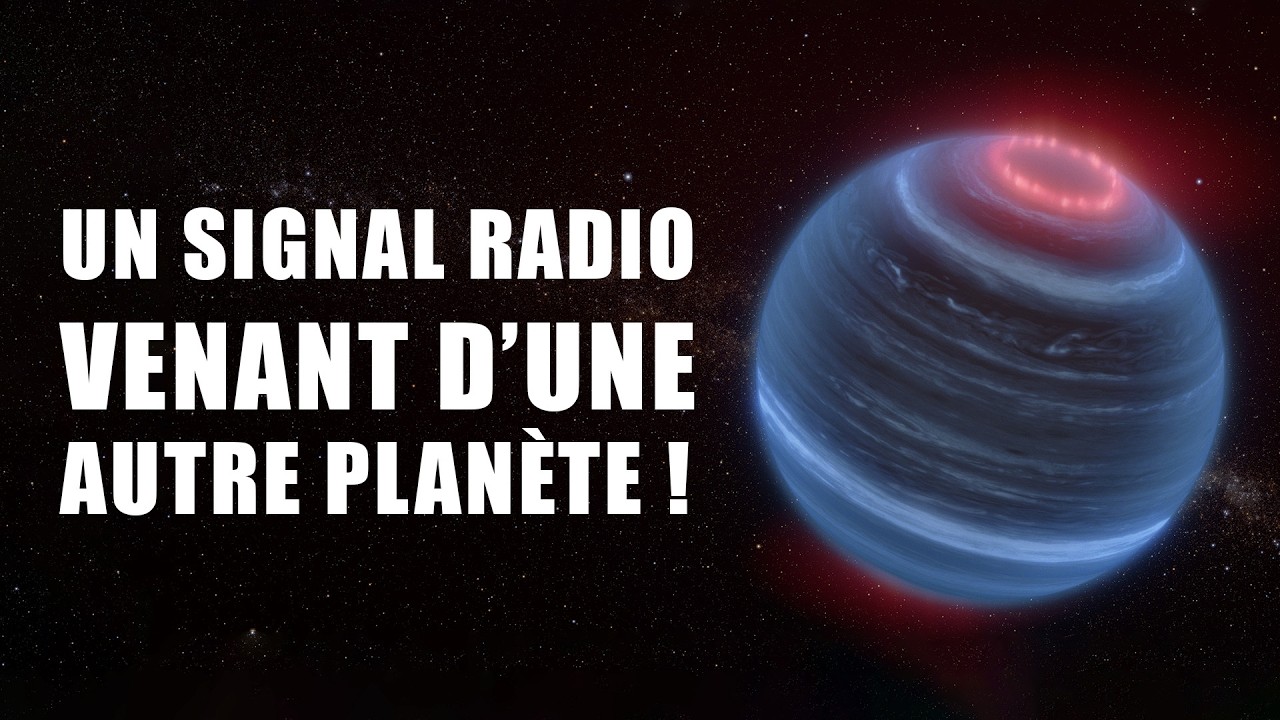
Un SIGNAL RADIO capté sur une EXOPLANÈTE : une première !
A RADIO SIGNAL detected on an EXOPLANET: a first!
Keywords
Summary
118 words
Critical Evaluation
Value of the Information & Strength of the Argument
The video’s value lies in its clear presentation of a groundbreaking detection, explaining how the signal’s origin was pinpointed and why it matters. The argumentation is solid: it walks through the methodology (using background quasars for positional calibration), the physical mechanism (auroral radio emission linked to magnetic fields), and the implications for exoplanet studies. The presenter also correctly distinguishes natural from artificial signals, avoiding sensationalism. The other news segments (Swift, Roman, Starship) are factual and well-contextualized, showing a balanced and informed perspective.
Scientific Rigor, Source Quality, Title Accuracy
The main claims are backed by a peer-reviewed preprint on arXiv and official NASA announcements. The SpaceX and Falcon 9 information is attributed to SpaceIntelReport, a reputable industry source. The video is rigorous in distinguishing confirmed results from ongoing analyses. The title is catchy but slightly ambiguous (‘capté sur une exoplanète’ could be misread), and it overemphasizes the radio signal relative to the broader news roundup. Nevertheless, the content aligns with the sources provided.
171 words
Title / Content Match
The title highlights the main discovery, but the video covers several space news items; it is moderately representative of the full content.
Quality & Reliability
8/10
The video cites a peer-reviewed arXiv paper and official NASA sources. Minor factual error (Swift launch year) noted by viewers, but overall information is reliable and well-contextualized.
Key Moments
Markers derived by PSI from the transcript: the creator did not define chapters.
- Introduction to exoplanet detection methods
- Sponsor segment about data privacy
- Context on radio signals from exoplanets and historical SETI efforts
- Detailed explanation of the Beta Pictoris b detection with MeerKAT
- Discussion of the magnetic field implications and future observations
- Failure of the LINK mission to rescue Swift satellite
- Roman telescope first images and instrument activation
- Starship Flight 14 reaches orbit, end of mission and implications
- Falcon 9 phase-out and summary
Cited Sources
- Radio emission from Beta Pictoris b — The peer-reviewed study announcing the detection
- NASA highlight on Swift mission lessons — Official NASA statement on the failed rescue of Swift
- NASA Roman blog on instrument activation — Update on Roman Space Telescope commissioning
- SpaceX Starship Flight 14 launch page — Official SpaceX page with flight details
- SpaceIntelReport on Falcon 9 bookings — Report on Falcon 9 commercial phase-out
Concurring Sources
- arXiv paper on Beta Pictoris b — Primary source confirming the detection
- NASA Swift mission page — Background on Swift mission and its end-of-life
External References
Contribution & Novelties
The video’s original contribution is to present a first unambiguous detection of radio emission from an exoplanet, explaining the methodology and its significance for planetary magnetospheres. It also serves as a useful summary of current space news. The ‘Pour aller plus loin’ section provides additional context on related concepts.
Pour aller plus loin :
- Exoplanet — Overview of exoplanet detection and characterization.
- Magnetosphere — Explanation of magnetic fields around planets and their role in radio emission.
- MeerKAT — The radio telescope array used for the detection.
- Aurora — Terrestrial analog to the phenomenon proposed for Beta Pictoris b.
98 words
Radar Profile
The radar profile shows high scores in information quantity and quality, indicating a dense and reliable content. Technical level is moderately high, balancing accessibility with scientific depth. The overall reliability is strong, supported by credible sources. The main weakness is a slight mismatch between the title's focus and the broader content.
💬 Sur les 30 commentaires analysés, le sentiment est globalement positif, avec des éloges pour la clarté et l'enthousiasme, et quelques critiques mineures sur le titre ambigu et une erreur factuelle (lancement de Swift) corrigée par un spectateur.