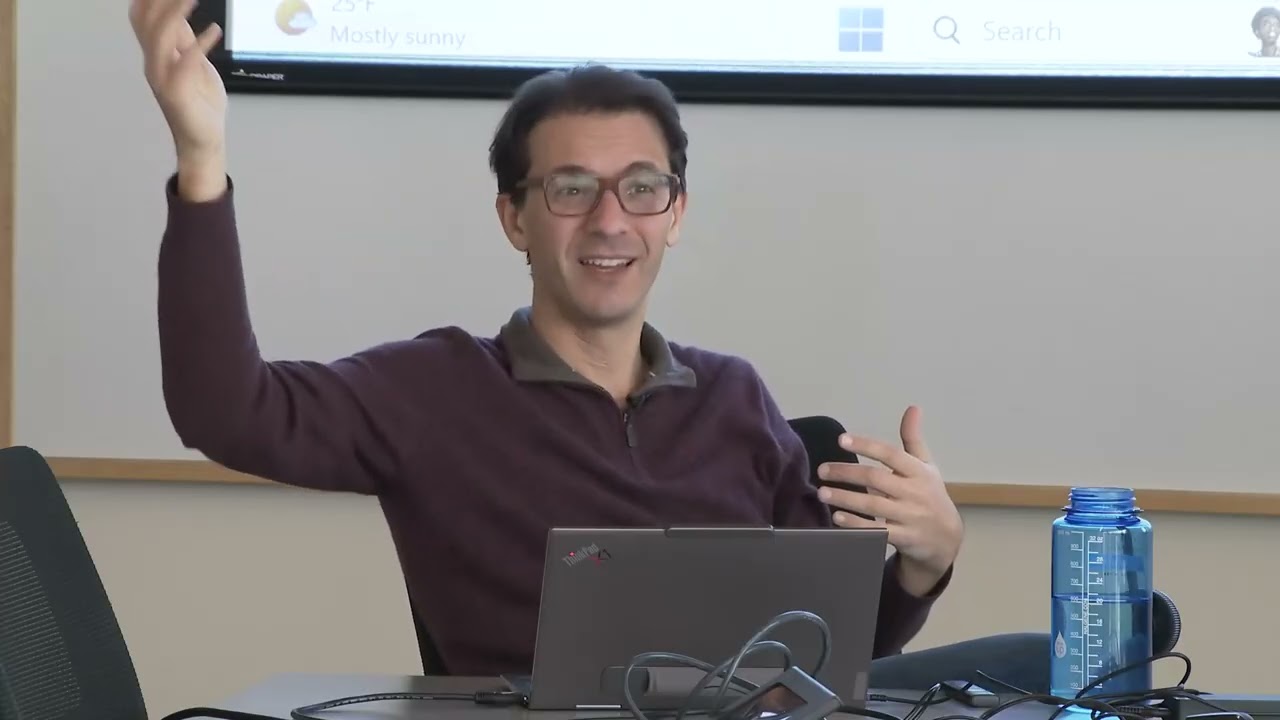
Session 3: Energy Efficiency Co-Flows
Keywords
Summary
136 words
Critical Evaluation
Value of the Information & Strength of the Argument
The lecture offers high practical value by dissecting real student models and illustrating common errors in coflow construction. The argumentation is solid; the instructor logically evaluates each model, identifies conceptual weaknesses, and proposes mathematically consistent alternatives. He provides clear reasoning for heuristic choices, such as the independence of immune waning rates and the importance of tracking coflow stocks for every main stock. The critique is constructive and grounded in system dynamics theory, making the session a valuable tutorial for advanced modelers.
Scientific Rigor, Source Quality, Title Accuracy
The scientific rigor is strong: the instructor consistently emphasizes internal consistency, robustness to extreme conditions, and explicit assumptions. The source material comes from a reputable academic institution (MIT OCW), and the lecture includes references to the course page and playlist. The title ‘Energy Efficiency Co-Flows’ accurately reflects the primary content, as the session delves deeply into coflow modeling for energy efficiency, though it also touches on prior epidemiological model aspects. The audience’s understanding is assumed to be advanced, but the analysis stands on its merits.
181 words
Title / Content Match
Title accurately reflects the main focus on energy co-flow modeling.
Quality & Reliability
9/10
Expert instructor, MIT OpenCourseWare platform, clear explanations, and consistent methodological rigor.
Key Moments
Markers derived by PSI from the transcript: the creator did not define chapters.
- Recap of SEIRb model and handling of waning immunity from natural vs vaccine sources.
- Discussion of dynamic vaccination willingness and equilibrium conditions.
- Introduction to energy coflows and problem definition.
- Review of Ali's model; discussion of coflow principles and retrofit handling.
- Review of Jake's model; analysis of flaw accumulation and robustness.
Cited Sources
- MIT OpenCourseWare: 15.879 Course Page — Course page with lecture materials and information.
- OCW Home — Main site for MIT OpenCourseWare.
- OCW Terms — Terms of use for OCW content.
- OCW Comments Policy — Guidelines for comments on OCW platforms.
- Playlist for 15.879 — YouTube playlist of course lectures.
- Support OCW — Link to support MIT OpenCourseWare.
Contribution & Novelties
The session provides an original contribution by systematically applying coflow modeling principles to energy efficiency in buildings, with a focus on vintage effects, retrofits, and technology evolution. It showcases practical heuristics and pitfalls through student model reviews, offering actionable guidance for modelers. The lecture also extends epidemiological modeling nuances (e.g., waning immunity) with clear formulations, demonstrating transferable system dynamics skills.
Pour aller plus loin :
- System dynamics — Core methodology used in the lecture.
- Stock and flow — Foundational concept for coflow models.
- Compartmental models in epidemiology — Context for SEIRb model discussed at the start.
- Retrofitting — Relevant to the energy efficiency retrofits analyzed.
105 words
Radar Profile
The radar profile is dominated by high scores across all dimensions, reflecting a technically intensive tutorial with rich content and robust reliability. The high technical level (10) indicates that the material is advanced, suitable for graduate students or professionals.