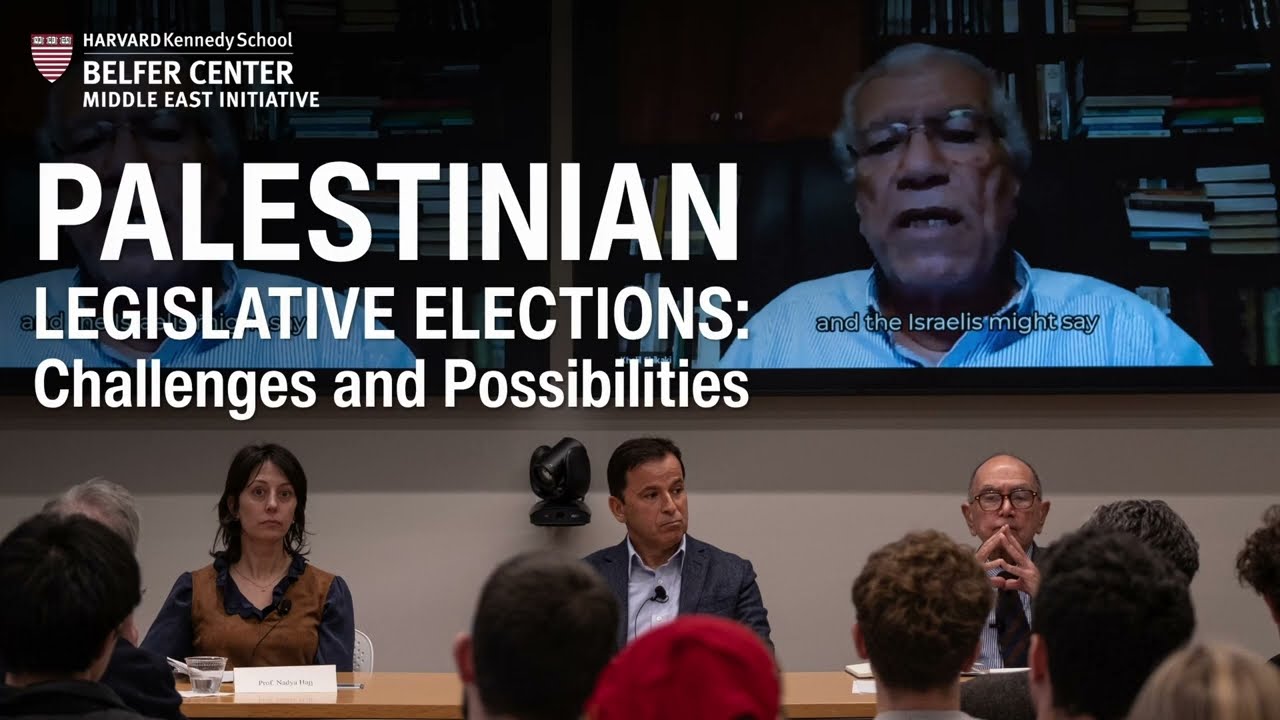
2026 Palestinian Legislative Elections: Challenges and Possibilities
Keywords
Summary
186 words
Critical Evaluation
Value of the Information & Strength of the Argument
The information provided is of significant value, drawing on Khalil Shikaki’s extensive polling data and the analytical perspectives of two academics. The arguments are well-structured, moving from macro-level geopolitical obstacles to micro-level voter apathy and rational choice. Shikaki presents a compelling case for postponement, backed by data on the legitimacy crisis. The discussion benefits from a clear distinction between expert predictions (often probabilistic) and firm conclusions, strengthening the overall argumentation without overclaiming certainty.
Scientific Rigor, Source Quality, Title Accuracy
The scientific rigor is high, as the event is hosted at the Harvard Belfer Center, and the primary source cited is Khalil Shikaki’s own Palestinian Center for Policy and Survey Research, a renowned institution for such data. The speakers explicitly reference their methodologies and provide caveats about the uncertainty inherent in their forecasts. The title accurately reflects the content, which precisely addresses the challenges and possibilities of the upcoming elections. The discussion refrains from unsubstantiated claims, grounding arguments in known political dynamics and recent polling figures.
174 words
Title / Content Match
The title accurately reflects the content's focus on the 2026 Palestinian legislative elections, their challenges, and potential scenarios.
Quality & Reliability
8/10
The content relies on experienced experts, including a leading pollster, offering high-quality expert opinions, though predictions are inherently speculative.
Chapters
Cited Sources
- Event page at Belfer Center — Official event page for this discussion
- MEI Newsletter subscription — Link to subscribe to MEI updates
Concurring Sources
- Belfer Center event page — Matches the panel discussion details
Contribution & Novelties
The session brings together a unique combination of voices, including the preeminent pollster Khalil Shikaki, whose recent data on electoral participation is a distinct novel contribution. The discussion offers a novel synthesis of obstacles, linking international pressure with local fragmentation and voter psychology. The proposition to combine parliamentary and presidential elections is a concrete policy suggestion presented here.
For further reading:
- 2006 Palestinian legislative election - Essential background for understanding the last PLC elections.
- Palestinian Legislative Council - Context on the institution being elected.
- Marwan Barghouti - Key political figure discussed in the panel due to his popularity and imprisonment.
- Oslo Accords - The political framework referenced when discussing the PLO program and conditions for candidacy.
116 words
Radar Profile
The radar profile indicates a highly balanced and information-dense presentation, with high scores across quantity, quality, technical depth, and reliability. This reflects an expert panel providing rigorous, context-rich, and well-substantiated analysis.