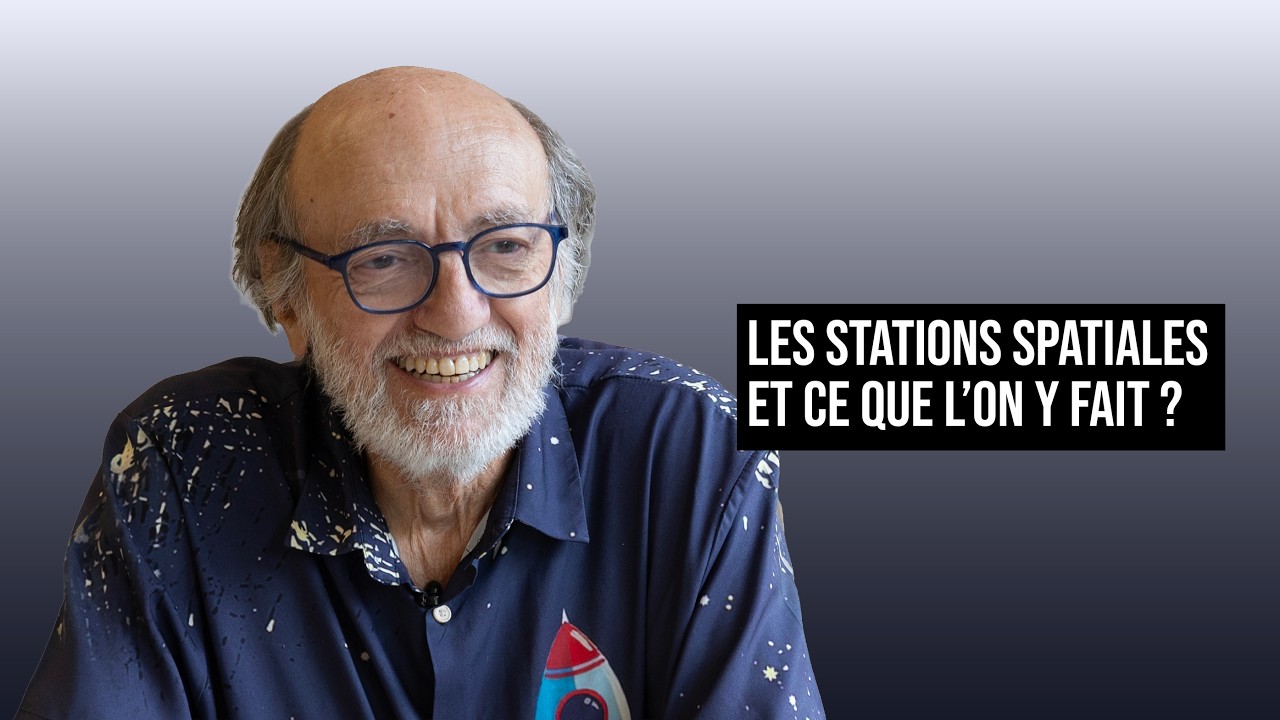
LES STATIONS SPATIALES ET CE QUE L'ON Y FAIT
SPACE STATIONS AND WHAT WE DO THERE
Title history
- LES STATIONS SPATIALES ET CE QUE L'ON Y FAIT — observed on 20261103-1449 UTC (YouTube)
- LES SPATIONS SPATIALES ET CE QUE L'ON Y FAIT — observed on 20261102-1422 UTC (YouTube)
Keywords
Summary
175 words
Critical Evaluation
Value of the Information & Strength of the Argument
The lecture provides exceptional value through the unique perspective of a scientist who personally supervised numerous space biology experiments. The argumentation is solid, contrasting the official narrative of scientific purpose with the actual political origins of the ISS, supported by first-hand anecdotes and concrete examples. The discussion on plant gravitropism, detailing the specific threshold perception and the role of statocytes, effectively demonstrates the scientific process and the value of fundamental research in revealing unknown mechanisms. The explanation of experimental protocols, such as using pleurodèle females capable of storing sperm for in-flight fertilization, showcases the ingenious adaptation of terrestrial methods to the space environment.
Scientific Rigor, Source Quality, Title Accuracy
The scientific rigor is strong, based on decades of hands-on experience and direct collaboration with other researchers (Perbal, Gasset, Houillon). However, the talk refrains from citing specific publications, relying instead on oral testimony. The quality of sources is anchored in the speaker’s authority and the concrete nature of the experiments described. The title is perfectly fitting, as the content exhaustively addresses what is done on space stations, from maintenance to complex life sciences experiments. The description provides useful links to related content, notably the channel’s exobiology playlist and website.
207 words
Title / Content Match
Perfectly aligned. The conference comprehensively covers the history, political motivations, scientific experiments, and daily life aboard space stations, exactly as the title promises.
Quality & Reliability
8/10
High reliability due to the speaker's expert background (exobiologist) and direct involvement in space biology experiments on Mir and the ISS. The information is accurate and richly detailed, though some historical analogies and physical simplifications are made to suit a live lecture format, and no formal scientific citations are provided.
Key Moments
Markers derived by PSI from the transcript: the creator did not define chapters.
- Introduction of Michel Viso and the context of the conference on space stations.
- History of Soviet space stations (Salyut, Mir) and the first French astronauts on board.
- The political genesis of the ISS: retaining Russian space engineers after the fall of the Berlin Wall.
- Clarification of the physical concept of microgravity versus weightlessness.
- Effects of microgravity on human physiology: vascular fluid redistribution and balance disorders.
- Plant gravity perception experiments: lentil roots and the detection threshold of 0.3g.
- Ground-based simulation of microgravity using head-down bed rest at -6°.
- Embryonic development experiments (pleurodèle) and the first successful fertilization in space.
Cited Sources
- Ideas in Science - Official Website — The channel's main website hosting the scientific video library and further resources.
- Exobiology Playlist (Ideas in Science) — A curated playlist of conferences related to exobiology, directly linked by the speaker for further exploration.
- Support Ideas in Science — The channel's donation page provided in the description to support their non-profit work.
Concurring Sources
- Exobiology Playlist (Ideas in Science) — This playlist provides additional videos in the same scientific field, reinforcing the credibility and scope of the content presented.
Contribution & Novelties
The main novelty lies in offering a first-hand perspective on a usually opaque domain: the true political motivations behind the ISS, paired with a detailed account of the scientific experiments conducted in collaboration with French teams. The talk demystifies common perceptions by stating that science serves as a justification for political goals, yet it succeeds in proving that fruitful research is carried out. It provides unique insights into experiment design, such as determining gravity thresholds in plants and achieving fertilization in microgravity, which are rarely explained in such depth in public media.
Pour aller plus loin :
- International Space Station (Wikipedia) — Essential for understanding the structural, historical, and geopolitical context of the ISS discussed in the talk.
- Weightlessness / Microgravity (Wikipedia) — Explains the physical principles governing the environment where the described experiments take place.
- Gravitropism (Wikipedia) — Directly related to the lentil root experiments, detailing the biological mechanisms of plant orientation towards gravity.
155 words
Radar Profile
The radar shows a balanced profile with high scores in information quantity and quality (8/10), reflecting the speaker's extensive knowledge. The technical level is slightly lower (6/10), highlighting the accessible nature of the talk for a general audience, while the global reliability remains very high (8/10).