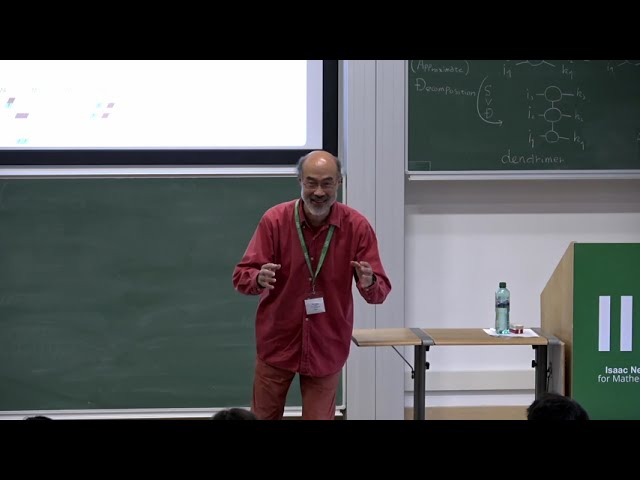
Prof. Tomotoshi Nishino | Entanglement scaling
Title history
- Prof. Tomotoshi Nishino | Entanglement scaling — observed on 20261029-0924 UTC (YouTube)
Keywords
Summary
145 words
Critical Evaluation
Value of the Information & Strength of the Argument
The value of this lecture lies in its synthesis of entanglement scaling principles across various tensor network algorithms, including DMRG, CTMRG, and tree tensor networks. The argumentation is grounded in concrete numerical results, such as the collapse of data using two-parameter scaling and the extraction of central charges from entanglement entropy. The discussion of tree network selection based on bipartite entanglement is insightful and practical. However, some parts are presented informally, and the logical flow is occasionally interrupted by personal anecdotes and AI-generated images, which may dilute the rigor. The argument about the importance of entanglement scaling is well-supported by examples from statistical mechanics and molecular physics, though the central charge anomaly is left open, indicating ongoing research.
Scientific Rigor, Source Quality, Title Accuracy
The scientific rigor is high, as the speaker is a recognized expert and the content is based on published research and standard methods in the field. The sources are only implicitly referenced; the description provides links to the Isaac Newton Institute and the specific seminar page, which are relevant but do not directly cite the underlying papers. The title ‘Entanglement scaling’ is fully appropriate and matches the main topic. The talk is part of a European tensor networks school, indicating a pedagogical context. However, the lack of explicit citations within the talk itself reduces transparency for those wanting to verify details. The speaker mentions Strassen’s algorithm and references to articles, but no URLs are given in the transcript. Overall, the content is reliable, but source attribution could be improved.
262 words
Title / Content Match
The title 'Entanglement scaling' accurately reflects the central theme: scaling properties of entanglement entropy in tensor network methods, including finite-entanglement scaling and applications to statistical models.
Quality & Reliability
8/10
The lecture is given by a leading researcher in tensor networks, presenting original work on entanglement scaling. The content is technically precise and research-based, though the delivery is informal with occasional digressions on AI-generated images and personal anecdotes. Transcription errors make some parts difficult to follow, but the scientific substance is solid.
Key Moments
Markers derived by PSI from the transcript: the creator did not define chapters.
- Introduction and homework on Strassen's algorithm
- Explanation of Strassen's algorithm and its tensor network representation
- Discussion of AI-generated images and digression
- Entanglement entropy definition and scaling laws, introduction to DMRG and tree tensor networks
- CTMRG application to Ising model and finite-entanglement scaling
- Vector models and anomalous central charge, random systems, and final questions
Cited Sources
- Isaac Newton Institute for Mathematical Sciences — Homepage of the institute hosting the seminar
- Seminar page for Prof. Nishino's talk — Official seminar page with details of the event
Contribution & Novelties
The lecture provides an overview of entanglement scaling as a unifying concept in tensor network methods, emphasizing its role in determining optimal tree structures and in finite-size scaling corrections. The presentation of two-parameter scaling (bond dimension and system size) is a key contribution, illustrating how entanglement entropy can be used to extract critical properties. The unexpected large central charges in simple vector models are highlighted as an open puzzle, inviting further investigation.
Pour aller plus loin :
- Tensor network — Foundational concept underlying the entire talk.
- Density matrix renormalization group — Core algorithm discussed in relation to tree tensor networks.
- Entropy of entanglement — Definition and properties of entanglement entropy, central to scaling discussion.
- Strassen algorithm — Matrix multiplication algorithm used as an introductory example.
125 words
Radar Profile
The radar profile shows high technical level and good information quality, with slightly lower scores on quantity and reliability due to informal delivery and limited explicit citations. The balance indicates a dense, expert-level talk that may be challenging for non-specialists but offers valuable insights for advanced listeners.