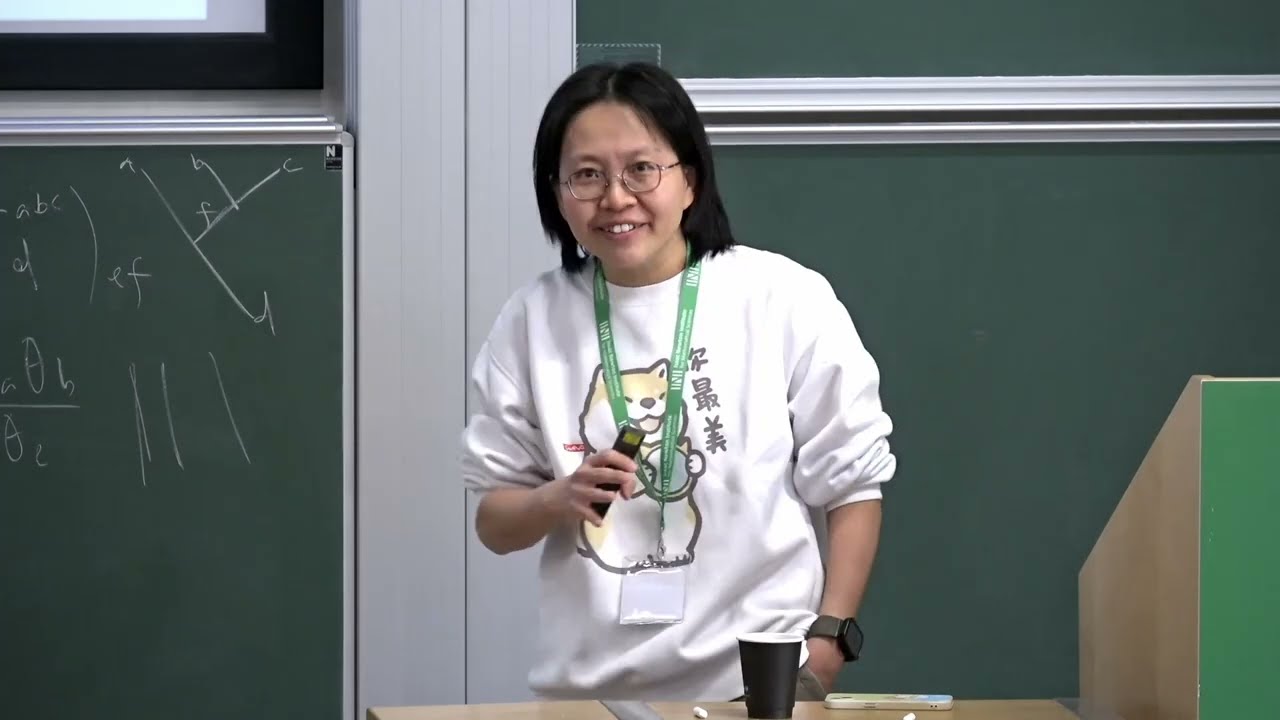
Prof. Ling Yan Hung | Tensor networks and generalized symmetries for field theories Part II
Title history
- Prof. Ling Yan Hung | Tensor networks and generalized symmetries for field theories Part II (PSI archive)
- Prof. Ling Yan Hung | Tensor networks and generalized symmetries for field theories Part II — observed on 20261030-1054 UTC (YouTube)
Keywords
Summary
164 words
Critical Evaluation
Value of the Information & Strength of the Argument
The value of the information is high: the talk presents a novel and powerful technique to build CFTs from tensor networks, with clear mathematical formulation and practical implications. The argumentation is rigorous: the speaker systematically derives the fixed-point equation, explains the role of singular value decomposition, and convincingly shows that topological solutions arise for finite bond dimension, while CFTs require infinite bond dimension. The transition from topological to critical behavior is well motivated, and the construction of the CFT path integral using three-point functions is mathematically explicit. The argumentation is strengthened by references to known mathematical structures (e.g., Provenian algebra) and by the stated possibility of generating new theories numerically. Overall, the talk provides deep insight into the interplay between tensor networks and field theories.
Scientific Rigor, Source Quality, Title Accuracy
The scientific rigor is exemplary: the presentation is based on original research and follows a deductive path, with careful attention to technical details such as the infinite bond dimension requirement and the convergence of sums. The sources are reputable: the talk was given at the Isaac Newton Institute, a world-leading center for mathematical sciences, and the seminar links to its official page. The title matches the content accurately: it promises a lecture on tensor networks and generalized symmetries, and the delivered material indeed covers these topics, with a focus on constructing field theories. No public comments were provided for analysis, so public reception cannot be assessed; however, the talk’s technical depth suggests it is aimed at specialists.
257 words
Title / Content Match
Title accurately reflects the content: the talk is the second part of a lecture on tensor networks and generalized symmetries for field theories.
Quality & Reliability
9/10
High-quality technical seminar by an expert, presenting original research in mathematical physics, hosted by the Isaac Newton Institute. The presentation is mathematically rigorous and self-consistent.
Key Moments
Markers derived by PSI from the transcript: the creator did not define chapters.
- Introduction of the tensor network representation of omega as a PEPS on triangles.
- Use of singular value decomposition to split tensors during renormalization iterations.
- Observation that finite bond dimension fixed points correspond to topological phases, not CFTs.
- Identification of CFTs at phase transitions between topological phases; need for infinite bond dimension.
- Construction of CFT path integral from triangles representing three-point functions and summing over boundary operators.
- Removal of holes by weighted sums of conformal boundary conditions; relation to 3D TQFT measure.
Cited Sources
- Isaac Newton Institute for Mathematical Sciences — Official website of the host institution.
- Event seminar page — Page with details of this specific seminar.
Contribution & Novelties
The talk introduces a systematic tensor network approach to solve the renormalization fixed-point equation for a 2D boundary in a 3D TQFT, showing how to obtain both topological and conformal field theory solutions. The key novelty lies in expressing the CFT path integral as a discrete sum over triangulated geometries using three-point correlation functions of boundary-changing operators, with an explicit mechanism to remove holes via weighted sums of boundary labels. This provides a concrete constructive method to bridge tensor networks and continuous field theories, potentially enabling new numerical algorithms and theoretical insights.
Pour aller plus loin :
- Tensor network — Background on tensor networks and their role in many-body physics.
- Conformal field theory — Foundation of 2D CFTs, including operator product expansions and correlation functions.
- Topological quantum field theory — Mathematical definition and examples relevant to the TQFT in the talk.
141 words
Radar Profile
The radar profile shows high scores across all dimensions, with a very high technical level, indicating an advanced, information-dense seminar aimed at specialists. The balanced scores for quantity and quality reflect a comprehensive and rigorous presentation.