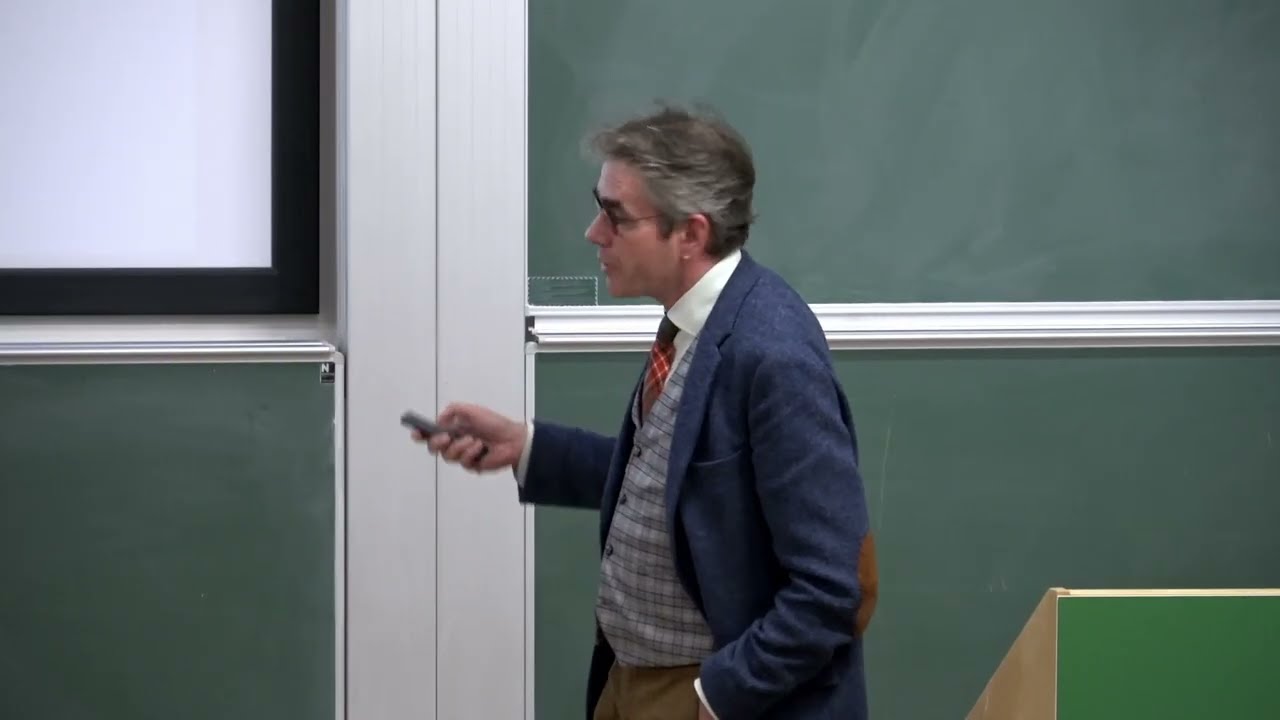
Prof. Olaf Beyersdorff | Fine-grained size-cost-capacity for strong semantic QBF proof systems
Keywords
Summary
148 words
Critical Evaluation
Value of the Information & Strength of the Argument
The value of the information is high: the talk introduces a novel and general technique for proving lower bounds in strong QBF proof systems, an area with limited prior results. The argumentation is rigorous and well-structured. The speaker clearly defines all key concepts (cost, capacity, semantic systems) and illustrates them with a concrete example (equality formula). The main theorem is stated with intuition and a proof sketch, and the follow-up discussion answers audience questions about the system’s placement among existing QBF proof systems. The argumentation is logically coherent and avoids hand-waving, though some technical details are necessarily omitted for time.
Scientific Rigor, Source Quality, Title Accuracy
The talk is scientifically rigorous: it builds on known proof complexity concepts and presents original research. The speaker is affiliated with a university and speaks at the Isaac Newton Institute, adding to credibility. No explicit sources are cited in the talk, but the description provides links to the institute and the specific seminar page, which serve as reliable references. The title accurately reflects the content, which focuses on the fine-grained size-cost-capacity technique for strong semantic QBF proof systems. No comments were available for analysis.
199 words
Title / Content Match
The title accurately describes the talk's focus on fine-grained size-cost-capacity lower bounds for strong semantic QBF proof systems.
Quality & Reliability
9/10
Talk by a recognized researcher at a prestigious mathematics institute, with rigorous formal definitions, clear technical claims, and a detailed proof outline. The content is highly reliable and well-structured.
Key Moments
Markers derived by PSI from the transcript: the creator did not define chapters.
- Introduction to QBF and proof systems for false formulas.
- Explanation of Q-resolution and universal reduction.
- Definition of semantic QBF proof systems and semantic entailment.
- Introduction of cost and capacity measures.
- The size-cost-capacity theorem and its basic proof idea.
- Application to the QKDNF hierarchy and exponential separations.
- Conclusion and potential extensions to other function classes.
Cited Sources
- Isaac Newton Institute for Mathematical Sciences — Host institution and general reference from the video description.
- Seminar page: Logical foundations of complexity theory (LFCW02) — Direct link to the specific seminar event from the video description.
Contribution & Novelties
The main novelty is the fine-grained rescaling of the size-cost-capacity technique using a function class, enabling lower bounds for strong semantic proof systems where the original capacity explodes. The paper demonstrates that the QKDNF hierarchy is strict with exponential separations, which is a significant contribution to QBF proof complexity.
Pour aller plus loin :
- Quantified Boolean formula — Overview of QBFs and their decision problem.
- Proof complexity — General background on measuring proof length and lower bound techniques.
- Resolution (logic) — The base proof system underlying Q-resolution.
- K-DNF — Representation class used in the paper (though no dedicated Wikipedia page, this is the standard concept).
105 words
Radar Profile
The profile shows very high technical level and reliability, with moderately high quantity of information for a short talk, and high novelty for a specialist audience. The scores reflect a dense, rigorous contribution that will appeal primarily to researchers in proof complexity.