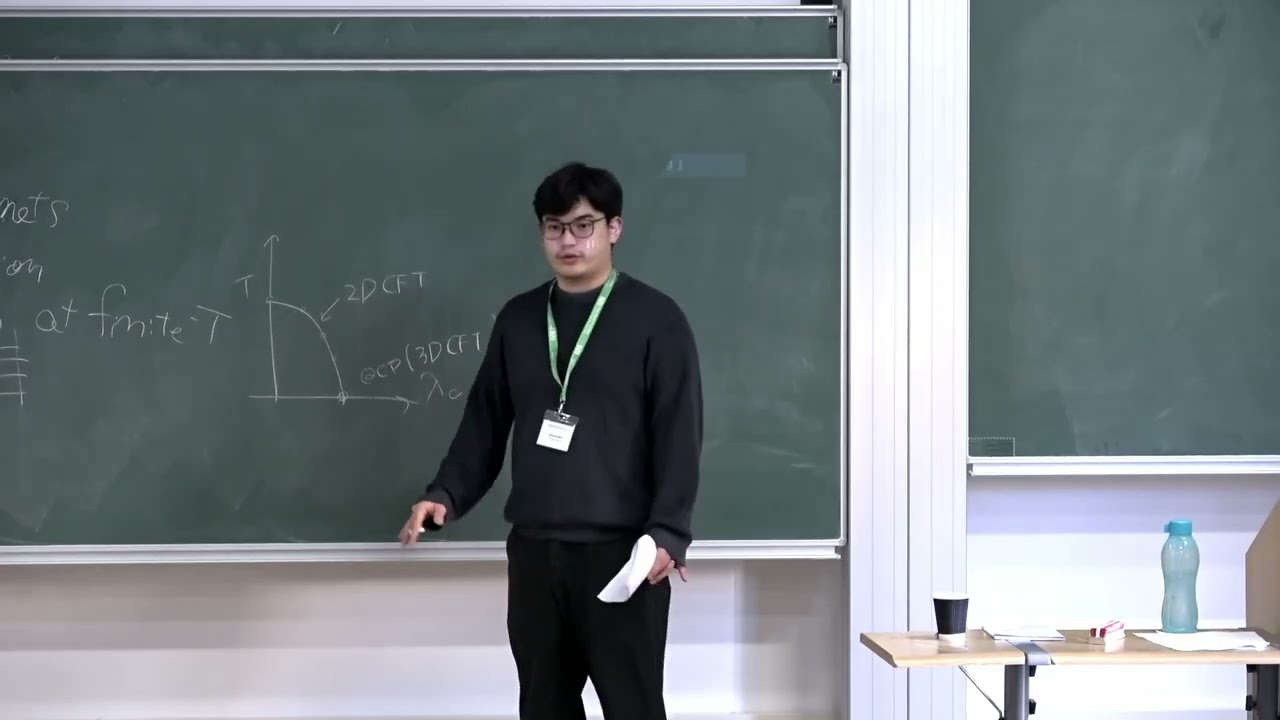
Dr. Atsushi Ueda | Tutorial on Tensor Network Renormalization
Title history
- Dr. Atsushi Ueda | Tutorial on Tensor Network Renormalization — observed on 20261102-1006 UTC (YouTube)
Keywords
Summary
140 words
Critical Evaluation
Value of the Information & Strength of the Argument
The video provides valuable insight into the current landscape of TNR research, briefly covering several frontier applications and open problems. The speaker’s argumentation is logical and grounded in his own research experience, particularly on using TNR for finite-temperature PEPS contraction and the extraction of critical exponents. He effectively communicates the advantages of TNR over conventional methods, such as CTM, in specific contexts. The tutorial section is well-structured, with clear instructions and a practical notebook, though the actual technical details are not elaborated in the video.
Scientific Rigor, Source Quality, Title Accuracy
The video is scientifically rigorous, coming from an established researcher at a reputable institution. The source links in the description point to the Isaac Newton Institute and the specific seminar page, providing context for the event. The title accurately describes the content as a tutorial on TNR, and the video delivers exactly that, albeit with a focus on instructions and overview rather than deep derivations. No unsubstantiated claims are made; the speaker cites ongoing work and references to specific groups without naming papers, but this is acceptable for a tutorial aimed at early-career researchers.
194 words
Title / Content Match
The title accurately reflects the content: a tutorial session on tensor network renormalization, including practical guidance and an overview of open problems.
Quality & Reliability
9/10
Video from the Isaac Newton Institute, a prestigious research centre; the speaker is a domain expert. The content is accurate and authoritative, though limited in depth due to the tutorial structure.
Key Moments
Markers derived by PSI from the transcript: the creator did not define chapters.
Cited Sources
- Isaac Newton Institute Official Website — General information about the hosting institution.
- Seminar Page for the Event — Details about the specific seminar and event (European tensor networks school).
Concurring Sources
- Evenbly & Vidal, 'Tensor Network Renormalization' — Foundational paper on TNR, consistent with the speaker's description of the method.
Contribution & Novelties
The video’s main contribution is its concise overview of open problems in tensor network renormalization, especially the speaker’s personal perspectives on finite-temperature PEPS and the use of TNR for criticality extraction. It also serves as a practical tutorial, offering a ready-to-run notebook for implementing TRG. The ‘Pour aller plus loin’ section suggests further exploration.
Pour aller plus loin :
- Renormalization Group — Core concept underlying TNR.
- Tensor Network — General framework for tensor networks.
- Density Matrix Renormalization Group — Related algorithm, useful context.
- Projected Entangled Pair States — Relevant to the speaker’s discussion on finite-temperature PEPS.
96 words
Radar Profile
The radar profile shows high technical level and reliability, with moderate quantity and quality of information. This reflects a specialized tutorial that provides authoritative but concise guidance, suitable for an advanced audience while not offering exhaustive details.