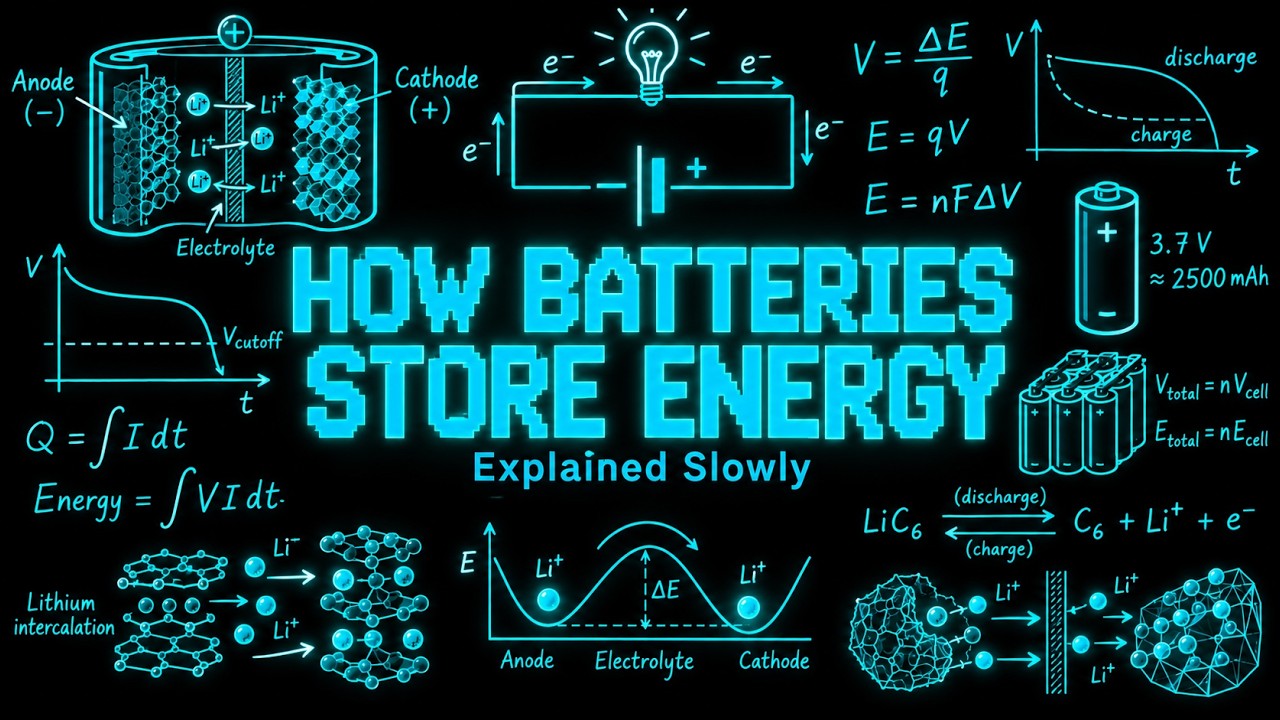
Literally Everything About How Batteries Store Energy Explained Slowly (For Sleep)
Keywords
Summary
146 words
Critical Evaluation
Value of the Information & Strength of the Argument
The video’s value lies in its comprehensive yet accessible treatment of battery science, weaving historical anecdotes with clear explanations of electrochemical principles. The argumentation is structured logically, building from elementary concepts (chemical energy to electrical energy) to complex modern systems (lithium-ion, solid-state). It effectively uses historical narratives to illustrate why batteries work, making abstract chemistry tangible. The slow pace and repetitive emphasis on key ideas (oxidation, reduction, ion flow) reinforce understanding without overwhelming the listener. However, the argumentation is purely descriptive—there is no critical analysis of competing theories or evaluation of scientific controversies, which limits its depth. Still, for a general audience, it provides a solid foundation.
Scientific Rigor, Source Quality, Title Accuracy
The scientific rigor is high for a popular explanation: the video relies on well-established historical and electrochemical facts, and the description lists authoritative sources (Department of Energy, Encyclopaedia Britannica). The content aligns with mainstream scientific consensus, and no speculative or unverifiable claims were identified. The title accurately reflects the content’s scope and pacing. No comments were provided, so public reception trends could not be analyzed.
187 words
Title / Content Match
The title accurately describes the content: a comprehensive, slow-paced explanation of battery energy storage, explicitly designed for sleep.
Quality & Reliability
8/10
The video presents a historically grounded and technically accurate overview of battery electrochemistry, from Volta's pile to lithium-ion, in an accessible narrative style. No significant factual errors detected; the description includes authoritative references (DOE, Britannica).
Key Moments
Markers derived by PSI from the transcript: the creator did not define chapters.
- Introduction: batteries are everywhere and store energy.
- Galvani's frog experiments and the concept of animal electricity.
- Volta invents the first true battery: the voltaic pile.
- Daniel cell and the introduction of half-cell concept.
- Leclanché cell and the development of the dry cell.
- Lead-acid battery invention by Gaston Planté and its importance.
- Nickel-cadmium batteries and emerging technologies like lithium-ion.
Cited Sources
- How Does a Lithium-Ion Battery Work? — Referenced as a resource on lithium-ion batteries
- Battery (electronics) — General reference on batteries
- Electrochemistry — Reference on electrochemistry
- Energy Storage — Reference on energy storage
- Cosmo Explains (Spotify) — Podcast version of the content
Concurring Sources
- How Does a Lithium-Ion Battery Work? — Supports the lithium-ion explanation
- Battery (electronics) — General concordance with battery fundamentals
- Electrochemistry — Concordant with the electrochemical principles described
Contribution & Novelties
The video’s original contribution lies in its synthesis of battery history and electrochemistry into a single, slow-paced narrative designed for relaxation. It connects 18th-century discoveries to modern energy storage challenges, emphasizing the continuous evolution of technology. The presentation format (‘for sleep’) is novel, making dense material accessible without intellectual pressure.
Pour aller plus loin :
- Voltaic pile - Wikipedia — Essential for understanding the first battery’s construction and chemistry.
- Lead-acid battery - Wikipedia — Details the oldest rechargeable battery technology still in use.
- Lithium-ion battery - Wikipedia — Covers the dominant modern battery chemistry and its variants.
- Electrochemistry - Wikipedia — Provides broader context on the chemical processes underpinning all batteries.
111 words
Radar Profile
The radar profile shows strong scores in quantity of information (9) and reliability (8), with moderate technical level (5). This indicates a comprehensive, trustworthy overview that remains accessible to non-specialists, though it does not dive deeply into advanced electrochemistry or engineering specifics.