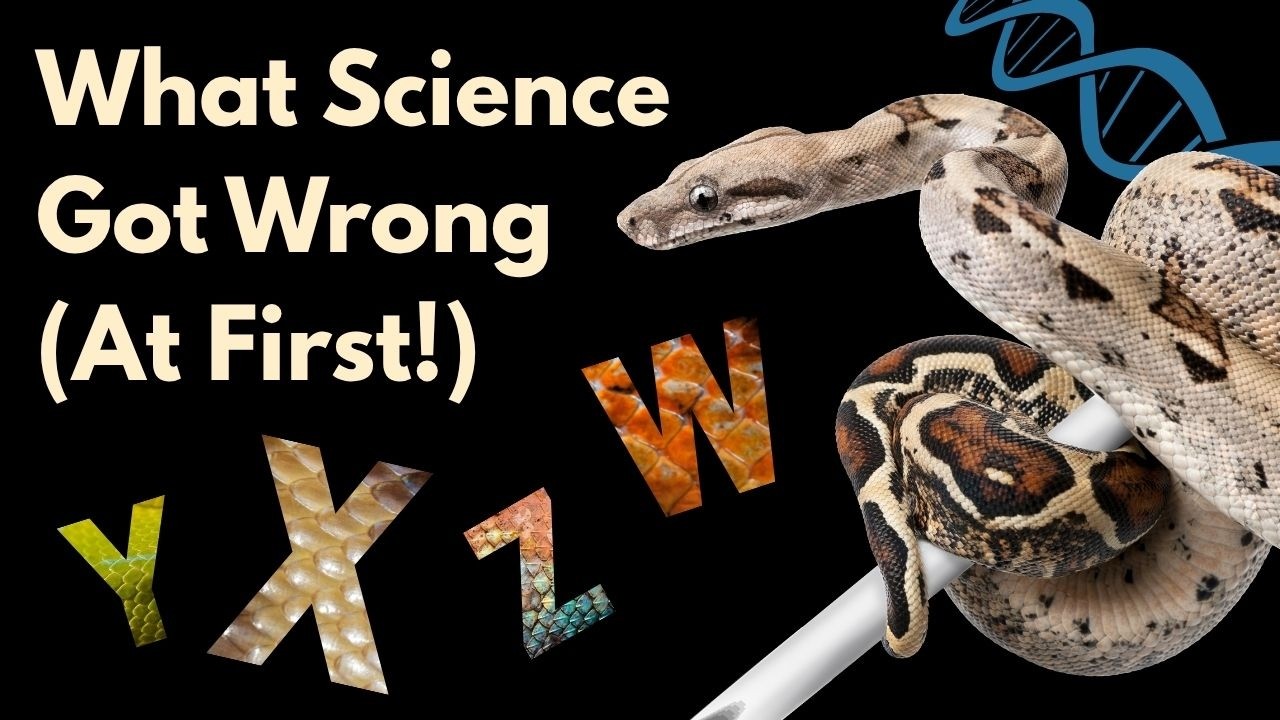
Scientists Got Something Wrong (Part 1) - Virgin Birth Boas To The Rescue! | RGW Ep 168
Title history
- Scientists Got Something Wrong (Part 1) - Virgin Birth Boas To The Rescue! | RGW Ep 168 — observed on 20261104-0837 UTC (YouTube)
Keywords
Summary
140 words
Critical Evaluation
Value of the Information & Strength of the Argument
The value of the information is high for hobbyists and those interested in reptile genetics, as it presents recent peer-reviewed findings in an accessible manner. The argumentation is solid: Dr. Morrill grounds his explanations in published studies, cites specific authors (Warren Booth, J.J. Emerson), and uses clear examples (morph genetics in parthenogenetic boas). He correctly distinguishes between established facts and remaining uncertainties, such as why chromosome size differences vary among species. The logical progression from the initial assumption to the revised understanding is well-structured and supports the scientific process of correction.
Scientific Rigor, Source Quality, Title Accuracy
The scientific rigor is good: the speaker references concrete publications (2010 Biology Letters, 2017 Evolution) and explains the methodology (sequencing, chromosome staining). The quality of sources is enhanced by the author’s direct involvement in genetic testing. The title is appropriate and not exaggerated; it clearly signals a correction of previous scientific understanding. The video includes one promotional segment for the speaker’s Patreon and commercial announcements about genetic tests, but these are clearly separated from the main content.
183 words
Title / Content Match
Title accurately reflects the content: the video focuses on a scientific correction regarding sex chromosomes in snakes, illustrated by the parthenogenesis case in boas.
Quality & Reliability
8/10
The video is presented by a geneticist with direct involvement in the research and references peer-reviewed publications (Biology Letters 2010, 2017 in Evolution). It clearly distinguishes established data from speculative explanations. Minor limitation: the commercial context and promotional segments reduce neutrality.
Key Moments
Markers derived by PSI from the transcript: the creator did not define chapters.
- Introduction: science told us wrong about sex chromosomes in reptiles.
- Update on genetic tests and upcoming panels.
- Adult: discussion of the 2010 parthenogenesis case in boas and its implications.
- Explanation of 2017 discovery that boas and pythons are XY, not ZW.
- Comparison of XY and ZW systems and effects on parthenogenesis.
- Chromosome morphology differences across snake families (elapids, colubrids, vipers).
- History of X/Y/Z/W nomenclature and promotion of Reptile Institute.
- Closing remarks and teaser for part two.
Cited Sources
- Submit Sheds For Future Research — Link in description for submitting sheds for research.
- How To Order Your Own Genetic Test — Link to order genetic tests.
- Order in bulk — Commercial link for bulk orders.
Concurring Sources
- Biology Letters (2010) – Evidence for viable nonclonal but fatherless boa constrictors — Paper by Warren Booth et al. documenting parthenogenesis in boas, mentioned in video.
- Evolution (2017) – A paradigm shift in snake sex chromosome genetics — Paper by J.J. Emerson et al. demonstrating XY chromosomes in boas and pythons, mentioned in video.
Contribution & Novelties
This video provides a clear, up-to-date summary of a recent paradigm shift in snake genetics: the discovery that boas and pythons have XY sex chromosomes, contrary to the long-assumed ZW system common to other snakes. It highlights the role of captive breeding and parthenogenesis observations in prompting this correction, making it an original contribution to popular science communication in the reptile hobby. The explanation of how parthenogenesis outcomes differ between XY and ZW systems adds practical value for breeders.
Pour aller plus loin :
- Sex-determination system — Overview of different sex chromosome systems, including XY and ZW.
- Parthenogenesis — Background on asexual reproduction in vertebrates.
- Boa constrictor — Species context for the parthenogenesis study.
- Warren Booth (scientist) — Researcher involved in the cited studies.
124 words
Radar Profile
The radar profile shows a balanced performance with high scores in information quantity and quality, and moderate technical level. The reliability is strong, while the engagement metrics (views/likes) are low, reflecting a niche audience rather than lower content quality.