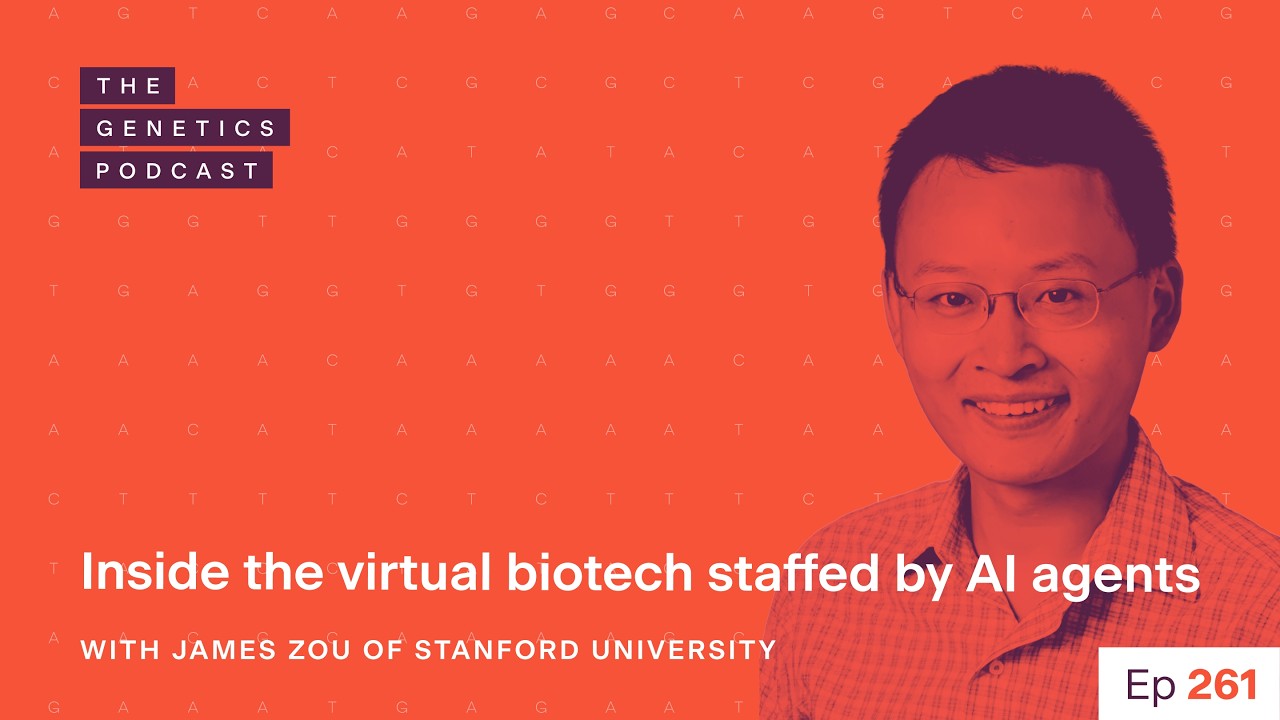
EP 261: Inside the virtual biotech staffed by AI agents with James Zou of Stanford University
Keywords
Summary
201 words
Critical Evaluation
Value of the Information & Strength of the Argument
The value of the information is high, rooted in peer-reviewed studies and practical demonstrations. Zou provides concrete quantitative results, such as the 48% improvement in trial success rates when drug targets have single-cell support, and discusses the autonomous decision-making processes of the agents. His argumentation is coherent and well-supported: he illustrates how virtual biotech agents can scale beyond human capabilities, offers evidence of their effectiveness through the discovery of a novel splicing error linked to ADHD, and justifies the need for human verification. The discussion is balanced, acknowledging limitations such as missing proprietary data and the importance of reproducibility checks. The trajectory from virtual lab to virtual biotech is logically presented, and the potential for agent teams to evolve their own dynamics is substantiated by examples like forced role reversal.
Scientific Rigor, Source Quality, Title Accuracy
The scientific rigor is strong: the topics are based on papers published in Science and Nature, with open-source implementations. Zou details the methodology of virtual biotech and paper-to-agent, and supports claims with documented outcomes. The sources cited in the description directly correspond to the discussed works, ensuring traceability. The title accurately encapsulates the interview’s core subject, and the content stays on-topic throughout. No discrepancy between title and content is apparent. The episode also benefits from clear chapter markers, aiding navigation and comprehension.
227 words
Title / Content Match
The title precisely reflects the interview's focus on virtual biotech, AI agents, and James Zou's work.
Quality & Reliability
9/10
The discussion is grounded in peer-reviewed research published in Science and Nature, presented by an expert from Stanford. The claims are supported by specific experimental results and open-source tools, ensuring high reliability.
Chapters
- Intro to The Genetics Podcast
- Welcome to James
- An overview of James’s virtual biotech and its AI scientist agents
- How single cell evidence behind drug targets predicts clinical trial success
- Behind the scenes of how autonomous the virtual biotech agents are
- Missing proprietary trial data as the next gap for the virtual biotech
- Scaling the number of collaborating AI agents as a new frontier for drug discovery
- How teamwork and structure evolved among the agents
- Behind the idea of Paper to Agent and virtual authors
- What converting over 100 papers into agents revealed about reproducibility
- The story behind EchoNet, an FDA-cleared AI tool for cardiac ultrasound
- Predicting risk for over 100 future diseases from one night of sleep
- Transferring SleepFM from sleep labs to consumer wearables
- Combining multimodal health data to predict disease
- Longitudinal blood proteomics as the biggest data gap for health AI
- The role of academia as an open, neutral counterweight to big AI labs
- How James’s path from Cambridge math and Harvard machine learning led to biology
- Closing remarks
Cited Sources
- Paper2Agent paper — Discussed as the paper-to-agent platform that converts papers into virtual authors.
- Virtual biotech paper — Discussed as the virtual biotech with AI scientist agents and the finding on single-cell evidence and trial success.
Contribution & Novelties
This episode provides an accessible yet technically rich overview of cutting-edge AI applications in biomedical research, particularly the paradigm shift from static knowledge artifacts to active AI agents. The novelty lies in the scalable use of thousands of collaborative agents for drug discovery and the transformation of papers into living entities that can reproduce and generate new knowledge. The discussion also offers insights into emergent teamwork structures among agents and addresses challenges such as reproducibility and data gaps.
Pour aller plus loin :
- Single-cell RNA sequencing — Relevant to understanding the single-cell data used to assess drug target evidence.
- AI in drug discovery — Broader context for the virtual biotech approach.
- EchoNet — The FDA-cleared AI tool for cardiac ultrasound mentioned in the episode.
- Open science — Related to the open-source ethos emphasized by Zou.
135 words
Radar Profile
The profile shows high scores across all dimensions, indicating a well-balanced and reliable resource. The strong performance in quantity and quality of information, coupled with high technical depth and reliability, suggests an expert-led discussion backed by substantial and verified content.