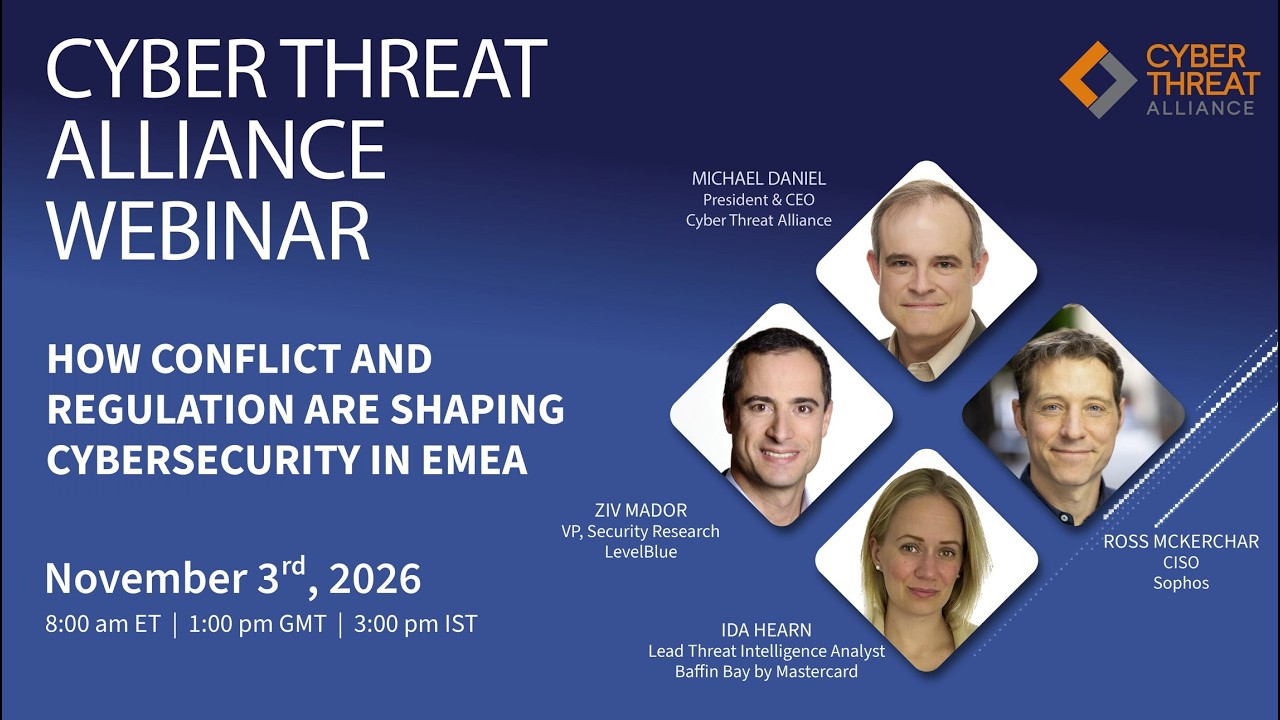
CTA Webinar: How Conflict and Regulation are Shaping Cybersecuirty in EMEA
Title history
- CTA Webinar: How Conflict and Regulation are Shaping Cybersecuirty in EMEA — observed on 20261105-2136 UTC (YouTube)
Keywords
Summary
247 words
Critical Evaluation
Value of the Information & Strength of the Argument
The information value is high for executives and security professionals seeking strategic guidance, as the panel provides firsthand accounts from industry leaders. The argumentation is solid, with each speaker building on the others’ points and offering concrete examples. Ross effectively connects technical debt to strategic risk, Ziv illustrates how AI accelerates both offensive and defensive capabilities, and Ida brings a practical perspective on geopolitical spillovers. The discussion is well-structured, moving from observations to predictions, and avoids alarmism while acknowledging serious threats. The argumentation is persuasive because it relies on real-world incidents (e.g., APT attacks on Sophos, Swedish grocery stores, Striker Medical) and logical reasoning about future trends. However, the lack of quantitative data or cited studies slightly weakens the rigor, though the panel’s authority compensates.
Scientific Rigor, Source Quality, Title Accuracy
While the panelists are credible experts, the webinar does not cite external sources or provide links to reports. The claims are anecdotal and based on the speakers’ experiences, which limits verifiability. The title accurately reflects the content, which consistently returns to the themes of conflict (geopolitical tensions, cyber operations) and regulation (EU directives). The discussion on regulation is more inferential, with references to upcoming laws but little deep analysis of specific requirements. The adequacy between title and content is strong, and the absence of formal sources is partially offset by the participants’ recognized positions in the industry.
237 words
Title / Content Match
The title accurately represents the webinar's focus on how conflict and regulation shape cybersecurity in the EMEA region. The content directly addresses these two forces, discussing geopolitical tensions, regulatory impacts, and organizational responses.
Quality & Reliability
7/10
The panel consists of senior cybersecurity executives from recognized organizations (Sophos, LevelBlue, Baffin Bay, Cyber Threat Alliance) sharing real-world experiences and strategic insights. No formal citations or data sources are provided, but the arguments are coherent and grounded in practical expertise. The score reflects the value of expert perspectives without verifiable references.
Key Moments
Markers derived by PSI from the transcript: the creator did not define chapters.
- Introduction by Michael Daniel and panelist self-introductions (Ross McKerchar, Ziv Mador, Ida Hearn).
- Ross discusses nation-state focus on perimeter devices and the growing use of unpatched infrastructure as initial entry vectors.
- Ziv highlights the impact of conflicts on cyber activity, including hacktivist groups and crossfire victims; example of Striker Medical.
- Ida shares Sweden's NATO accession as a case where diplomatic decisions triggered cyberattacks, emphasizing the need for broad risk assessment.
- Discussion on technical debt: Ziv underscores the importance of mapping attack exposure, and Ross advises trade-offs between risk domains to close gaps.
- Ziv predicts AI will sharply increase vulnerability discovery and exploit automation; Ross notes the 'wave' of vulnerabilities and the upcoming exploitation surge.
- Ida foresees more strategic prepositioning by nation-state actors in critical infrastructure; panel discusses regulatory changes and their impact on cybersecurity obligations.
Contribution & Novelties
The webinar provides a timely, practical perspective on how geopolitical conflicts and European regulations are converging to shape cybersecurity strategies. The panelists offer original insights into the evolution of threat actor behavior, particularly the rise of hacktivism and the strategic use of AI in both attack and defense. They also challenge traditional risk management approaches, advocating for a more dynamic trade-off between different risk categories. The discussion on technical debt and the necessity of accelerating patching cycles is particularly relevant.
Pour aller plus loin :
- NIS2 Directive — The Network and Information Security (NIS2) Directive is a key EU regulation mentioned in the webinar, setting higher cybersecurity standards for essential entities.
- Cyber Resilience Act — This EU proposal imposes mandatory cybersecurity requirements for hardware and software products, directly affecting manufacturers and users.
- AI Act — The EU’s Artificial Intelligence Act introduces risk-based rules for AI systems, with implications for cybersecurity and adversarial use.
153 words
Radar Profile
The radar profile shows strong scores in information quantity and quality, while technical depth and reliability are moderate. This reflects a webinar that delivers substantial strategic insights but relies on expert opinion rather than deep technical analysis or verified data. The highest score in quantity indicates a broad coverage of topics, but the lower technical level suggests it targets a managerial audience.