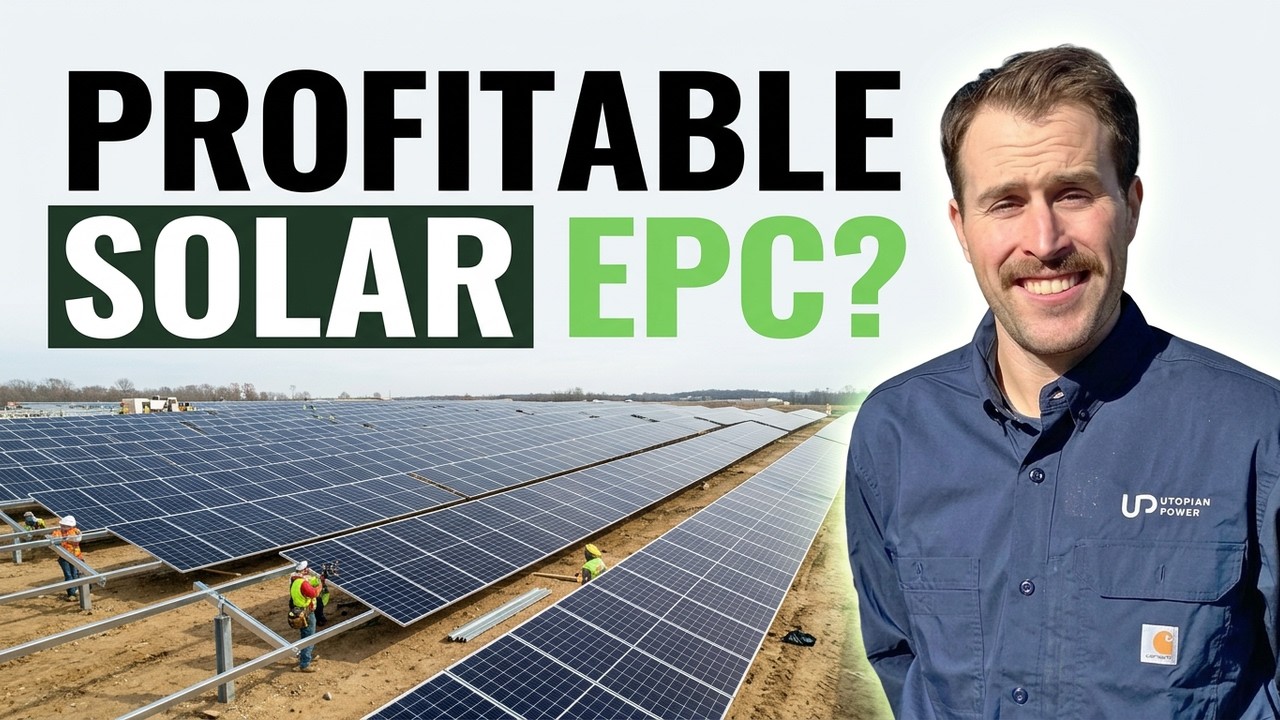
The Business of Solar EPC: Profitability, Policy Risks, and Project Delivery
Keywords
Summary
165 words
Critical Evaluation
Value of the Information & Strength of the Argument
The video provides valuable insights into the operational and financial aspects of running a solar EPC business, a perspective often underrepresented. The argumentation is grounded in practical experience, particularly regarding bonding capacity, project selection, and financing discipline. Cohn’s emphasis on doing what you say you will do, and the need to build trust with sophisticated clients, offers a credible framework for industry professionalism. The discussion of policy risks is relevant but presented from a single company’s viewpoint, lacking broader data or contrast. The logical progression from origin story to specific challenges and recommendations makes the argument coherent, though some statements are anecdotal without external validation.
Scientific Rigor, Source Quality, Title Accuracy
The video relies primarily on the guest’s personal experience, with no direct citations to external reports or studies. Mentioned policy measures (tariffs, FCC bans) are not formally referenced, but the context is consistent with mainstream energy news. The title accurately encapsulates the core topics. The production includes sponsor segments which are clearly separated and do not interfere with the content. The discussion is technically accurate for an expert audience, with some simplification for accessibility. The lack of explicit sources reduces the rigor, but the practical nature of the interview compensates somewhat. The quality of presentation is high, with good audio and logical flow.
223 words
Title / Content Match
The title accurately reflects the content: the interview covers EPC business practices, profitability, policy risks, and project delivery.
Quality & Reliability
7/10
Based on direct professional experience of the guest, but mitigated by commercial bias and limited external references.
Key Moments
Markers derived by PSI from the transcript: the creator did not define chapters.
- Introduction of Forrest Cohn and Utopian Power, background of the company.
- Discussion on early contracts with Michigan DNR and how it shaped the business.
- Explaining bonding capacity and its importance for EPC firms.
- Analysis of tariff impacts, FCC inverter ban, and tax credit timeline.
- Advice on industry integrity and long-term business sustainability.
Cited Sources
- Utopian Power — Official website of the guest's company.
- Forrest Cohn (LinkedIn) — LinkedIn profile of the guest.
External References
Contribution & Novelties
The video brings a practical, operator-level perspective on running a small solar EPC, filling a gap often dominated by large corporate voices. It highlights the role of municipalities and bonding in the growth path, offering concrete lessons for entrepreneurs. The discussion on how EPCs can partner with developers during safe-harbor projects is timely.
Pour aller plus loin :
- Community solar — Explanation of the community solar model referenced throughout the interview.
- Engineering, procurement, and construction — Overview of the EPC business model.
- Surety bond — Details on construction bonds, central to the bonding capacity discussion.
95 words
Radar Profile
The scores are balanced, with moderate quantitative information and technical depth. Reliability is good but not outstanding due to the lack of external sources. The technical level is accessible to a professional audience but not highly specialized. The overall profile suggests a practical, experience-driven discussion that is credible but not empirically grounded.