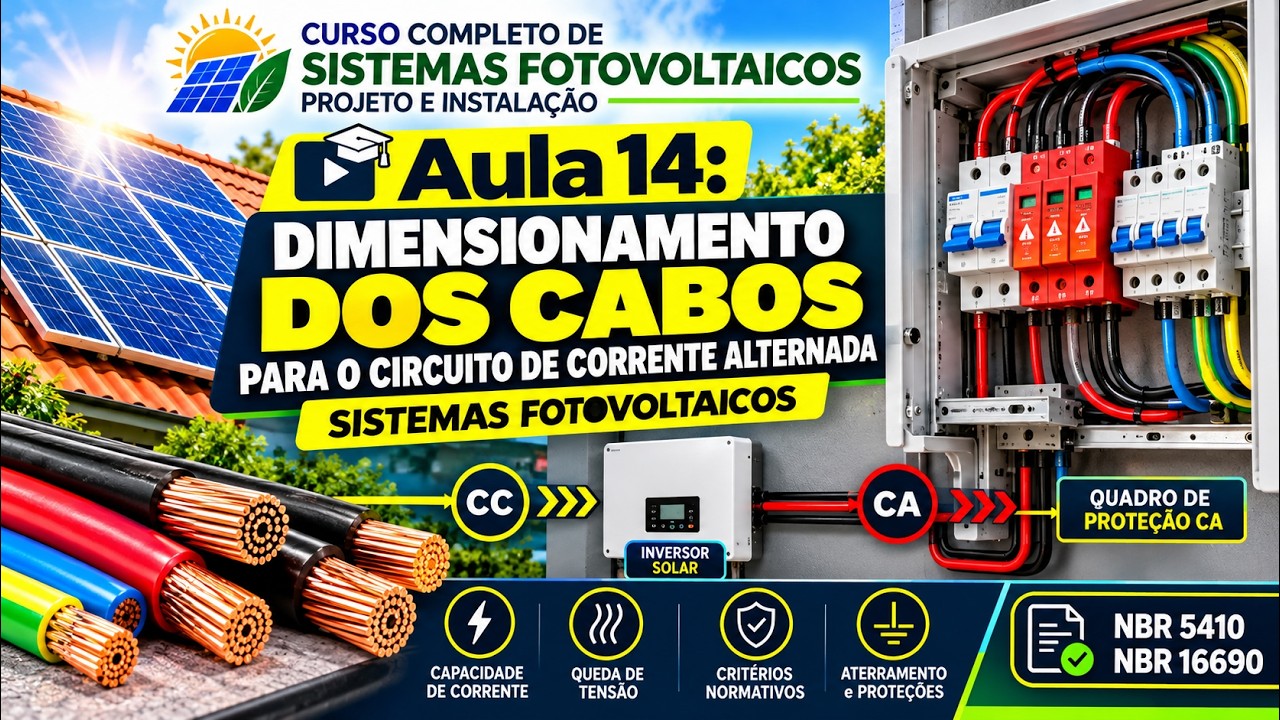
Aula 14: Dimensionamento dos cabos para o circuito de corrente alternada
Lesson 14: Sizing cables for AC circuits
Keywords
Summary
177 words
Critical Evaluation
Value of the Information & Strength of the Argument
The video provides a systematic and practical approach to cable sizing, grounded in established Brazilian standards. The argumentation is logical and pedagogically sound: it starts with the basic concepts of current (nominal, project, and carrying capacity), then explains the relevant tables and correction factors, and finally illustrates the process with worked examples. The instructor clearly links each step to the requirements of NBR 5410, ensuring that the reasoning is normative and consistent. The value lies in its step-by-step guidance, which is directly applicable to real-world PV system design. However, it does not introduce new scientific findings; it serves as a tutorial on applying existing standards.
Scientific Rigor, Source Quality, Title Accuracy
The content relies exclusively on the Brazilian standards NBR 5410 and NBR 16690, which are official technical regulations. The explanations are faithful to these standards, and the instructor frequently references specific tables and factors, demonstrating rigor. No external scientific literature is cited, but the use of national standards confers a solid foundation for the technical domain. The title accurately describes the lesson’s focus, and the content fully aligns with the stated objective. The video does not include any critical evaluation of the standards themselves, but that is not its purpose.
210 words
Title / Content Match
The title accurately reflects the lesson content: sizing cables for the AC circuit in photovoltaic systems.
Quality & Reliability
7/10
Lesson based on recognized Brazilian standards (NBR 5410 and NBR 16690) with practical examples, but lacks external verification or additional authoritative sources beyond the norms.
Key Moments
Markers derived by PSI from the transcript: the creator did not define chapters.
- Introduction to the lesson: sizing AC cables in photovoltaic systems and overview of standards.
- Explanation of NBR 5410 and the key tables (33, 36, 40, 42, 46) used for cable sizing.
- Discussion of current concepts: nominal current, project current, and carrying capacity, with emphasis on the AC circuit of a PV inverter.
- First worked example: sizing cables for a bifásico circuit with 34 A, 30°C ambient, no grouping, selecting a 6 mm² cable.
- Second worked example introducing correction factors for temperature and grouping, with step-by-step application of tables 40 and 42.
- Summary emphasizing the need to check both current capacity and voltage drop limits.
Cited Sources
- NBR 5410 - Instalações elétricas de baixa tensão — Main standard for low-voltage electrical installations, used for cable sizing tables and correction factors.
- NBR 16690 - Sistemas fotovoltaicos — Standard for photovoltaic systems, referenced for AC circuit requirements and integration with NBR 5410.
Contribution & Novelties
The video contributes a clear, practical methodology for applying Brazilian standards to AC cable sizing in photovoltaic installations. It consolidates information from multiple NBR tables into a coherent process, which is valuable for professionals who may not be familiar with reading these standards directly. The worked examples illustrate common scenarios, including correction factors, making the content immediately applicable.
Pour aller plus loin :
- Electrical wiring — Provides foundational knowledge on conductors and installation methods relevant to cable sizing.
- Voltage drop — Explains the physical principle behind voltage drop limits, a key criterion in the lesson.
- Photovoltaic system — Gives an overview of PV system components, including the AC side and inverter interaction.
- NBR 16690 (no URL provided) — The Brazilian standard specifically for PV systems; consult official sources for the latest version.
132 words
Radar Profile
The profile shows high scores in quantity, technical level, and fiability (7-8), with a slightly lower quality score of 7. This indicates a technically dense tutorial with a solid normative basis, but limited external corroboration. The radar suggests the video is well-suited for practitioners seeking practical guidance.