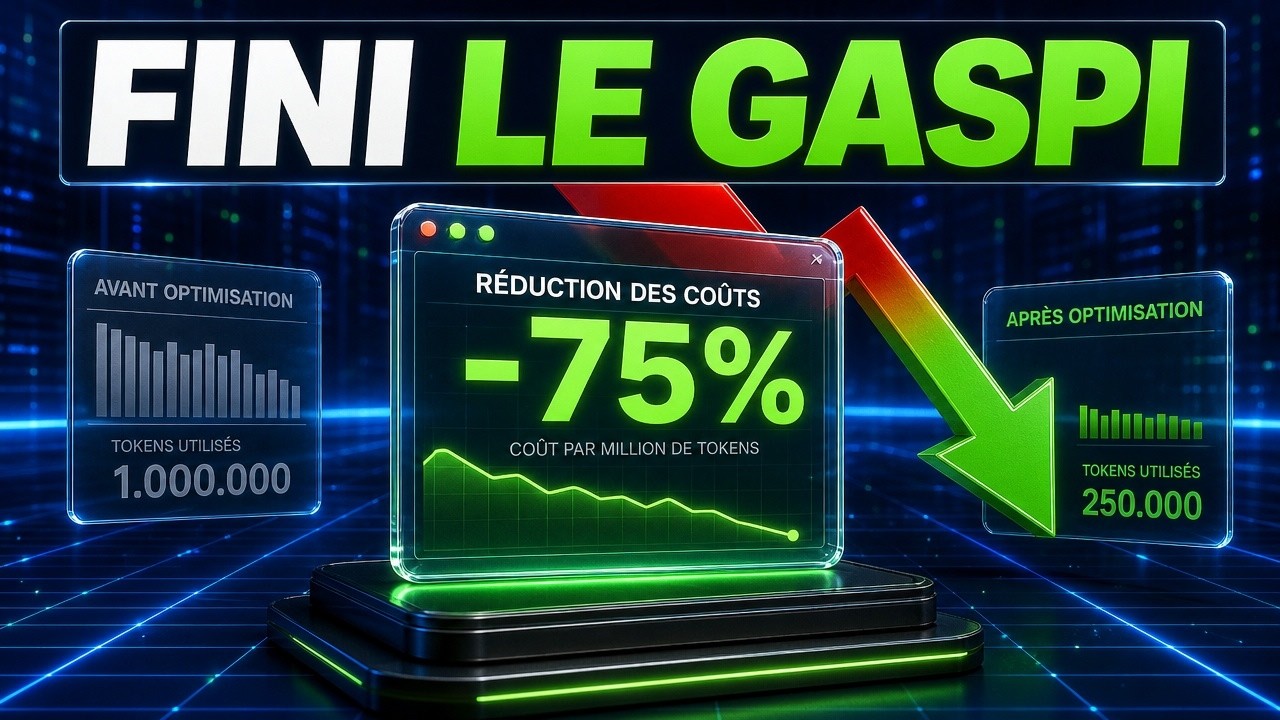
Ces 4 plugins rendent Claude Code beaucoup moins gourmand
These 4 plugins make Claude Code much more efficient
Title history
- Ces 4 plugins rendent Claude Code beaucoup moins gourmand — observed on 20261110-0253 UTC (YouTube)
Keywords
Summary
177 words
Critical Evaluation
Value of the Information & Strength of the Argument
The video offers substantial practical value for developers seeking to optimize their Claude Code usage. Each tool is presented with clear installation steps and live demonstrations, allowing viewers to follow along. The argumentation is grounded in concrete examples, such as the Graphify knowledge graph on a real blog project and CodeBurn’s spending analysis, which strengthens the credibility of the claims. The author effectively argues that these tools not only reduce token consumption but also improve productivity and code quality, as seen in the Ponytail example simplifying a cache implementation. The presentation is structured and logical, moving from context compression to codebase understanding, then to coding behavior, and finally to analytics, providing a comprehensive overview.
Scientific Rigor, Source Quality, Title Accuracy
The video lacks formal citations; the author does not provide direct links to the tools’ GitHub repositories or documentation, instead relying on personal experience. The description only includes links to the author’s website and video playlists, which are not directly related to the tools. The title is accurate and directly matches the content, focusing on four specific plugins. The demonstrations are authentic, showing real terminal sessions and dashboards, which adds credibility. However, the absence of external sources or official documentation limits the viewer’s ability to verify claims independently. The video’s rigor is moderate, typical of casual tech tutorials, but it serves well as a practical guide.
235 words
Title / Content Match
The title accurately describes the content: the video presents exactly four plugins aimed at reducing token consumption in Claude Code.
Quality & Reliability
6/10
The video provides practical demonstrations and installation steps for four open-source tools, but relies entirely on the author's own experience without citing external sources or linking directly to the tools' repositories. The subjective nature of the recommendations limits overall reliability.
Key Moments
Markers derived by PSI from the transcript: the creator did not define chapters.
- Introduction to the video and overview of four token-saving plugins.
- Headroom: compression of context via a proxy, installation and dashboard demo.
- Graphify: creating a knowledge graph and querying it to avoid token-heavy searches.
- Ponytail: enforcing lazy senior developer rules to minimize unnecessary code.
- CodeBurn: analyzing token spending and displaying cost reports.
- Conclusion: summary of tools and their benefits.
Cited Sources
- Pentiminax website — Author's personal website, mentioned in the description.
- Playlist: Symfony tutorials — Linked in the description as a tutorial playlist.
- Playlist: PHP tutorials — Linked in the description as a tutorial playlist.
- Playlist: Xamarin tutorials — Linked in the description as a tutorial playlist.
- Playlist: C# tutorials — Linked in the description as a tutorial playlist.
Contribution & Novelties
The video compiles four specific open-source tools into a single tutorial, offering a time-saving overview for developers. Its original contribution lies in the practical demonstration of each tool on a real project, providing tangible examples of token savings and efficiency gains. The author also shares personal observations, such as the surprising connections in the knowledge graph, which add a unique perspective. However, the tools themselves are external projects, and the video does not introduce novel techniques or research.
Pour aller plus loin :
- Knowledge graph — A foundational concept behind Graphify, which structures information as nodes and edges to enable efficient querying.
- Context window — The amount of tokens an AI model can consider at once, relevant to Headroom’s compression approach.
- Tokenization in LLMs — Understanding how tokens are counted helps appreciate the savings described.
- ‘Lazy senior developer’ — A coding philosophy emphasizing minimalism and reuse, popularized in software engineering discussions; no canonical URL is provided due to its informal nature.
161 words
Radar Profile
The radar chart shows a balanced profile with high scores in quantity of information and technical level, reflecting the detailed tutorial style. Quality and reliability scores are slightly lower, indicating that while the content is practical, it lacks robust citations and independent verification. The overall pattern suggests a useful hands-on guide rather than a rigorous scientific source.