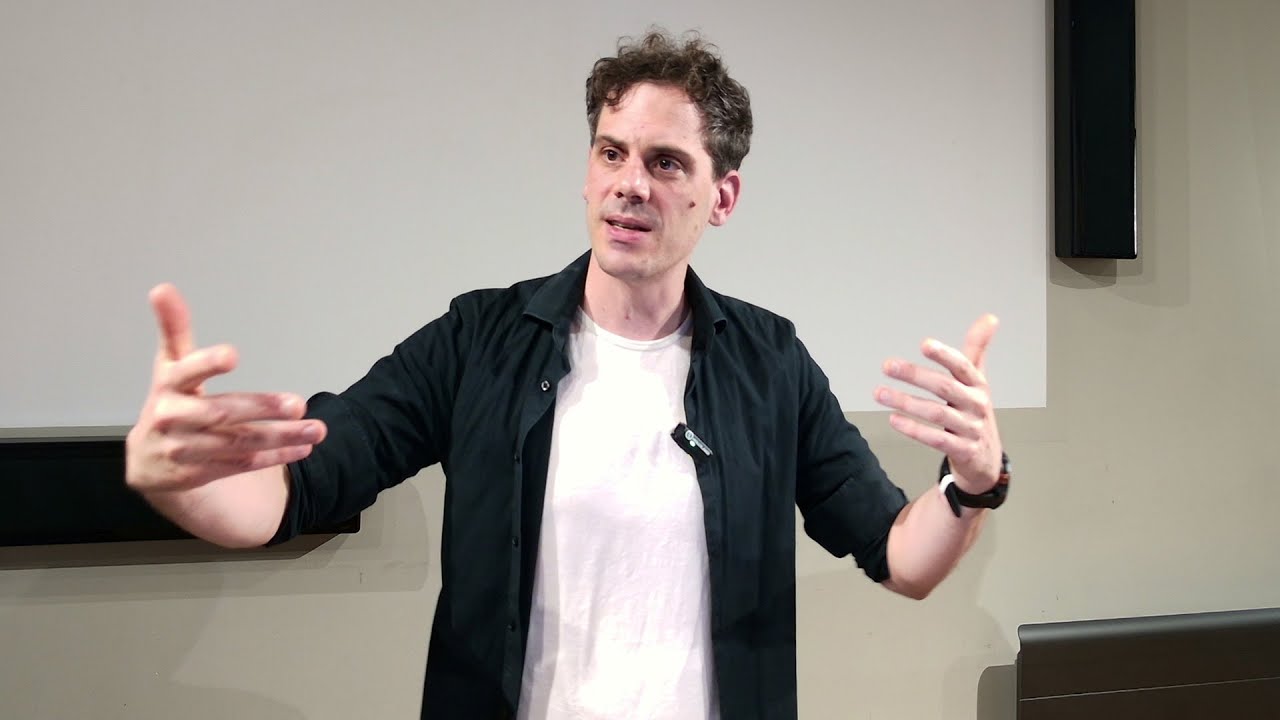
Etienne Ollion : S’augmenter ? Promesses, dangers et possibles bénéfices de l’usage de l’IA en SHS
Etienne Ollion: Augmenting oneself? Promises, dangers and possible benefits of using AI in the humanities and social sciences
Keywords
Summary
159 words
Critical Evaluation
Value of the Information & Strength of the Argument
The value of the information is high: it offers a critical and empirically grounded reflection on the use of AI in SHS. The argumentation is solid, moving from a descriptive mapping of usages to a detailed case study. Ollion effectively uses the comparison between generative and encoder models to demonstrate that performance metrics alone are insufficient to evaluate research value. The argument is well-supported by concrete examples and references to the research process, including the importance of iterative conceptualization during annotation. The talk avoids simplistic stances and acknowledges limitations, making the argument more persuasive and scientifically credible.
Scientific Rigor, Source Quality, Title Accuracy
The talk demonstrates scientific rigor through transparent methodology and careful interpretation of results. Ollion cites his own earlier work and the controversial ‘paper factory’ paper by Perzel and Wilmers, situating his position within the ongoing debate. The empirical study is based on a significant dataset (80,000 images) and uses a dual methodological approach, with clear explanations of model choices and performance metrics. The title accurately conveys the content, exploring the concept of augmentation in a critical and nuanced manner. The presentation includes a clear structure (introduction, empirical case, discussion) and explicitly acknowledges the limitations and open questions, which enhances its reliability.
213 words
Title / Content Match
The title accurately reflects the content: it addresses the promises, dangers, and possible benefits of AI in the social sciences, moving beyond a simplistic 'augmentation vs replacement' dichotomy.
Quality & Reliability
9/10
The talk is delivered by a senior researcher (director of research in sociology, professor at École Polytechnique), based on a methodological reflection and an original empirical study. The content is well-structured, transparent about the research process, and critically engages with established debates.
Key Moments
Markers derived by PSI from the transcript: the creator did not define chapters.
- Introduction: omnipresence of AI and the context of social sciences.
- Cartography of AI uses in SHS: transcription, coding, analysis, imputation, etc.
- Presentation of the debate: replacement vs augmentation, historical background and current relevance.
- Introduction of the empirical study on photos of presidential candidates, methodology with two AI approaches.
- Results: performance comparison between generative and encoder models, highlighting the efficiency of manual annotation.
- Second result: the importance of annotation and conceptualization for scientific quality, beyond mere performance.
- Discussion: criticism of the augmentation discourse and proposal of a more nuanced perspective.
Cited Sources
- Inathèque — Institution hosting the seminar and providing access to audiovisual archives.
- INA Le Lab — Organizer of the seminar and source for research activities in digital humanities.
Contribution & Novelties
The original contribution of this talk lies in the empirical demonstration that the augmentation discourse in AI usage is often a ‘pious wish’ when not accompanied by deep engagement with the research object. By comparing generative and encoder models on the same annotation tasks, the author shows that fine-tuned smaller models with manual annotation yield better results and, more importantly, force researchers to conceptualize and refine their categories, thus improving the scientific process itself.
Pour aller plus loin :
- Active learning (machine learning) — This concept relates to the iterative annotation process described, where the model selects informative examples for human labeling, increasing efficiency.
- Human-in-the-loop — This idea is central to Ollion’s argument, emphasizing the necessity of human judgment and contextual understanding in AI-assisted research.
- Computational social science — The talk fits into this interdisciplinary field, using computational methods to address social science questions.
144 words
Radar Profile
The radar profile shows high scores in information quality and reliability, with lower but still notable scores in technical level and information quantity. This reflects a lecture that is rigorous and conceptually rich, though not extremely technical or exhaustive in scope.