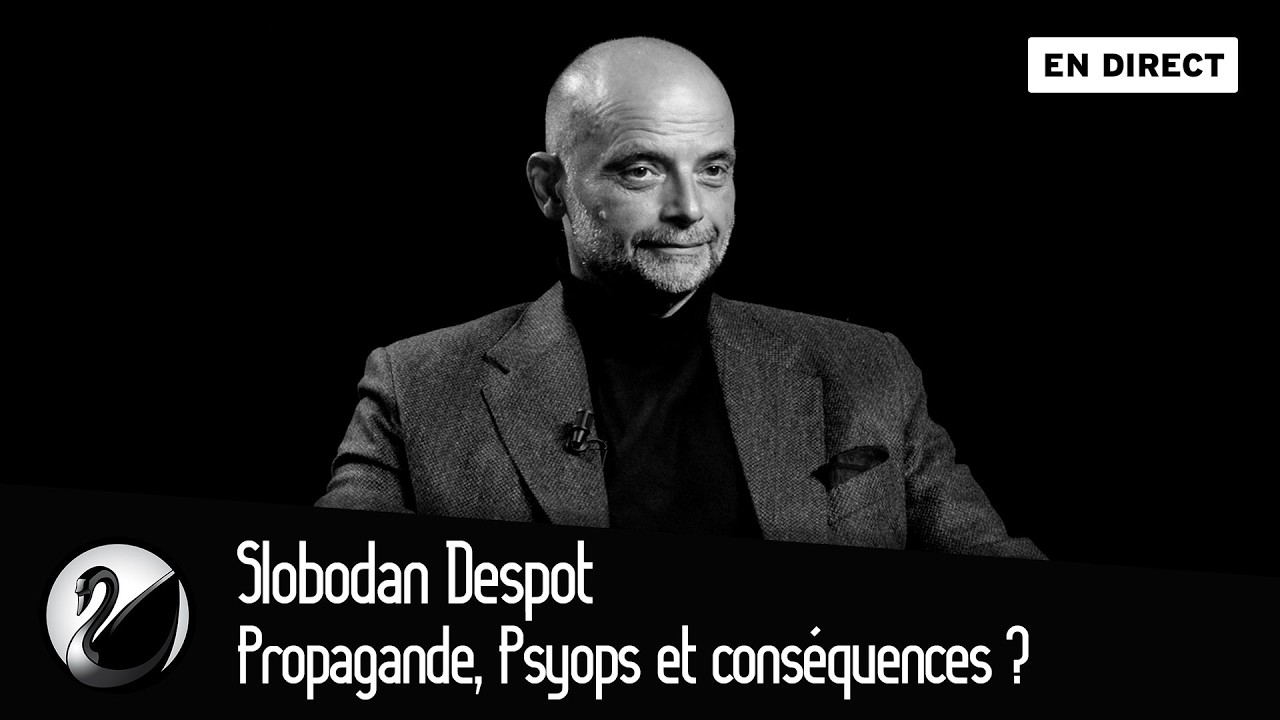
Propagande, Psyops et conséquences ? Slobodan Despot [EN DIRECT]
Propaganda, Psyops and consequences? Slobodan Despot [LIVE]
Keywords
Summary
132 words
Critical Evaluation
Value of the Information & Strength of the Argument
The interview provides a valuable alternative perspective on propaganda and geopolitics, enriched by Despot’s literary and philosophical background. However, the argumentation is largely anecdotal and subjective, often relying on personal impressions and rhetorical devices rather than factual evidence. The guest uses logical fallacies such as overgeneralization and argument from authority, and his critique of Western diplomacy, while articulate, lacks concrete data or citations. The discussion of linguistic differences and their social implications is insightful but speculative. Overall, the value lies in stimulating critical thinking, but the solidity of the argumentation is weak due to the absence of rigorous sourcing and verification.
Scientific Rigor, Source Quality, Title Accuracy
The video does not cite specific external sources beyond mentioning authors like Chakotin, Bernays, and literary figures, but no actual works or studies are referenced in detail. The links in the description are all about the Thinkerview channel itself (website, apps, podcasts) and do not provide supporting evidence. The title is adequately matched to the content, though the term ‘consequences’ is never systematically developed. The rigour is limited: the video is an opinion piece presented as an interview, lacking peer-reviewed support and clear source citation. The lack of factual precision and the reliance on personal anecdotes undermine its scientific credibility.
216 words
Title / Content Match
The title accurately reflects the main themes of propaganda and psyops, though the 'consequences' are discussed only indirectly; the focus is more on critiquing Western media and diplomatic incompetence.
Quality & Reliability
5/10
The interview offers a coherent but highly subjective and opinionated analysis of propaganda and geopolitics, referencing classical theorists (Chakotin, Bernays) but providing no empirical evidence or verifiable data. Claims rely heavily on anecdotal examples and personal interpretations, limiting overall reliability.
Key Moments
Markers derived by PSI from the transcript: the creator did not define chapters.
- Introduction: Slobodan Despot presents his background as a writer and editor of Antipresse.
- Discussion on propaganda theories, referencing Serge Chakotin and Edward Bernays.
- Example of Western claims about Russian washing machine missiles as propaganda.
- Comparison of diplomatic skills between Russian, Indian, Chinese and Western foreign ministers.
- Reflection on how language and accents signal social class and access to public speech.
- Argument that the Ukraine conflict started in 2014, and the case of Colonel Jacques B. under EU sanctions.
Cited Sources
- Thinkerview official website — Main website of the channel
- Support Thinkerview on Tipeee — Crowdfunding support page
- CaptainFact Thinkerview profile — Fact-checking platform for Thinkerview interviews
- Thinkerview app on Google Play — Android application
- Thinkerview app on App Store — iOS application
- Thinkerview on Twitch — Live streaming on Twitch
- Thinkerview podcast on Spotify — Audio podcast
- Thinkerview podcast on iTunes — Apple Podcasts
- Thinkerview on Facebook — Official Facebook page
- Thinkerview on Twitter — Official Twitter account
- Thinkerview on Peertube — Decentralized video platform
- YouTube channel — Official YouTube channel
- Music by Mitom — Music remix source
- The Thinkerview theme download — Download of the theme music
- Creative Commons License — Video license
Contribution & Novelties
The interview provides a personal and literary perspective on propaganda, arguing that modern state propaganda uses Pavlovian conditioning regardless of ideological content. Its originality lies in the integration of linguistics and social class into the analysis of media manipulation, as well as the contrast between Western and non-Western diplomatic performance. The guest also introduces the concept of ‘administrative sanctions’ as a tool of legal repression, exemplified by Colonel Jacques B., a claim rarely discussed in mainstream media.
Pour aller plus loin :
- Propaganda — Historical and theoretical background of propaganda techniques.
- Psychological warfare — Overview of psyops and modern applications.
- Edward Bernays — Pioneer of public relations and propaganda, referenced in the interview.
- Classical conditioning — Pavlovian basis of conditioning mentioned as a foundation of propaganda.
126 words
Radar Profile
The radar profile shows a moderate quantity of information with a lower reliability score, reflecting the opinion-heavy nature of the interview. Technical level is average, indicating accessible content without deep academic rigor. Overall, the interview is engaging and thought-provoking but not suited for factual verification.