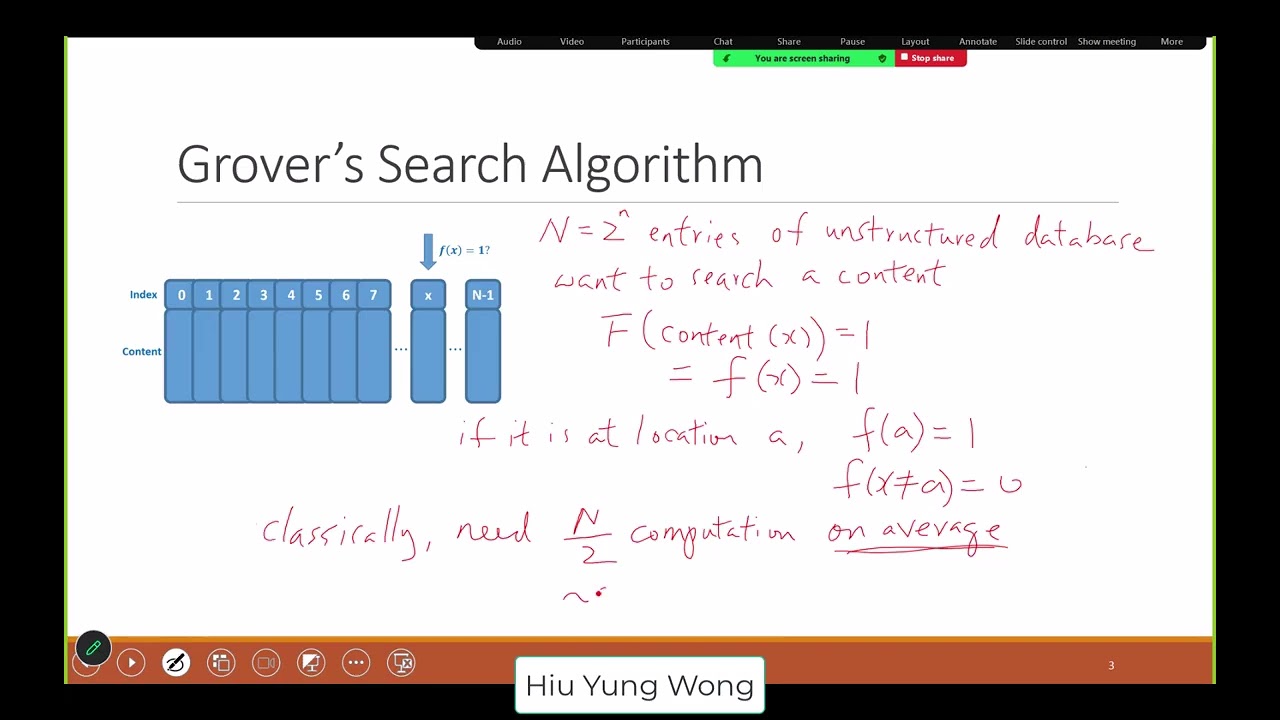
L17 Grover's Algorithm I
Keywords
Summary
128 words
Critical Evaluation
Value of the Information & Strength of the Argument
The lecture provides a clear and methodical explanation of Grover’s algorithm, focusing on conceptual understanding. The argumentation is solid, building from the problem definition to the construction of an example oracle and the mathematical derivation of orthogonal states. The Socratic approach actively questions students, reinforcing understanding. However, it does not deeply explore the full circuit implementation or potential pitfalls beyond the basics.
Scientific Rigor, Source Quality, Title Accuracy
The content is scientifically accurate and well-structured. No external sources are cited within the video, but the instructor likely draws on established quantum computing literature. The title accurately reflects the content, as it is indeed the 17th lecture on Grover’s algorithm. The playlist link in the description indicates this is part of a broader course.
132 words
Title / Content Match
The title exactly matches the content: a lesson on Grover's algorithm.
Quality & Reliability
8/10
The lecture is rigorous, interactive, and explains complex ideas step by step. However, the content is not backed by explicit external references within the video itself.
Key Moments
Markers derived by PSI from the transcript: the creator did not define chapters.
- Introduction to the search problem and classical vs quantum complexity
- Definition of unstructured database and example of oracle construction
- Introduction of three vectors: |a>, |a_perp>, and |ψ> and their properties
- Explanation of phase oracle and the geometric interpretation of operators
- Discussion on embedding the oracle and clarifying misconceptions
Cited Sources
- Course Playlist — Playlist of the Quantum Computing course by Hiu-Yung Wong, of which this video is a part.
Contribution & Novelties
This lecture offers a pedagogical approach that stresses the conceptual difference between the uniform superposition and the state orthogonal to the target, a point often underemphasized in standard texts. It also provides a concrete worked example of an oracle construction. The Socratic questioning helps students identify and resolve common misunderstandings.
Pour aller plus loin :
- Grover’s algorithm — Comprehensive overview of the algorithm and its proof.
- Quantum oracle — Explanation of the oracle model used in quantum algorithms.
- Amplitude amplification — Generalization of Grover’s algorithm to arbitrary amplitudes.
88 words
Radar Profile
The profile shows high scores on quantity and technical level, reflecting a dense and detailed lecture. The fiabilité score is slightly lower due to the absence of explicit external references, but the pedagogical quality is evident.