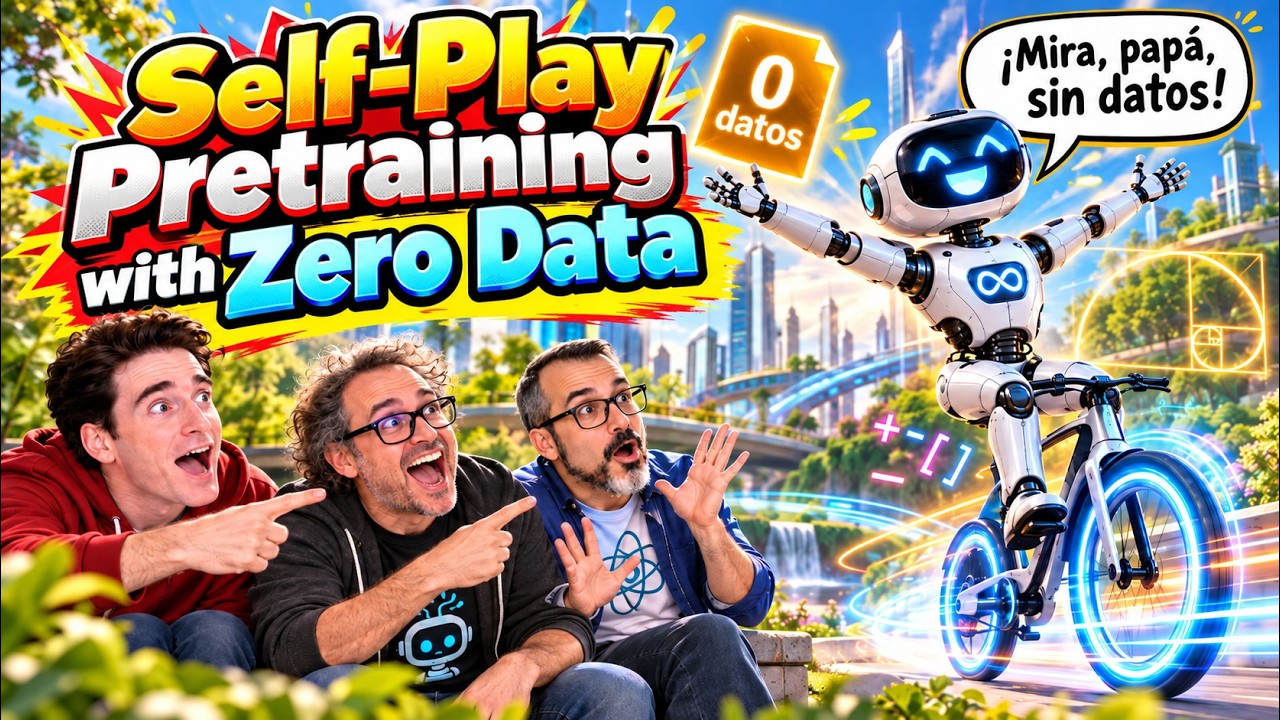
Entrenar modelos de lenguaje sin datos
Training language models with zero data
Keywords
Summary
151 words
Critical Evaluation
Value of the Information & Strength of the Argument
The discussion provides a valuable critical analysis of the paper. The speakers not only describe the method but also probe its underlying logic, such as the rationale for using a custom language that always executes, and the role of gradient alignment in preventing the generator from producing either trivial or random programs. They compare the approach to concepts like GANs and curriculum learning, offering insightful analogies. Their argumentation is solid, acknowledging both the paper’s potential and its limitations, such as small model sizes and empirical scaling law uncertainty. The conversation balances enthusiasm with skepticism, making a compelling case for the paper’s novelty while recognizing open questions.
Scientific Rigor, Source Quality, Title Accuracy
The podcast is scientifically rigorous in its treatment of the paper. It accurately explains technical details, addresses potential misunderstandings (e.g., the difference between gradient usage in GANs and here), and situates the work in the broader context of AI research. The only source cited is the podcast’s website, though the paper itself is naturally the primary reference. The video’s title is consistent with its content. No external data or sources are relied upon beyond the paper and the panelists’ expertise.
201 words
Title / Content Match
The title accurately reflects the video's core topic: training language models without data, which is the paper discussed throughout.
Quality & Reliability
8/10
The podcast thoroughly discusses a recent research paper, explaining its central ideas, experiments, results, and limitations with critical reasoning. The speakers are knowledgeable and provide clear analogies. While the discussion is oral and references few external sources beyond the paper, the scientific content is accurately represented and well contextualized.
Key Moments
Markers derived by PSI from the transcript: the creator did not define chapters.
- Introduction of the paper and thesis: training a model with zero data through self-play.
- Explanation of the setup: two transformers, generator writes programs in a Brainfuck-like language, learner predicts outputs.
- Detailed discussion of the generator's reward mechanism based on gradient alignment and its role in curriculum learning.
- Presentation of key results: transferability to multiple modalities, discovery of Fibonacci sequences, and emergence of in-context learning.
- Limitations: small model sizes and uncertainty about scalability of the empirical scaling laws.
Cited Sources
- La Tertulia de la IA – Podcast website — Official website of the podcast, providing additional information and links.
Concurring Sources
- Self-Play Pretraining with Zero Data (paper) — The research paper discussed in the video, referenced by the hosts, though no direct URL is provided.
Contribution & Novelties
This episode offers an accessible yet deep explanation of a recent paper that challenges the necessity of massive datasets for pretraining language models. The hosts highlight the innovative idea of using gradient alignment to guide data generation, which allows continuous curriculum creation without any natural data. They also emphasize the discovery of universal predictive structures and the model’s ability to generalize to various data types. This contributes to understanding emerging research directions in self-supervised and self-play methods.
Pour aller plus loin :
- Brainfuck — The minimal programming language on which the paper’s custom language is based.
- Self-play (reinforcement learning) — Technique used in games like AlphaGo, analogous to the generator-learner interaction.
- Curriculum learning — A method of gradually increasing task difficulty, directly relevant to the adaptive curriculum approach.
128 words
Radar Profile
The scores suggest a well-rounded presentation: good quantity and quality of information, with a solid technical level. The reliability score aligns with a critical discussion of a novel paper, indicating both enthusiasm and cautious skepticism.