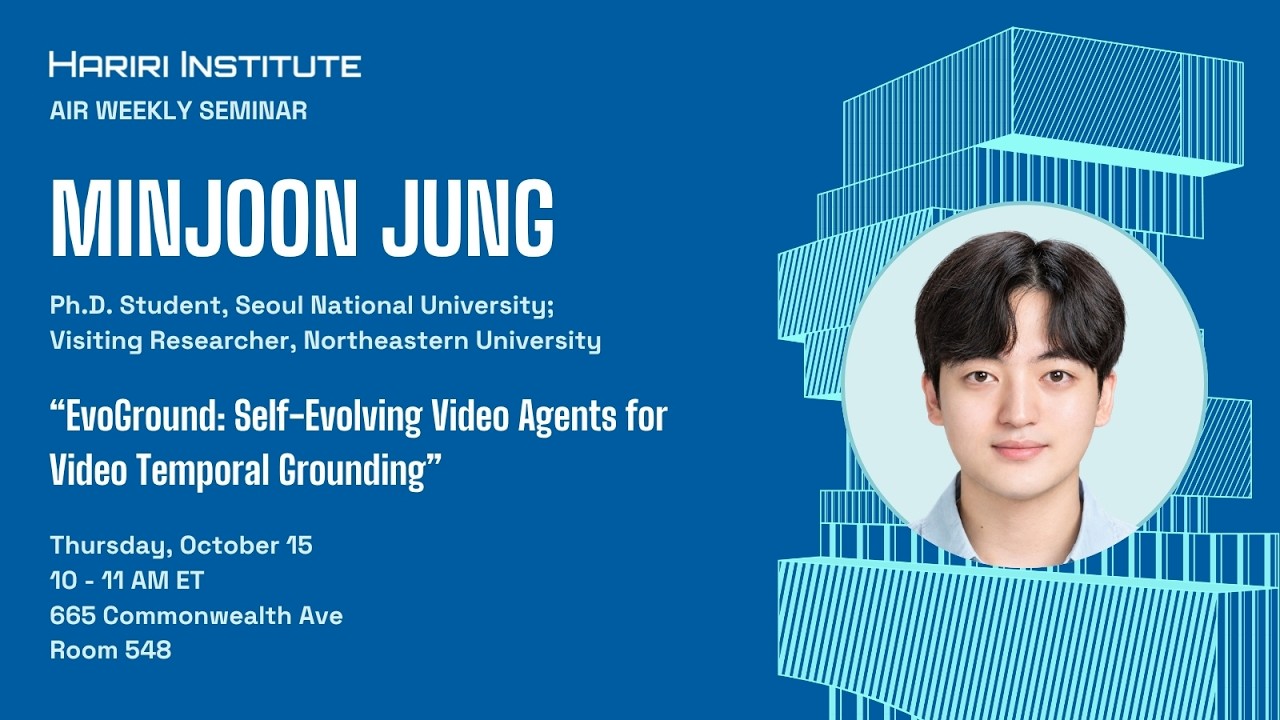
AIR Seminar with Minjoon Jung | Hariri Institute | Boston University
Keywords
Summary
153 words
Critical Evaluation
Value of the Information & Strength of the Argument
The talk provides a valuable contribution by addressing the high cost of temporal annotations in video understanding with a self-evolving loop that leverages two agents. The argumentation is systematic: each design choice is motivated (e.g., why three rewards, why GDPO), and validated through experiments and distribution analyses. The authors show that deleting one reward changes generated data distribution and performance, supporting complementarity. They also distinguish between generating valid pairs versus meaningful pairs, using a curriculum to increase difficulty. The comparison of GRPO and GDPO is insightful, demonstrating that reward normalization order matters. However, claims are appropriately scoped (e.g., ’evidence for our optimization choice’ rather than universal superiority). The analysis of training dynamics and data efficiency strengthens the paper’s impact. Minor limitation: the evaluation relies on five benchmarks, but generalizability beyond those is not demonstrated.
Scientific Rigor, Source Quality, Title Accuracy
The title precisely captures the talk’s focus on EvoGround for video temporal grounding. The presentation is rigorous: it provides mathematical formulations for rewards, explains the algorithmic loop clearly, and includes quantitative results with appropriate caveats. The speaker references prior work implicitly (e.g., base models like Qwen2.5) but does not list explicit sources in the transcript; however, the host introduces the speaker’s background, which adds credibility. The watchable format includes audience Q&A that clarifies ambiguities, enhancing transparency. The description provides a link to the Hariri Institute events page, which serves as a resource for further context. No external sources are cited beyond this, but the depth of technical detail likely relies on a corresponding paper. Overall, the rigor is high, and the title accurately reflects the content.
275 words
Title / Content Match
The title accurately reflects the content: a research seminar on EvoGround for video temporal grounding.
Quality & Reliability
8/10
Academic seminar presenting original research with detailed methodology, empirical results, and open Q&A. The approach is technically sound, but limited by the specific experimental setup and lack of external peer-review evidence in the video.
Key Moments
Markers derived by PSI from the transcript: the creator did not define chapters.
- Introduction to research interests: video understanding and temporal reasoning.
- Problem statement: annotation cost for temporal grounding.
- Overview of EvoGround: two agents (proposer and solver) and the interaction loop.
- Detailed explanation of three rewards: format, consistency, and feedback.
- Optimization choice: comparison of GRPO and GDPO, and the rationale for GDPO.
- Training dynamics: curriculum with increasing threshold and reward evolution over iterations.
- Results on five temporal grounding benchmarks and comparison with supervised methods.
- Fine-grained video captioning results and analysis of driving factors.
- Q&A: clarifications on conditioning, groups, and moment overlap.
Cited Sources
- Hariri Institute for Computing Events — Event page for the seminar series, including this talk.
Contribution & Novelties
The main contribution is the self-evolving framework EvoGround that bypasses manual temporal annotations by alternating between two agents with complementary roles. The design of three distinct rewards and the use of GDPO for stable multi-reward optimization are novel. The talk provides empirical evidence on five benchmarks and analytical insights into how each reward shapes generated data. This reduces reliance on expensive annotation and demonstrates that strong temporal grounding can be achieved with minimal labeled data.
Pour aller plus loin :
- Reinforcement Learning — Fundamental background for the optimization methods used in EvoGround.
- Video Understanding — Broad field covering tasks like temporal grounding, which this work advances.
- GRPO and GDPO — These specific algorithms are not widely covered on Wikipedia; they are part of recent RL literature (e.g., DeepSeekMath for GRPO). Without confirmed URLs, we omit links but note their relevance.
140 words
Radar Profile
The radar profile is balanced with high scores across all dimensions, reflecting a technically deep presentation with abundant information and strong reliability. The slight dip in fiabilite_globale compared to qualite_information suggests that while the content is high-quality, the lack of externally verified sources in the video slightly tempers confidence.