AI for Materials Discovery | Konstantin Novoselov | ADIA Lab Symposium 2026
Title history
- AI for Materials Discovery | Konstantin Novoselov | ADIA Lab Symposium 2026 — observed on 20261104-0952 UTC (YouTube)
Keywords
Summary
216 words
Critical Evaluation
Value of the Information & Strength of the Argument
The talk’s value lies in its insider perspective from a leading researcher who has personally witnessed the full material-development cycle, from fundamental discovery through hype and denial to real industrial deployment. The argumentation is structured and empirical: each domain (transport, energy, infrastructure, electronics) is anchored in concrete quantified examples — 10-15% conductivity gains in super-copper, 1 kg/year graphene needed for all global touch panels, 20-50% concrete strength improvements. The reasoning builds logically from material production challenges to the epistemological limits of current AI databases, and culminates in a well-argued proposal to invert the predictive paradigm from structure-property to synthesis-property mapping. The boron nitride example provides compelling experimental evidence for the complexity this inversion entails. Throughout, the speaker maintains intellectual honesty about what remains unsolved, explicitly stating ‘we haven’t done any discovery yet,’ which strengthens credibility.
Scientific Rigor, Source Quality, Title Accuracy
The scientific rigor is high, reflecting the speaker’s Nobel-level expertise and direct laboratory involvement. The discussion of AI limitations is unusually candid for a keynote, acknowledging that existing databases are inadequate for real-world materials (steels, alloys, defects) and that synthesis remains a fundamental bottleneck. However, few explicit citations to specific papers are provided during the talk, and quantitative claims — while plausible and aligned with known literature — are presented without named references or data tables. The title adequately matches the content, which centers on AI for materials discovery with graphene as the illustrative thread. No comments were available for analysis.
251 words
Title / Content Match
The title accurately reflects the content: the lecture focuses on AI-driven materials discovery, using graphene and 2D materials as primary case studies.
Quality & Reliability
8/10
Nobel laureate in Physics (2010) with direct research experience, presenting a balanced, honest perspective on both successes and limitations of AI for materials discovery. Claims are grounded in laboratory experience, though some quantitative assertions (e.g., concrete strength gains) lack explicit citation to specific studies during the talk.
Key Moments
Markers derived by PSI from the transcript: the creator did not define chapters.
- Graphene introduction: structure, record properties, and the hype cycle from gimmick applications (e.g., $1M McLaren watch) to serious industrial use.
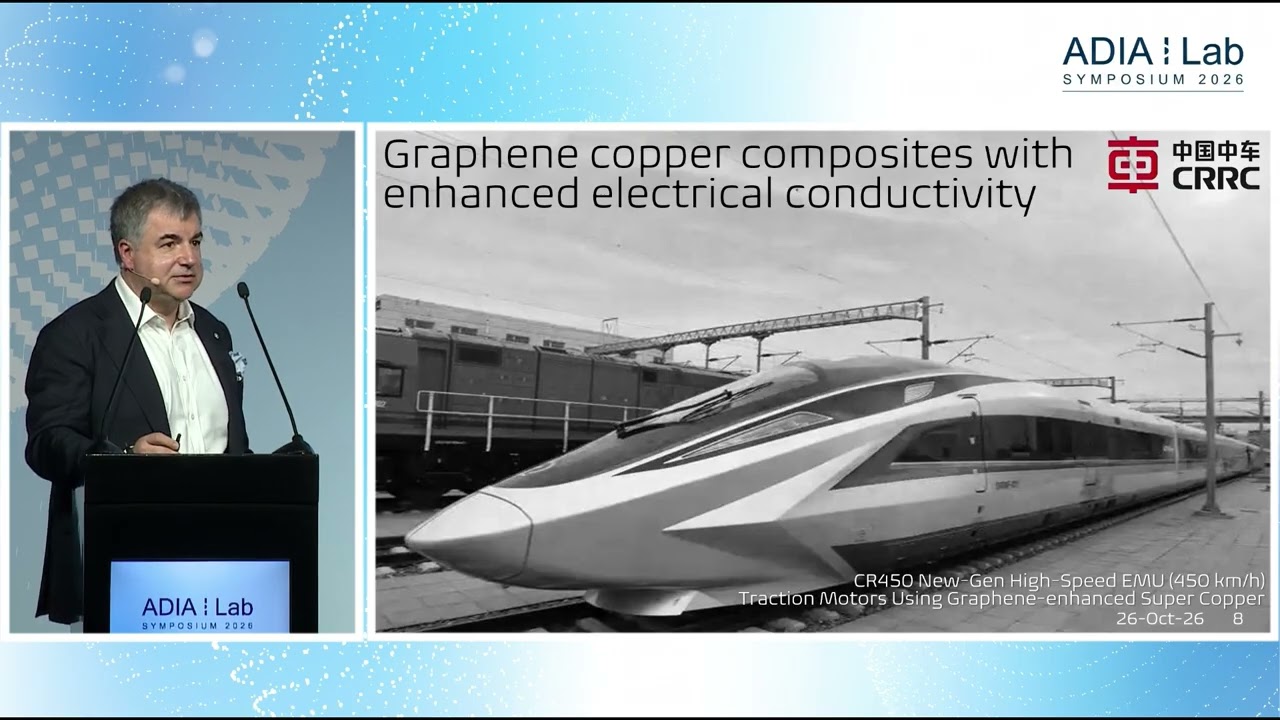
- Super copper with graphene additives: 10-15% conductivity increase enabling 4-5% efficiency gains in Chinese maglev train electric motors.
- Optronics as the promising future: optical interconnects, optical compute, and quantum optics; three graphene-silicon fabs under construction in Europe.
- Production methods: CVD and plasma technology; proposal to capture hydrocarbon flaring gas from petrochemical plants for graphene and hydrogen production.
- Remarkable scale fact: replacing all touch panels worldwide requires only 1 kg of graphene per year, motivating bulk applications in concrete and asphalt.
- Graphene composites: 0.5% graphene in concrete boosts compressive strength 20-50%, asphalt lifespan doubles, and concrete batteries for energy storage.
- Core AI challenges: databases contain only ideal equilibrium materials, missing real-world complexity of steels, alloys, defects and nanostructures.
- Boron nitride synthesis case: 33-dimensional reaction coordinate space, mapping intermediates and reaction pathways to enable targeted synthesis control.
- Knowledge-tree approach to hypothesis generation for high-entropy alloys and spin glasses; honest admission that no discovery has yet been achieved.
Cited Sources
- ADIA Lab Symposium 2026 — Official symposium page mentioning the event schedule, speakers, and the session in which this talk was presented (Expert Case Study - Day 1: Prediction).
Concurring Sources
- Graphene — Wikipedia — Corroborates the described properties (strength, conductivity, thermal management) and applications of graphene mentioned in the talk.
- Chemical vapor deposition — Wikipedia — Confirms the CVD method described by the speaker for large-scale graphene production.
Contribution & Novelties
The talk’s original contribution is its practitioner-level honest assessment of AI’s current limits in materials science, combined with a concrete proposal to reframe predictive models from structure-property to synthesis-property relationships. The reaction-network approach applied to boron nitride synthesis — treated as a navigable knowledge tree — offers a distinctive methodological perspective on hypothesis generation. The starkly quantified scale mismatch (1 kg of graphene per year for all global touch panels) provides a memorable illustration of the commercialization challenge facing 2D materials.
Pour aller plus loin :
- Graphene — Thorough background on the discovery, properties, and applications of the material central to this talk.
- Monolayer materials — Expanded context on the family of 2D materials (including MoS₂ and boron nitride) referenced as alternatives to graphene.
- High-entropy alloys — The complex alloy class discussed as a target for AI-driven materials design.
- Materials informatics — Domain connecting machine learning to materials discovery, relevant to the AI methodology presented.
155 words
Radar Profile
The radar shows high reliability (9) and strong information quality (8), reflecting the speaker's expert credentials and honest presentation, with somewhat lower technical level (7) due to the broad, accessible style aimed at a mixed symposium audience. Information quantity (8) is solid, though the breadth prevents deep dives into any single subtopic.