JFDS Award Ceremony & Research Collaborations - Presentations | ADIA Lab Symposium 2026
Title history
- JFDS Award Ceremony & Research Collaborations - Presentations | ADIA Lab Symposium 2026 — observed on 20261105-1151 UTC (YouTube)
Keywords
Summary
153 words
Critical Evaluation
Value of the Information & Strength of the Argument
The video provides substantial value by showcasing cutting-edge research in financial data science, particularly the award-winning work on interpretable AI models. The presentations are well-argued, with the third-place paper offering empirical evidence (e.g., 7–8 percentage point gains in explanatory power) for their graph-constrained approach. The research collaboration updates are equally compelling, presenting clear research questions and expected contributions. The argumentation is rigorous, relying on peer-reviewed papers and expert testimony, though the video does not delve into potential limitations or critiques.
Scientific Rigor, Source Quality, Title Accuracy
The sources are credible, drawn from peer-reviewed journals and institutional research. The video itself is a presentation of original research, and the speakers are recognized experts. The title ‘JFDS Award Ceremony & Research Collaborations - Presentations’ matches the content precisely. However, since no external references are provided beyond the symposium link, the rigor is high but relies on the reputation of the speakers and the journal. The adéquation between title and content is exact, with no misleading elements.
173 words
Title / Content Match
The title accurately reflects the content: the video covers the award ceremony and presentations of research collaborations.
Quality & Reliability
8/10
The content is presented by leading experts and reflects peer-reviewed research, but there is no external verification of the claims in this video.
Key Moments
Markers derived by PSI from the transcript: the creator did not define chapters.
- Opening and introduction to the ADIA Lab Financial Data Science Award.
- Announcement of the three winning papers and their authors.
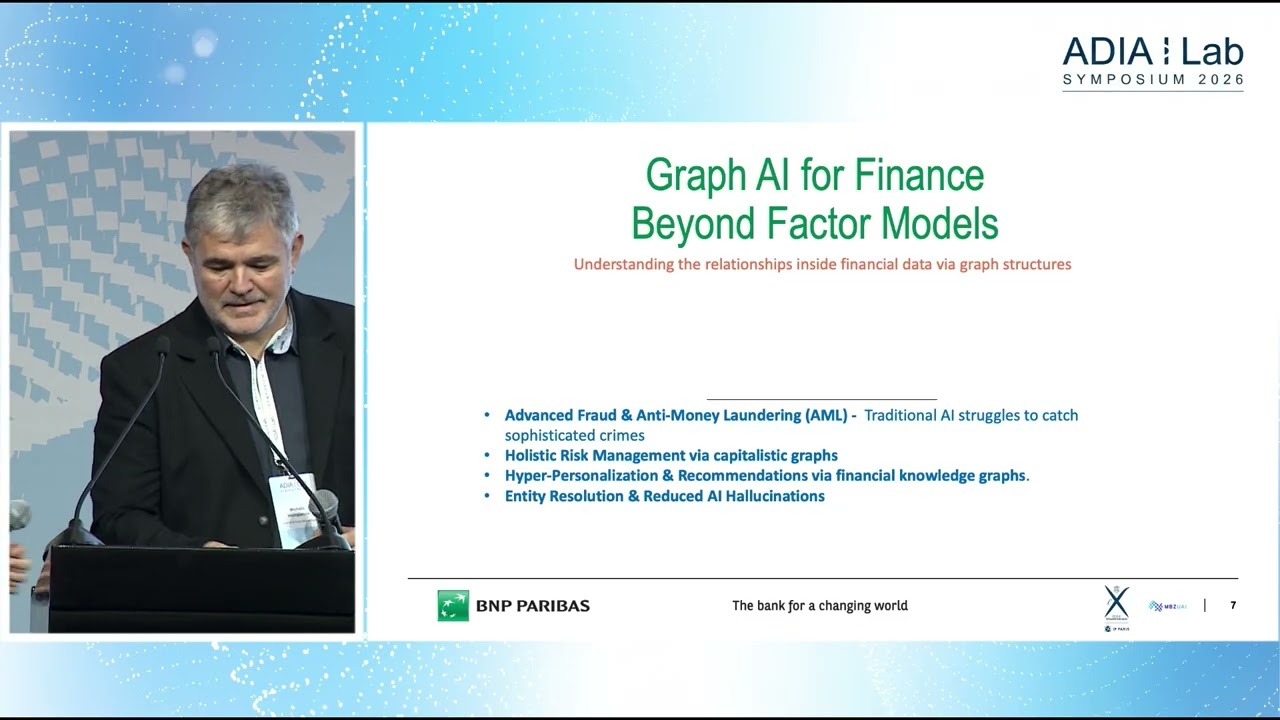
- Presentation by the third-place team on graph-based factor models for credit spreads.
- Introduction of four new research collaborations.
- Presentation of the 'Safir' project on autonomous financial agents by Professor Davor Svetinović.
- Presentation on global economic networks by Professor Jean Imbs and Aaron Kofman.
Cited Sources
- ADIA Lab Symposium 2026 — Official symposium page with agenda and event information.
Contribution & Novelties
The video presents several novel contributions: the award-winning paper ‘The Virtue of Transparency’ discusses how to maximize utility of data without overfitting, emphasizing the need for explainable AI in finance. The third-place paper introduces graph-based factor models that embed financial knowledge into autoencoders, leading to interpretable and robust credit spread decomposition. Additionally, the new research collaborations propose innovative frameworks, such as the ‘Safir’ control plane for verified autonomous agents and a multiplex network model of the global economy. These initiatives push the boundaries of applying AI and network theory to finance.
Pour aller plus loin :
- Graph neural network — Directly relevant to the graph-based factor models discussed; explains how graphs enhance learning on relational data.
- Autoencoder — Core technology behind the compression and reconstruction in the factor models; useful for understanding the method.
- Multiplex network — Relevant to the multi-layered global economic network research proposed by NYU.
- Autonomous agent — Fundamental concept underlying the Safir project on autonomous financial agents.
161 words
Radar Profile
The profile shows high scores on information quantity, quality, and technical level, indicating a densely packed, expert-driven presentation. The slightly lower fiability score reflects the lack of external verification, but overall the radar is balanced and skewed toward strong technical content.