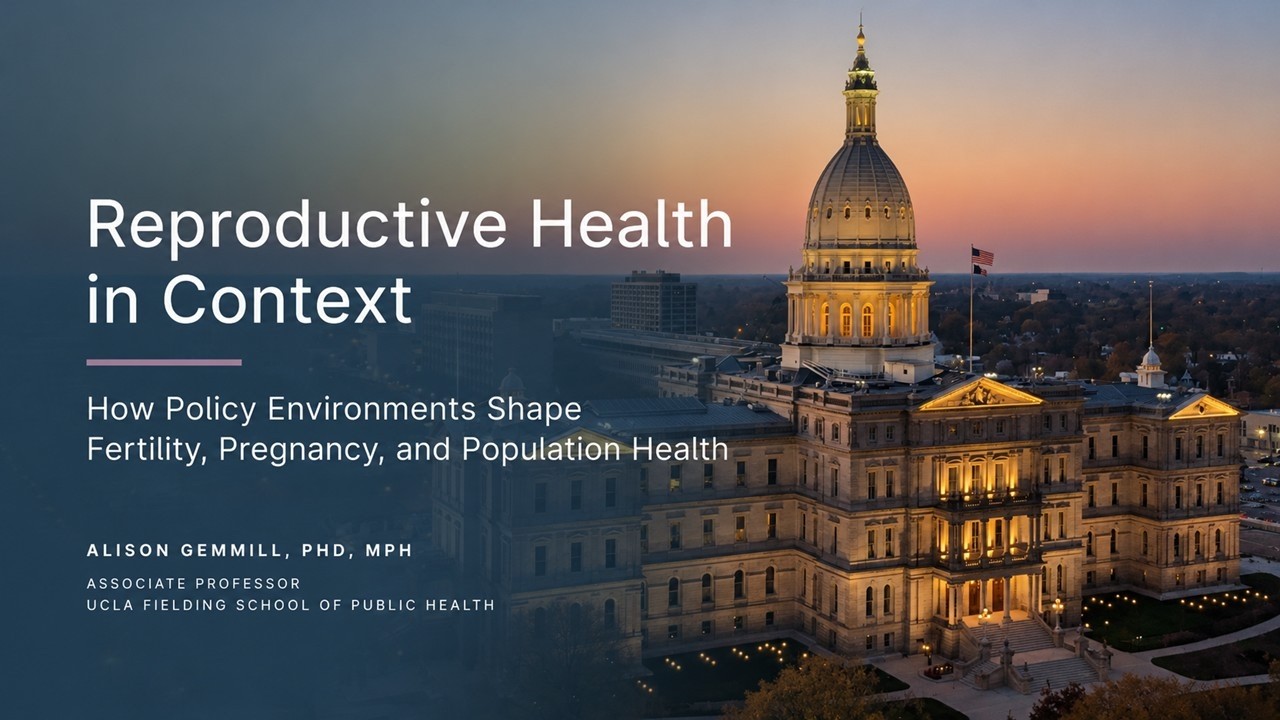
Claudia Holzman Seminar in Women's and Reproductive Health - Alison Gemmill, PhD
Title history
- Claudia Holzman Seminar in Women's and Reproductive Health - Alison Gemmill, PhD — observed on 20261025-1505 UTC (YouTube)
Keywords
Summary
143 words
Critical Evaluation
Value of the Information & Strength of the Argument
The presentation provides strong empirical evidence linking abortion bans to adverse health outcomes. The speaker systematically reviews fertility and infant mortality data, using quasi-experimental methods (difference-in-differences) and comparing across states. She acknowledges limitations, such as the rarity of outcomes and difficulties in causal inference, which strengthens the credibility. The argumentation is well-structured, moving from macro-level life expectancy to specific maternal outcomes, and consistently ties findings to sociological and health equity frameworks.
Scientific Rigor, Source Quality, Title Accuracy
The speaker cites peer-reviewed publications (Montez et al. in Milbank Quarterly), journalistic sources (NPR, ProPublica), and mentions funding from NIH and the Society of Family Planning. She transparently notes data limitations and the need for better surveillance. The title accurately reflects the seminar’s focus on women’s and reproductive health, though it does not specify the policy angle. No comments were provided, so public reception cannot be assessed.
153 words
Title / Content Match
Le titre reflète fidèlement le contenu : un séminaire académique présentant les recherches d'Alison Gemmill sur la santé reproductive.
Quality & Reliability
8/10
Presentation by a researcher of her peer-reviewed studies, with references to established institutions like Milbank Quarterly, NPR, and ProPublica. The content is highly policy-relevant and based on rigorous epidemiological methods, though the seminar itself is not peer-reviewed.
Key Moments
Markers derived by PSI from the transcript: the creator did not define chapters.
- Introduction and overview of state policy effects on reproductive health
- Life expectancy divergence across states, citing Karas Montez research
- Background on abortion bans: Texas SB8 and Dobbs decision
- Mechanisms linking abortion bans to infant mortality: fatal fetal anomalies and care denial
- Fertility findings: 1.7% increase and disproportionate impact on disadvantaged groups
- Infant mortality findings: 5.6% increase, 478 excess deaths, racial disparities
- Maternal health evidence: sepsis and blood transfusions increase in Texas
- Discussion of broader policy environment and COVID-19 as natural experiment
Cited Sources
- Montez et al. (2019) - US State Policy Contexts and Population Health — Referenced for showing that state policies like cigarette taxes and firearm laws correlate with life expectancy divergence.
- NPR article on fatal fetal anomaly case — Cited to illustrate the trauma caused by abortion bans when a fetus is diagnosed with anencephaly.
- ProPublica investigations on maternal health — Collaboration on hospitalization data showing increases in sepsis and blood transfusions in Texas.
Contribution & Novelties
The talk provides novel quantitative evidence quantifying the population-level health impacts of abortion bans, particularly on infant mortality and disparities. It combines multiple data sources and highlights rare outcomes often overlooked. The presentation also emphasizes the need for more comprehensive surveillance systems.
Pour aller plus loin :
- Dobbs v. Jackson Women’s Health Organization — Context of the Supreme Court decision.
- Maternal mortality in the United States — Overview of maternal death trends and challenges.
- Senate Bill 8 (Texas) — The first abortion ban in Texas.
85 words
Radar Profile
The radar profile shows a high, balanced performance across all axes, with slightly lower scores on information quantity due to the focused scope. The content is well-rounded, combining technical rigor with practical implications.