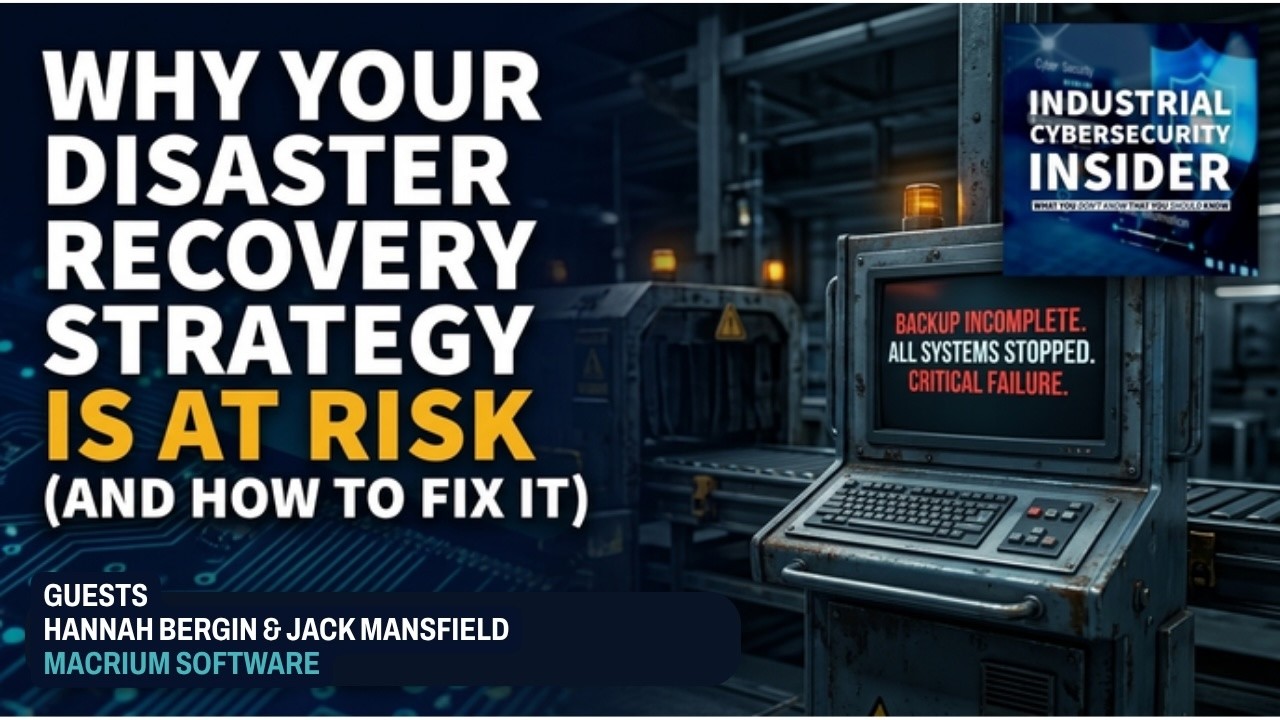
Why Your Disaster Recovery Strategy Is At Risk (And How to Fix It)
Title history
- Why Your Disaster Recovery Strategy Is At Risk (And How to Fix It) — observed on 20261105-2136 UTC (YouTube)
Keywords
Summary
149 words
Critical Evaluation
Value of the Information & Strength of the Argument
The value of this episode lies in its practical focus on a frequently overlooked aspect of OT security—disaster recovery. The speakers successfully argue that untested backups are insufficient and that recovery processes must be designed, documented, and practised. They provide concrete examples of legacy system fragility and the need for on-premises solutions in air-gapped environments. The argumentation is coherent and grounded in real-world experience with industrial customers, which strengthens its credibility. However, the perspective is inherently promotional for Macrium Software, and some claims about the product’s superiority are not independently verified. The discussion could benefit from more specific metrics or case studies, but it offers a solid conceptual framework for understanding OT backup and recovery.
Scientific Rigor, Source Quality, Title Accuracy
The title accurately conveys the content, which addresses risks in disaster recovery strategies and offers corrective measures. The sources mentioned are primarily the speakers’ professional experiences and references to industry incidents like the France supermarket disruption and Jaguar Land Rover. No external research studies or standards are explicitly cited, which limits the scientific rigour. The conversation is more of an expert opinion than a systematic literature review. The lack of citations is partially compensated by the practical depth of the discussion. The adéquation between title and content is good, with no significant mismatch.
223 words
Title / Content Match
The title accurately reflects the content: it addresses risks in disaster recovery strategies and offers solutions, focusing on industrial environments.
Quality & Reliability
7/10
The discussion provides practical insight into OT backup and recovery challenges, but it is presented by vendor representatives from Macrium Software, which introduces potential bias. Despite this, the advice is technically sound and aligns with industry best practices.
Key Moments
Markers derived by PSI from the transcript: the creator did not define chapters.
- Introduction to the episode and the 'set and forget' backup problem.
- Macrium Software's focus on backup and recovery for industrial systems, supporting legacy Windows versions.
- On-premises backup solutions for isolated OT networks, including offline activation.
- Discussion on backup retention policies and recovery point objectives (RPO).
- Building a disaster recovery program with documentation and training.
- Balancing plant-level control with enterprise oversight and compliance requirements.
- Recovery by design: integrating backup and recovery into OEM and integrator system designs.
- Funding OT security through capital projects and the importance of legacy system management.
- Testing recovery before disruption, emphasizing that hope is not a strategy.
Contribution & Novelties
This episode brings attention to the ‘recovery by design’ concept, emphasizing that backup and recovery should be integrated into system architecture from the start. It also highlights the gap between IT and OT priorities, and the necessity of considering legacy systems that are often neglected. The discussion offers a vendor’s perspective on how to approach backup and recovery in isolated OT environments, which is a niche but critical topic.
Pour aller plus loin :
- Disaster recovery — Key concept of planning and recovery processes.
- Operational technology — Background on OT environments and their unique security needs.
- IEC 62443 — Standard for industrial cyber security, relevant to recovery guidelines.
108 words
Radar Profile
The profile shows high scores in information quantity and technical level, indicating a rich and specialized discussion. The lower reliability score reflects the vendor-centric perspective and lack of external citations, while the moderate quality score suggests an informative but subjective narrative.