CS 471/671 (How to grow language models) - #17 - Fall 2026
Title history
- CS 471/671 (How to grow language models) - #17 - Fall 2026 — observed on 20261105-2038 UTC (YouTube)
Keywords
Summary
137 words
Critical Evaluation
Value of the Information & Strength of the Argument
The lecture provides valuable practical guidance on hyperparameter selection and training strategies, grounded in empirical observations and industry practices. The argumentation is solid, with clear explanations of trade-offs and connections to research findings. The use of concrete examples (e.g., DeepSeek’s batch size recommendations, BERT’s 40 epochs) strengthens the credibility of the points made. The instructor encourages student interaction and clarifies concepts with code snippets, making the content accessible while maintaining technical depth.
Scientific Rigor, Source Quality, Title Accuracy
The scientific rigor is high, as the content aligns with current best practices in NLP training. Sources mentioned include the DeepSeek paper and BERT, though detailed citations are not provided in the lecture itself; the course website link is given in the description. The title accurately reflects the lecture’s focus on growing language models, and the structure follows a logical progression from pre-training considerations to adaptation.
153 words
Title / Content Match
The title accurately reflects the course content, which focuses on practical aspects of training large language models, consistent with the course name and lecture number.
Quality & Reliability
8/10
Lecture content is based on established practices and includes references to industry papers (DeepSeek, BERT), with practical PyTorch code examples. The presentation is clear and incorporates empirical observations, but lacks formal citations within the talk beyond a few named papers.
Key Moments
Markers derived by PSI from the transcript: the creator did not define chapters.
- Introduction to batch size selection and critical batch size concept
- Explanation of gradient accumulation with PyTorch pseudo-code
- Distributed gradient accumulation and all-reduce operation
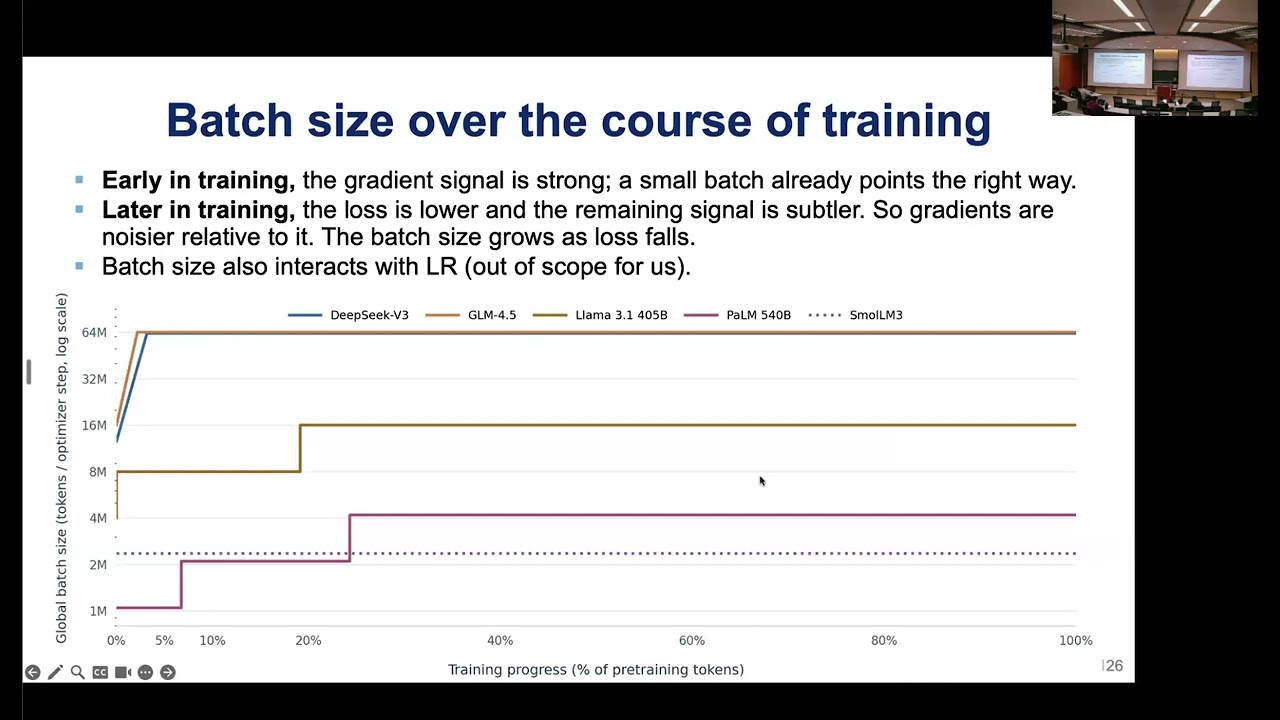
- Analysis of effective batch size trends and DeepSeek recommendations
- Packing technique to reduce compute waste and document masking
- Discussion on epochs and training multiple passes over data
- Training stability and mystery spikes, anecdote about 'm' characters
- Monitoring downstream task performance via next-token prediction
- Transition to adaptation, definition of task and supervised fine-tuning
Cited Sources
- Course website for CS 471/671 — Course materials and further resources linked in video description
Concurring Sources
- DeepSeek LLM paper — The lecture references DeepSeek's recommendations for batch size and learning rates based on training budget.
- BERT paper — BERT is cited as an outlier with 40 epochs, illustrating the interplay of compute and data.
Contribution & Novelties
The lecture provides a comprehensive and practical overview of common practices in training large language models, with particular emphasis on gradient accumulation and packing techniques that are often underexplained in academic contexts. The inclusion of real-world examples like DeepSeek’s batch size recommendations and the anecdote of unusual training data spikes adds valuable insight. For further exploration, one can look into scaling laws, mixture-of-experts models, and advanced fine-tuning methods.
Pour aller plus loin :
- Scaling Laws for Neural Language Models — Foundational paper on scaling behavior of language models, relevant to batch size and compute trade-offs.
- Mixture of Experts Explained — Overview of MoE models, which are mentioned in the lecture as using larger batch sizes.
- Gradient Accumulation in PyTorch — Official PyTorch documentation on gradient accumulation, relevant to the code discussed.
131 words
Radar Profile
The radar profile shows high scores across all dimensions, indicating a well-rounded lecture with strong information content, technical depth, and reliability. The balance between theoretical explanation and practical advice is excellent.