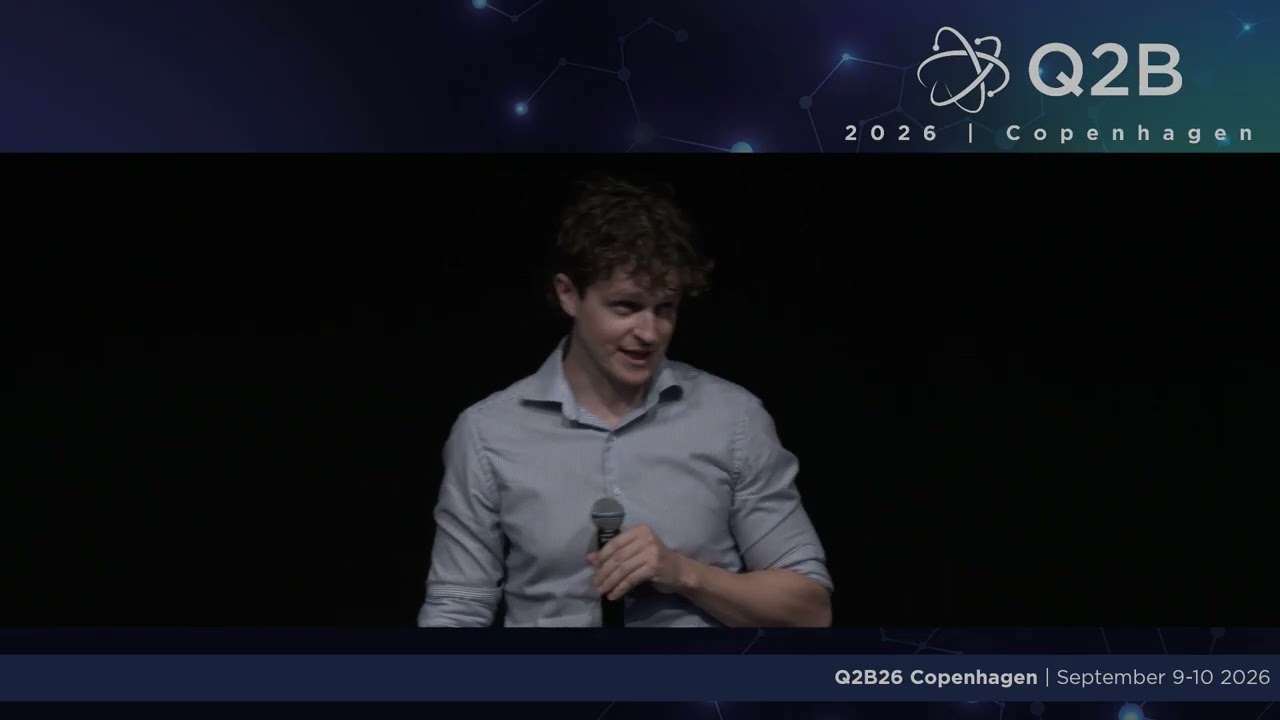
Q2B26 Copenhagen | Chayma Faraji & Pater Davis
Keywords
Summary
172 words
Critical Evaluation
Value of the Information & Strength of the Argument
The talk provides valuable insights into the African quantum community’s perspective and the practical barriers to access, a topic underrepresented in mainstream discussions. The argument for capacity-building before capital is well-articulated and reinforced by community testimonials. However, the argumentation relies more on anecdotal evidence and a preliminary survey than on rigorous data, and the survey’s small sample size (55 responses) limits generalizability. The presentation is persuasive but could be strengthened by more comprehensive evidence.
Scientific Rigor, Source Quality, Title Accuracy
Scientific rigor is moderate: the speakers reference credible legal frameworks (Wassenaar Arrangement, UN Declaration) and original survey data, but the data is preliminary and the talk is advocacy-oriented. The description provides only one link (the conference page), which is insufficient for verifying specific claims. The title is accurate but not descriptive of the content, focusing on names rather than subject. No comments were provided for analysis.
155 words
Title / Content Match
The title correctly identifies the speakers and event, but it does not hint at the substance (Africa's quantum ecosystem approach). It is functional but generic.
Quality & Reliability
6/10
The talk presents a clear advocacy for Africa's role in quantum computing, supported by preliminary survey data (55 responses from 1600 members) and references to established legal frameworks. However, the sample is small and the presentation is more persuasive than rigorously analytical.
Key Moments
Markers derived by PSI from the transcript: the creator did not define chapters.
- Introduction: Denmark's history as a model for Africa's approach
- Community voices: testimonies from students and researchers across Africa
- What the community does: policy groups, post-quantum security, Friday calls
- Peter Davis on export control laws and Wassenaar Arrangement
- Survey results: awareness and access barriers for African researchers
- Conclusion: partnership proposal and call to action
Cited Sources
- Q2B Conference — Official conference website where this talk was presented
Contribution & Novelties
This talk highlights Africa’s community-first approach to quantum technology, offering a perspective rarely heard in mainstream quantum forums. It also provides preliminary data on access barriers, which is a novel contribution.
Pour aller plus loin :
- Wassenaar Arrangement — The export control regime mentioned by Davis, critical for understanding quantum tech governance.
- Universal Declaration of Human Rights — Cited in the talk regarding the right to participate in scientific advancement.
- African Quantum Consortium — Not directly cited but relevant to the community discussed (URL uncertain, check reliability).
87 words
Radar Profile
The profile shows a balanced but low-to-moderate performance across metrics, with the strongest scores in information quality and reliability, reflecting the expert insights and legal background, while quantity and technical depth are moderate due to the advocacy focus. The talk is more impactful in raising awareness than in providing deep technical or statistical depth.