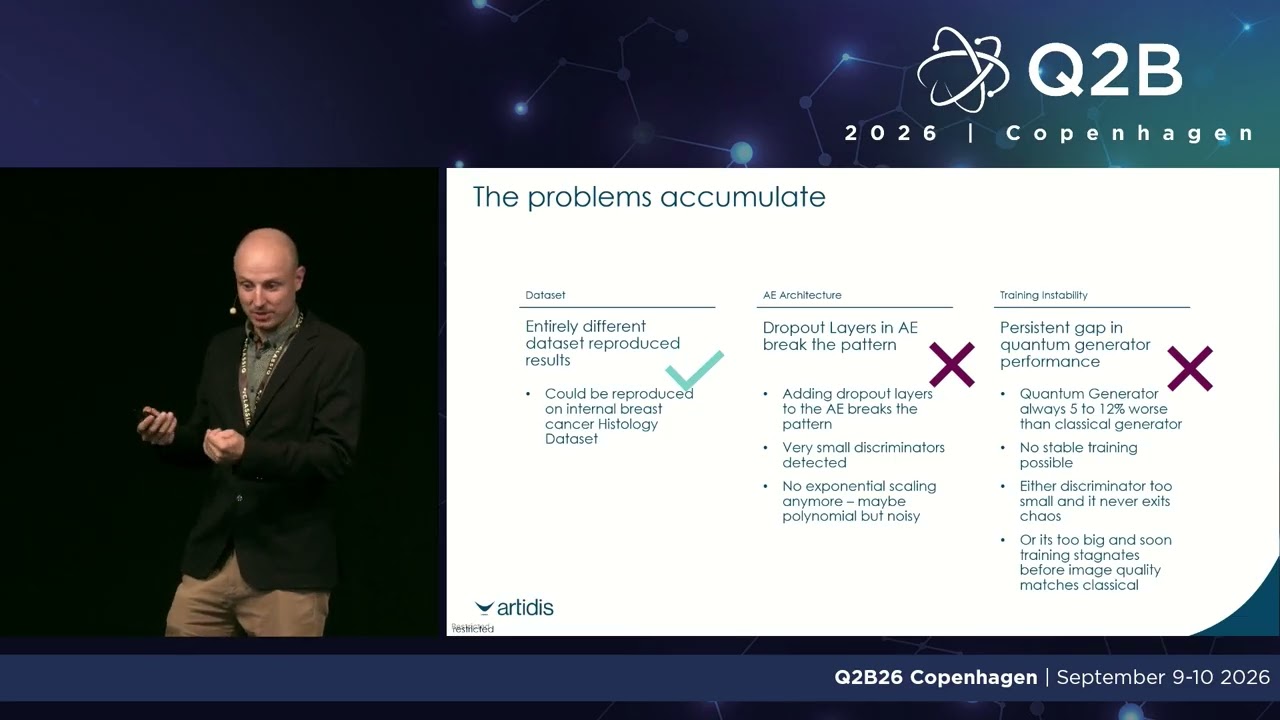
Q2B26 Copenhagen | Milan Liepelt, New Technologies Development Lead, ARTIDIS
Keywords
Summary
173 words
Critical Evaluation
Value of the Information & Strength of the Argument
The talk provides a well-structured narrative with empirical evidence. The initial surprising result is rigorously tested and eventually explained through a theoretical framework. The reasoning is logical: from observation of exponential scaling to hypothesis about spectral bias, then to validation via bandwidth measurement and successful interventions. The argument is convincing because it alternates between experiments and theoretical interpretation, and the interventions demonstrably fix the training issues. The presentation is clear and the scientific method is applied appropriately.
Scientific Rigor, Source Quality, Title Accuracy
The speaker cites two key sources: a paper from CERN for the GAN architecture and a paper on spectral amplitude principles, though specific references are not fully given. The description includes a link to the Q2B conference website as a supplementary resource. The title is functional but lacks descriptive detail; the description provides a better summary. The talk is presented at a professional conference, indicating a certain level of scrutiny, but it is not peer-reviewed. The methodology appears rigorous, with repeated experiments and careful controls, though the description of the experiments could be more detailed.
187 words
Title / Content Match
The title accurately identifies the speaker, event, and topic, while the description provides a more specific subtitle about the content.
Quality & Reliability
8/10
The talk presents original experimental results with reproducible evidence, though it is not peer-reviewed. The methodology is transparent and the reasoning from spectral bias principles to interventions is sound. Minor limitations include the lack of full references to cited papers.
Key Moments
Markers derived by PSI from the transcript: the creator did not define chapters.
- Introduction and company presentation of ARTIDIS
- Motivation for quantum data augmentation and description of the GAN architecture
- Experiments showing exponential scaling of discriminator size with quantum generator
- Failure to reproduce result with new autoencoder; persistent performance gap identified
- Discovery of spectral bias principle and explanation of the mismatch
- Measurement of discriminator bandwidth and first intervention (small discriminator trained longer)
- Second intervention using random Fourier features to avoid spectral bias
- Conclusion: quantum GANs promising for spectrally hard data; future directions
Cited Sources
- Q2B Conference website — Official conference page for Q2B26 Copenhagen
- CERN paper on autoencoder-based GAN — Architecture for the hybrid quantum GAN was first published from CERN, as mentioned in the talk
- Spectral amplitude principles for dynamics of quantum neural networks — Paper that provides the theoretical basis for the observed spectral mismatch
Contribution & Novelties
The talk offers an original contribution by connecting spectral bias theory to the practical challenge of stabilizing quantum GAN training. It provides empirical evidence that the mismatch between classical and quantum training principles can be exploited to design better hybrid models. The proposed interventions (carefully sized and trained discriminators, random Fourier features) are practical and potentially transferable. The work also suggests that quantum generators are particularly suited for data with large spectral bandwidth, which is an open question.
Pour aller plus loin :
- Quantum machine learning — Discusses the broader field and challenges.
- Generative adversarial network — Foundational concept for GANs.
- Spectral bias in neural networks — Overview of the phenomenon central to the talk.
- Parameterized quantum circuit — The architecture used for the quantum generator.
126 words
Radar Profile
The radar profile shows high technical level and reliability relative to the moderate amount of information, indicating a dense, specialized presentation with strong methodological grounding.