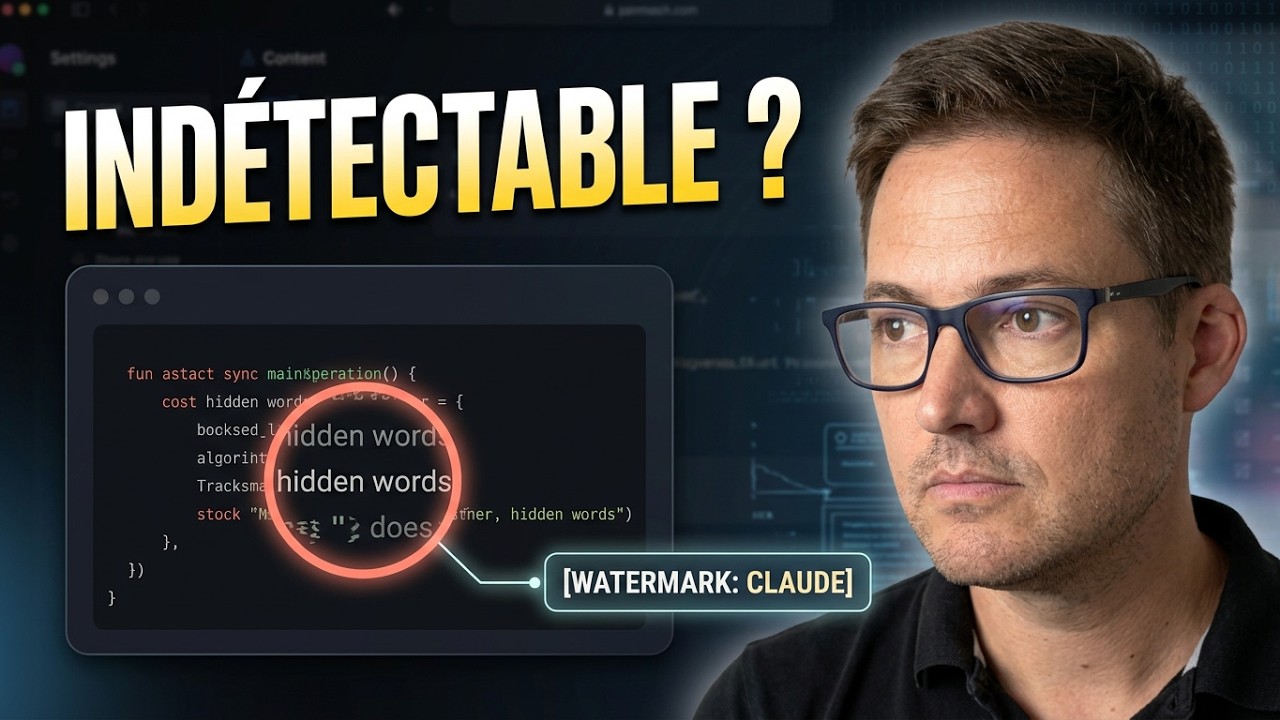
Watermark Claude : ce que ça change vraiment pour toi
Claude now watermarks your text: what it really means for you
Title history
- Watermark Claude : ce que ça change vraiment pour toi — observed on 20261111-2335 UTC (YouTube)
Keywords
Summary
180 words
Critical Evaluation
Value of the Information & Strength of the Argument
The video provides substantial value by breaking down the technical mechanism of the watermark in an accessible way and by directly citing the AI Act’s article 50, which is often misquoted. The argumentation is structured: he systematically addresses five objections (identification, detection, quality loss, cost, and code corruption) and refutes each with clear reasoning. However, some arguments rely on faith in the method and a single Nature study cited indirectly, without specific details. The creator’s personal stance is transparent and consistent, though it may appear one-sided since he openly supports AI tools. Overall, the logical flow is solid, and the distinction between obligations on providers versus users is well articulated.
Scientific Rigor, Source Quality, Title Accuracy
The creator claims to have read the Anthropic documentation and the AI Act itself, which adds credibility. He mentions a Nature study on Google’s watermark testing but does not provide a direct link, slightly reducing traceability. The description includes links to his own masterclass and related tutorials, which are useful for further learning, but not to the primary sources discussed. The title is well-matched: it signals a practical explanation of the watermark’s real consequences, which the video delivers. No public comments were provided to analyze, so no community feedback is considered.
216 words
Title / Content Match
The title accurately reflects the content, which explains the real impact of the Claude watermark on users and clarifies the regulatory context, debunking common misconceptions.
Quality & Reliability
8/10
The creator grounds his explanation in official Anthropic documentation and the actual text of the AI Act, addressing the law's article 50 adverbially. He acknowledges his own opinion and does not rely on hearsay. Minor bias is present given his endorsement of using AI tools, but overall the information is reliable and well-sourced.
Chapters
- Ce qu'on voit passer depuis deux semaines
- Ce qu'on va voir
- Depuis le 2 août : ce qui change, et pour qui
- Qui a signé, qui a refusé
- Le mécanisme : les mots où le modèle a le choix
- Pourquoi ça n'existe qu'à grande échelle
- Mon avis, en une phrase
- Les cinq objections, une par une
- Relire, traduire, coder : qu'est-ce qui est marqué ?
- L'AI Act : quatre étages, un seul nous concerne
- L'article 50, alinéa par alinéa
- Les sanctions, et pourquoi tout le monde a bougé en même temps
- La phrase que personne ne cite
- Mon avis
- Le bouton « AI slop » de LinkedIn
- Ce qu'il faut retenir
Cited Sources
- Claude AI — The tool discussed in the video, its official product page.
- Masterclass video by ThomRichard — Referenced as a resource for deeper understanding of using Claude.
- Free courses on Claude by ThomRichard — Mentioned as further learning material on Claude.
- Complete tutorial on Claude by ThomRichard — Another resource for advanced usage of Claude.
External References
Contribution & Novelties
The original contribution lies in the creator’s effort to read the actual law text (AI Act, article 50) and point out an often overlooked clause in paragraph 4 that exempts content with human editorial control. This clarifies that the watermark obligation is primarily on providers, not users, and that the law does not ban using AI but promotes transparency. He also debunks common misbeliefs circulating widely, such as the watermark allowing personal identification. The video bridges technical understanding and legal interpretation, making it informative for non-specialists.
Pour aller plus loin :
- Artificial Intelligence Act — Legal background of the AI Act, risk tiers, and key provisions.
- AI watermarking — General concept of embedding markers in AI outputs.
- Detection of AI-generated text — Overview of methods and challenges in detecting AI-authored content.
131 words
Radar Profile
The radar profile shows a balanced performer with high reliability and information quality, moderate quantity, and lower technical depth. This indicates the video is trustworthy and well-structured, but may not delve deeply into advanced technical specifics, favoring clarity for a broad audience.