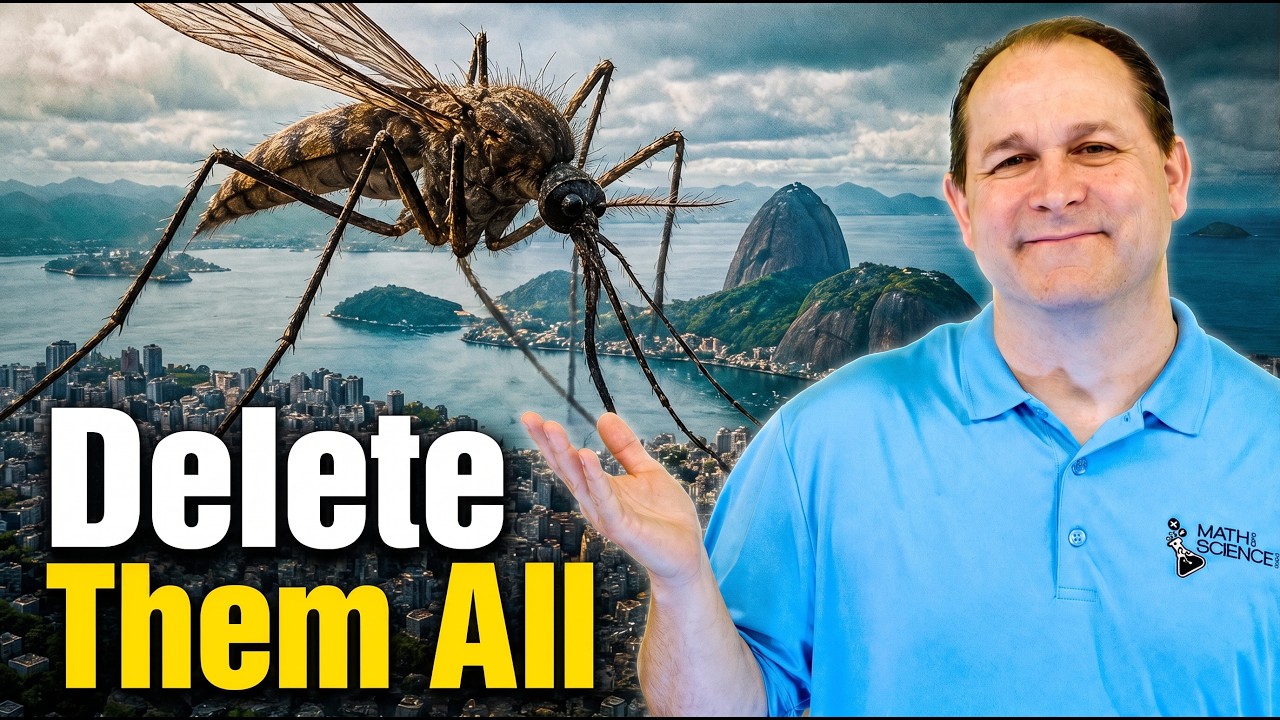
One Button Erases EVERY Mosquito on Earth. Press It?
Title history
- One Button Erases EVERY Mosquito on Earth. Press It? — observed on 20261027-1435 UTC (YouTube)
Keywords
Summary
159 words
Critical Evaluation
Value of the Information & Strength of the Argument
The video offers a balanced and scientifically grounded argument, presenting both the benefits of mosquito eradication (reduction in disease and death) and the potential ecological consequences. It effectively uses statistics, such as 263 million malaria cases in 2023 and 400 million dengue infections annually, to underscore the health burden. The argumentation is solid, citing the consensus among ecologists that ecosystems would not collapse but would experience local shocks. The explanation of mosquito biology and survival mechanisms is authoritative and clear, making the case that eradication is practically impossible with current methods. The video’s value lies in its comprehensive synthesis of ecological and medical perspectives, encouraging critical thinking about complex environmental trade-offs.
Scientific Rigor, Source Quality, Title Accuracy
The scientific content is rigorous, with accurate descriptions of mosquito behavior, life cycles, and ecological roles. However, the video does not cite specific studies or provide references, relying instead on general scientific knowledge. The title is slightly sensationalist but accurately reflects the core question addressed. The video’s conclusion aligns with expert opinions that while eradication would benefit humanity, it is not feasible and could cause ecological ripples. The lack of direct citations is a minor weakness, but the factual accuracy appears sound.
208 words
Title / Content Match
The title poses a provocative question that the video directly addresses by weighing ecological risks against human health benefits, offering a balanced thought experiment.
Quality & Reliability
8/10
The video presents accurate scientific facts about mosquito biology, ecology, and disease burden, with clear explanations. While no direct citations are provided, the channel Math and Science is known for reliable educational content, and the information aligns with established scientific consensus.
Key Moments
Markers derived by PSI from the transcript: the creator did not define chapters.
- Introduction: mosquitoes kill more humans than all wars combined, 1 million deaths per year.
- Mosquito lineage diverged 73-100 million years ago; oldest fossil in amber 99 million years old.
- Explanation that mosquitoes primarily feed on nectar, and females need blood for egg production.
- Description of female mosquito's biting mechanism and immune response causing itching.
- Mosquito survival strategies: diapause and winter-resistant eggs; resilience and adaptation.
- Ecological roles: larvae as filter feeders and food source, adults pollinating plants including Arctic orchids.
- Ecologists' consensus: eradication would cause disruption but not collapse; alternative insects could fill niches.
- Current population control methods are insufficient; global eradication impossible; conclusion.
Contribution & Novelties
The video provides a clear and engaging synthesis of existing knowledge about mosquitoes, distilling complex ecological and medical information into an accessible thought experiment. It effectively balances the human health imperative with ecological considerations, offering a nuanced perspective often missing in popular discussions.
Pour aller plus loin :
- Mosquito ecology and diversity — Overview of mosquito biology, species diversity, and ecological roles.
- Malaria impact and epidemiology — WHO fact sheet with latest malaria statistics and global burden.
- Sterile insect technique for mosquito control — Explanation of a genetic-based control method mentioned in the video.
- Arctic pollinator ecology — Context on pollinator importance in high-latitude ecosystems.
105 words
Radar Profile
The radar profile shows balanced scores across all dimensions, with slightly lower technical level reflecting the accessible nature, and high reliability and information quality indicating a well-researched presentation.