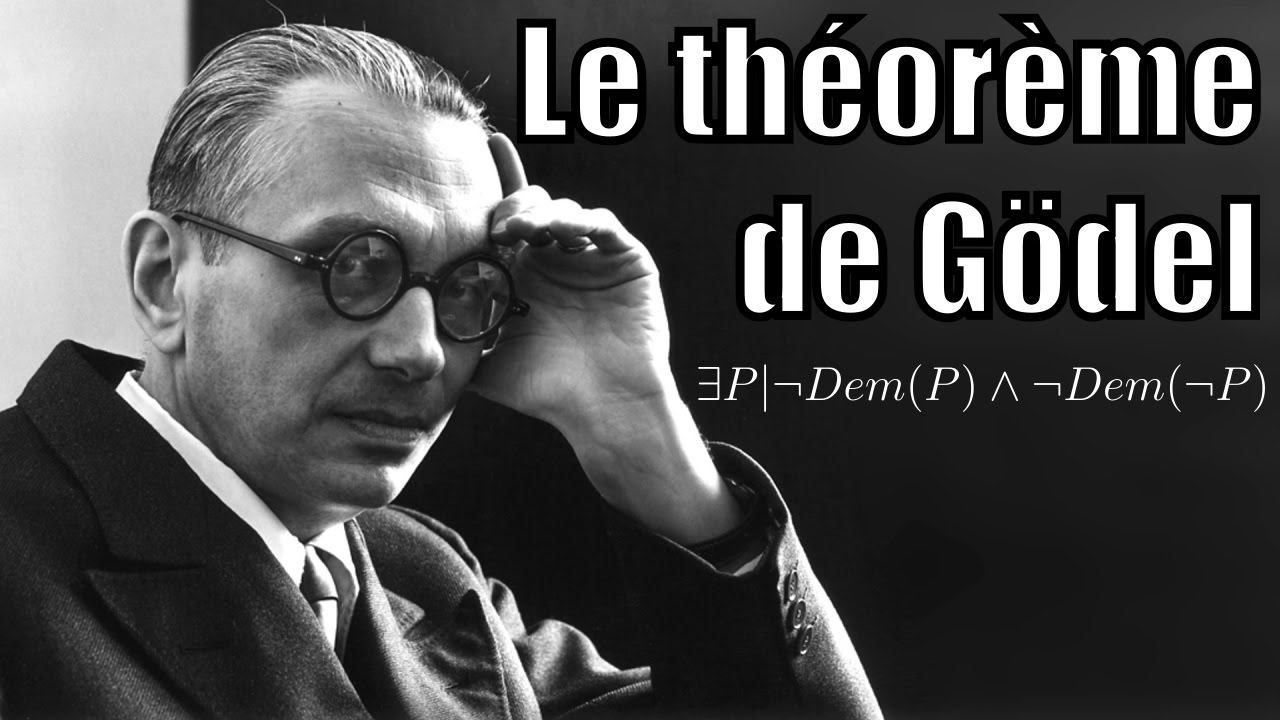
Les théorèmes d'incomplétude de Gödel
Gödel's incompleteness theorems
Title history
- Les théorèmes d'incomplétude de Gödel — observed on 20261019-0425 UTC (PSI archive)
Keywords
Summary
175 words
Critical Evaluation
Value of the Information & Strength of the Argument
The value of this video lies in its exceptional clarity and logical progression. The author builds the explanation step by step, using intuitive analogies and concrete examples to convey abstract ideas. The argumentation is solid: the distinction between truth and provability is carefully established, and the proof sketch of the first theorem is both accurate and comprehensible. The second theorem is presented with proper context, and the discussion of common misinterpretations adds critical value. The video does not shy away from technicalities but manages to make them accessible without oversimplifying the core concepts.
Scientific Rigor, Source Quality, Title Accuracy
The scientific rigor is high. The content aligns with standard mathematical literature, and the author explicitly points out nuances such as the requirement of recursive axiomatization. The main source is the accompanying blog post, which offers additional depth. The title accurately describes the subject matter, and the video stays focused on the theorems themselves without drifting into unrelated topics. The use of historical context (Hilbert’s program) and references to related problems (Goldbach’s conjecture, continuum hypothesis) enriches the presentation without compromising accuracy.
189 words
Title / Content Match
The title accurately reflects the content, which explains both theorems and their implications.
Quality & Reliability
8/10
Clear and accurate presentation of Gödel's theorems, with appropriate simplifications. The accompanying blog post provides deeper context. The video avoids common misinterpretations and explicitly warns against overstatement.
Key Moments
Markers derived by PSI from the transcript: the creator did not define chapters.
- Introduction to Gödel's theorems and personal anecdote
- Explanation of the axiomatic method and examples of axiom systems
- Hilbert's quest for a complete and consistent system
- Statement of the first incompleteness theorem and its consequences
- Gödel numbering and the construction of the self-referential statement G
- Second incompleteness theorem and discussion of consistency proofs
- Practical implications and warnings against overinterpretation
Cited Sources
- Blog post accompanying the video — The video refers to this blog post for additional details on model theory and Gödel's completeness theorem.
- Science Étonnante website — The channel's main site, providing access to other videos and articles.
Concurring Sources
- Gödel's incompleteness theorems (Wikipedia) — The content of the video aligns with the standard explanation found in this reference.
Contribution & Novelties
The video’s original contribution is its masterful distillation of a notoriously complex topic into an engaging and digestible format. It effectively bridges the gap between popular science and mathematical rigor, making the theorems understandable to a wide audience without sacrificing accuracy. The use of the Lego analogy and the careful distinction between truth and provability are particularly effective pedagogical choices.
Pour aller plus loin :
- Gödel’s incompleteness theorems — The standard reference for both theorems, including precise statements and historical context.
- Gödel numbering — Explains the coding technique central to the proof.
- Hilbert’s program — The framework that Gödel’s theorems undermined.
- Continuum hypothesis — An example of an undecidable proposition mentioned in the video.
114 words
Radar Profile
The profile shows high scores on information quantity and quality, with a somewhat lower but still respectable technical level, indicating a well-balanced presentation that is both informative and accessible. Reliability is rated high, reflecting the video's accuracy and clear sourcing.
💬 The 30 comments analyzed are overwhelmingly positive, with viewers praising the clarity and pedagogical quality of the explanation. Many express a newfound appreciation for mathematics.