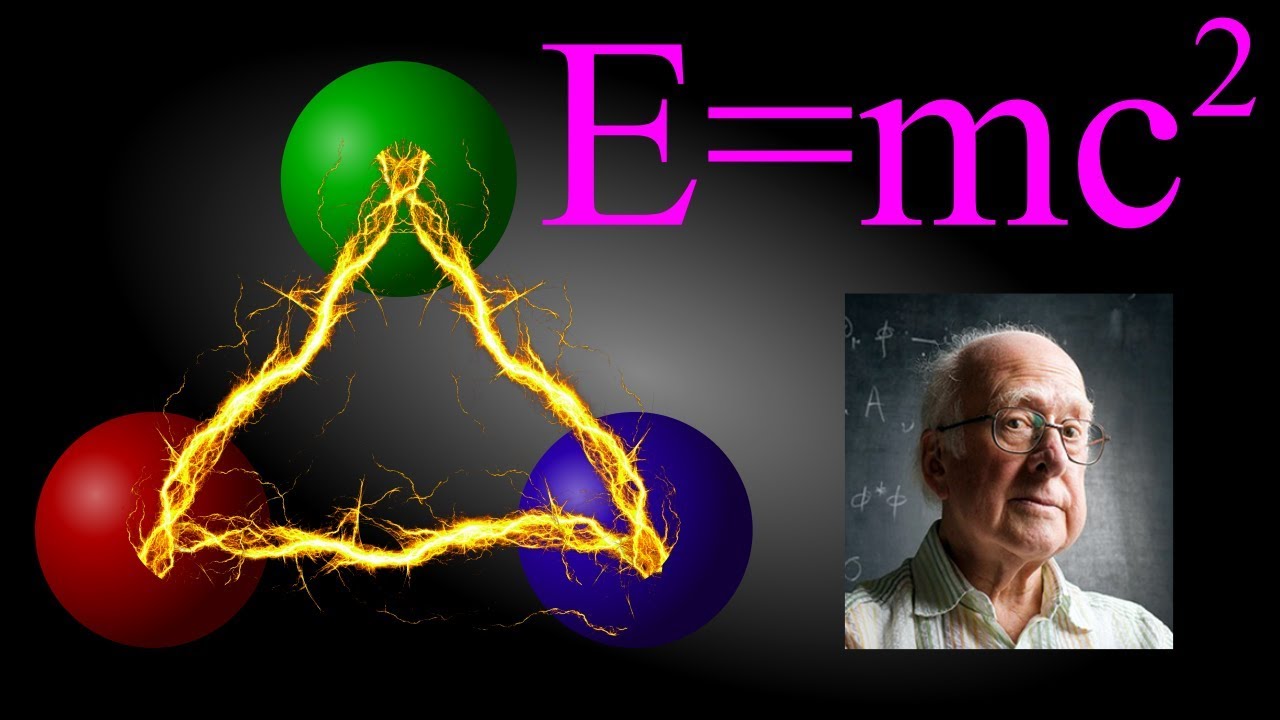
E=mc² et le boson de Higgs
E=mc² and the Higgs boson - Astonishing Science #46
Title history
- E=mc² et le boson de Higgs — observed on 20261019-0424 UTC (PSI archive)
Keywords
Summary
223 words
Critical Evaluation
Value of the Information & Strength of the Argument
The video provides a clear and rigorous explanation of a complex topic, using a logical progression from classical mechanics to quantum field theory. The argumentation is well-structured: it first establishes the mass-energy equivalence, then demonstrates its consequences with concrete examples, and finally addresses the origin of elementary particle masses via the Higgs mechanism. The explanations are supported by accurate calculations and analogies (e.g., the spring analogy for quark confinement). The presentation is engaging and avoids oversimplification, making it valuable for both laypersons and students. The author’s expertise is evident, and the reasoning is consistent with established scientific consensus.
Scientific Rigor, Source Quality, Title Accuracy
The video is scientifically rigorous, with no apparent factual errors. The author does not cite external sources during the presentation, but the accompanying blog post provides additional details and references. The title accurately reflects the content, as both E=mc² and the Higgs boson are thoroughly discussed and connected. The video aligns with standard textbook explanations of mass-energy equivalence and the Higgs field. The audience comments reflect high appreciation and understanding, with many praising the clarity and pedagogical quality, indicating that the content is well-received. No negative feedback or scientific objections were noted in the provided comments.
209 words
Title / Content Match
The title accurately reflects the content, focusing on both E=mc² and the Higgs boson, and the video effectively explains their connection.
Quality & Reliability
9/10
The content is scientifically accurate, well-structured, and based on established concepts in modern physics. The author is a known science communicator with a PhD in physics, and the video aligns with current understanding of mass-energy equivalence and the Higgs mechanism. No significant errors or misleading statements were found.
Key Moments
Markers derived by PSI from the transcript: the creator did not define chapters.
- Introduction to E=mc² and the Higgs boson, announcing the central questions.
- Explanation of inertial mass and gravitational mass, and the correct form Δm=ΔE/c².
- Example of heating water: the mass increase is minuscule, highlighting the practical insignificance.
- Discussion of the hydrogen atom: mass deficit due to binding energy.
- Helium nucleus formation: the mass decrease corresponds to released energy, not mass-to-energy conversion.
- Quarks and gluons: 99% of proton/neutron mass comes from interaction energy.
- Introduction of the Higgs field and how it gives mass to elementary particles.
Cited Sources
- E=mc² et le boson de Higgs (Blog post) — Companion blog post with additional details on derivations and clarifications.
- Science Étonnante (Official website) — Author's website hosting the blog and additional science videos.
Concurring Sources
- Science Étonnante blog post — The blog post complements the video with additional derivations and nuances, reinforcing the video's content.
Contribution & Novelties
The video excels at clarifying a commonly misunderstood equation and its relationship to the Higgs mechanism. It provides an accessible yet accurate explanation of how mass is primarily energy, demystifying the role of the Higgs boson by showing it accounts for only a small fraction of ordinary matter’s mass. The pedagogical approach — starting with classical examples and progressively moving to quantum concepts — helps viewers build intuition without sacrificing correctness.
Pour aller plus loin :
- Mass–energy equivalence — Détaille la relation E=mc² et son histoire, pertinente pour le fondement de la vidéo.
- Higgs mechanism — Explique le mécanisme de brisure de symétrie qui confère la masse, en lien direct avec la partie sur le champ de Higgs.
- Quark confinement — Phénomène selon lequel les quarks ne sont jamais isolés, illustré dans la vidéo par l’analogie du ressort.
- Standard Model of particle physics — Contexte général des particules élémentaires et interactions, utile pour approfondir.
154 words
Radar Profile
The radar profile shows high scores in information quality, reliability, and technical level, with a slightly lower quantitative score due to the video's focused scope. This indicates a well-researched, accurate, and educational resource, suitable for an audience seeking a clear understanding of mass and the Higgs mechanism.
💬 Très positif : Sur les 30 commentaires analysés, tous sont extrêmement élogieux, saluant la clarté pédagogique, la qualité des explications et l'utilité de la vidéo. Plusieurs commentaires mentionnent que la vidéo est plus claire que des cours universitaires, et certains soulignent un impact sur leur compréhension personnelle.