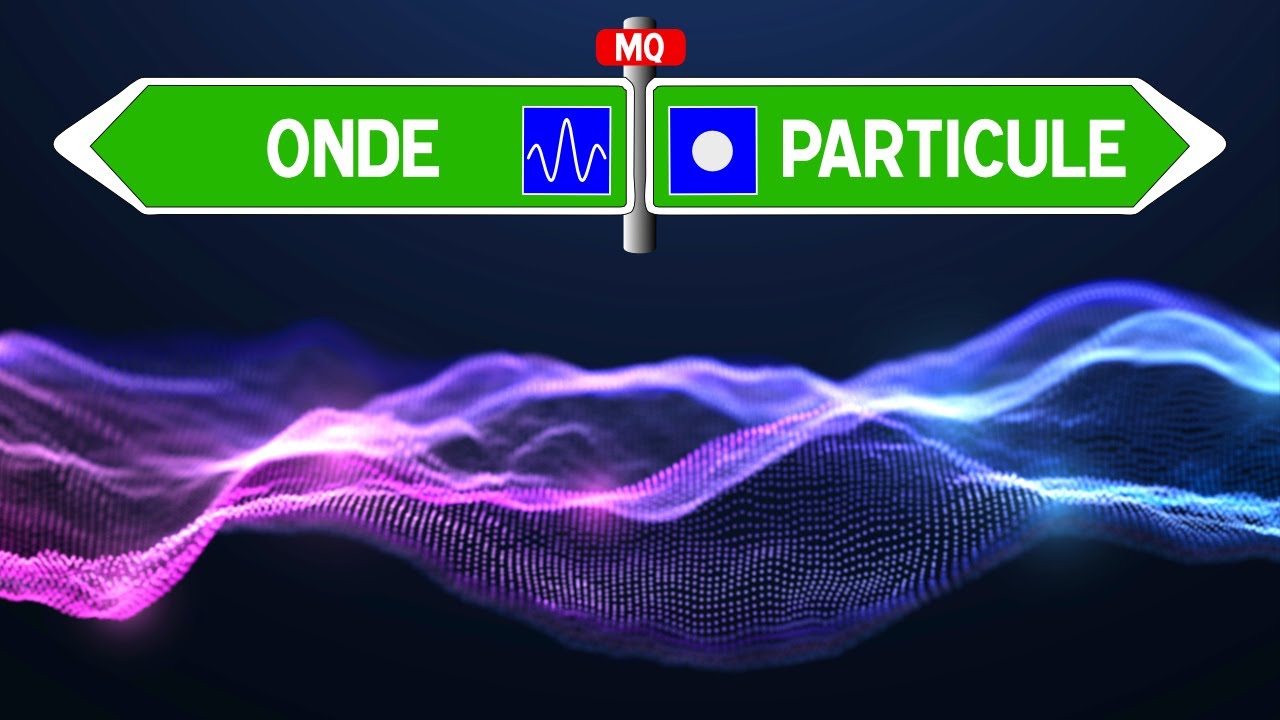
La Dualité Onde-Corpuscule
The Wave-Particle Duality
Title history
- La Dualité Onde-Corpuscule — observed on 20261019-0420 UTC (PSI archive)
Keywords
Summary
151 words
Critical Evaluation
Value of the Information & Strength of the Argument
The video provides a clear pedagogical explanation of complex quantum phenomena, building the argument step by step. It uses a concrete analogy (cornstarch) to make the concept of complementarity intuitive, then systematically introduces the Mach-Zehnder interferometer, explains the behavior of single photons, and finally presents the delayed-choice experiment as a critical test. The argumentation is solid and well-structured; the presenter explicitly addresses potential objections (e.g., whether single-photon sources really emit particles) and explains how the experiment is realized in practice. The qualitative explanations are accurate and avoid oversimplification, while the narrative arc from familiar to surprising ideas is effective.
Scientific Rigor, Source Quality, Title Accuracy
The video is scientifically rigorous: it correctly describes the historical context, the experiments, and the implications. The presenter cites specific sources: the 2006 experiment by Vincent Jacques and his team, and references Alain Aspect’s work on Bell inequalities. The accompanying blog post is linked, which provides additional technical details. The title is directly relevant to the content and does not overpromise. There is no indication of misinformation; the explanation aligns with standard quantum mechanics. The video also includes a promotional mention of the author’s book, but that does not detract from the scientific content.
208 words
Title / Content Match
The title accurately reflects the content, which explains the wave-particle duality and challenges the simple complementarity view using Wheeler's delayed-choice experiment.
Quality & Reliability
9/10
The video is produced by a recognized science communicator (David Louapre, PhD in physics) and covers a well-established quantum mechanics topic with clear references to the Wheeler delayed-choice experiment, including a real experiment from 2006. The explanation is rigorous, consistent with standard interpretations, and the accompanying blog post provides further technical details. No unsupported claims are made.
Key Moments
Markers derived by PSI from the transcript: the creator did not define chapters.
- Introduction to wave-particle duality and historical debate
- Explanation of interference with the Young double-slit experiment
- Introduction of the Mach-Zehnder interferometer and its analogy
- Demonstration that single photons still produce interference
- Presentation of Wheeler's delayed-choice experiment and its 2006 realization
- Conclusion: duality is more subtle than simple complementarity
Cited Sources
- Blog article accompanying the video — Provides additional details on phase shifts, single-photon sources, anticorrelation, and complementarity inequality.
- David Louapre's books page — Mentioned at the end of the video as a resource for further reading.
- ScienceEtonnante YouTube channel — Channel where the video is published; include for completeness.
Concurring Sources
- Wikipedia article on Wheeler's delayed-choice experiment — Supports the description of the experiment and its implications.
Contribution & Novelties
The video provides an accessible and compelling explanation of the Wheeler delayed-choice experiment, which is often cited as a mind-bending consequence of quantum mechanics. It skillfully builds up from basic interference to the radical implication that the choice of measurement can be made after the photon has passed the first beamsplitter, using a real experiment from 2006. The presenter’s analogy with cornstarch helps demystify complementarity, but the delayed-choice result forces a more nuanced interpretation, showing that quantum objects maintain superposition until the last moment.
Pour aller plus loin:
- Wheeler’s delayed choice experiment — Wikipedia provides an overview and references.
- Complementarity (physics) — Bohr’s concept explained.
- Mach–Zehnder interferometer — The experimental setup used.
- Single-photon source — Context on how photon sources work.
- Quantum randomness — Used in the experiment for random choice.
131 words
Radar Profile
The radar profile shows high scores in information quantity, quality, and reliability, with a slightly lower score for technical level (likely due to the accessible presentation). This indicates a well-balanced, trustworthy science communication video that is informative but not overly technical.
💬 Fervor: The comments are overwhelmingly positive, with viewers congratulating the channel for reaching one million subscribers and praising the clarity of the explanations. The tone is enthusiastic and grateful, with several comments highlighting the video's effectiveness in explaining complex quantum concepts.