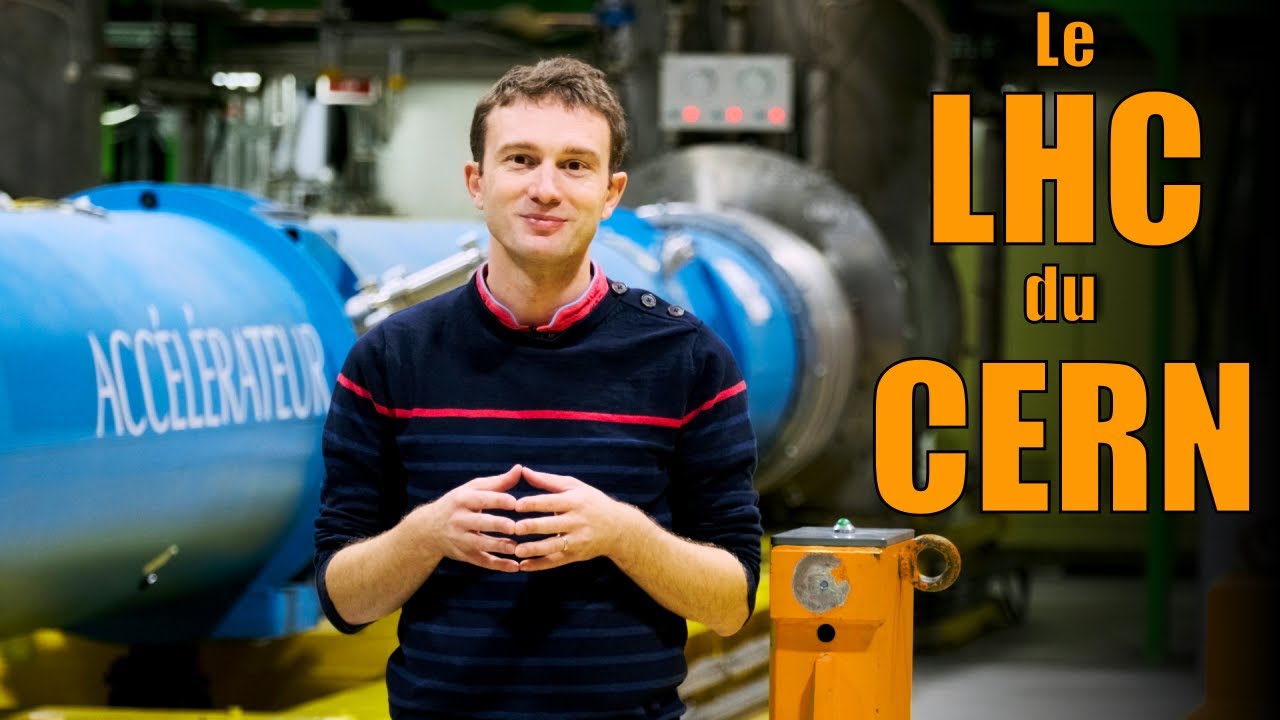
Le LHC 💥🧲🔬 : J'ai visité le plus grand accélérateur de particules du monde !
The LHC 💥🧲🔬: I visited the world's largest particle accelerator!
Title history
- Le LHC 💥🧲🔬 : J'ai visité le plus grand accélérateur de particules du monde ! — observed on 20261019-0420 UTC (PSI archive)
Keywords
Summary
171 words
Critical Evaluation
Value of the Information & Strength of the Argument
The video provides substantial informational value, effectively conveying complex concepts such as luminosity, superconducting magnets, and collision processes through a combination of visual demonstrations, analogies, and expert interviews. The argumentation is solid: each technical point is logically built from historical context to modern applications, and the explanations are consistent with current scientific understanding. The use of concrete numbers (e.g., 8 teslas, 12,000 amps, 20 collisions per bunch crossing) grounds the discussion in quantitative reality, while the visit format gives authenticity. The narrative flows smoothly, linking the need for high energy to the detection challenges, and culminates in the detailed description of the CMS detector. The video does not oversimplify, yet it remains comprehensible through clear pedagogical devices, such as the comparison of a cyclotron to a simple electron gun or the analogy of cooling to below -271°C.
Scientific Rigor, Source Quality, Title Accuracy
The scientific rigor is high: the presenter is a physicist, and the video features interviews with CERN staff, adding firsthand credibility. The content aligns with established particle physics and the official CERN narrative. The companion blog post provides additional references and details, enhancing the source base. The title correctly indicates a visit to the LHC, and the content fully delivers on that promise. No significant discrepancies were found between the title and the material. The video’s explanations of the Higgs mechanism and detection methods are accurate and up-to-date, and the use of CERN footage and diagrams from simulations reinforces the scientific foundation.
254 words
Title / Content Match
The title accurately reflects the content: a guided tour of the LHC with detailed explanations of its operation and the Higgs boson discovery.
Quality & Reliability
9/10
High-quality science communication by a PhD physicist, combining on-site footage, interviews with CERN researchers, and clear explanations consistent with established particle physics.
Key Moments
Markers derived by PSI from the transcript: the creator did not define chapters.
- Introduction to the CERN and the LHC, with context on the Higgs boson discovery.
- Historical overview: the standard model and the missing piece of the Higgs boson.
- Discovery of muons and the principle of particle detection using cloud chambers and magnets.
- How accelerators work: from simple electrostatic accelerators to cyclotrons and synchrotrons; introduction of the electronvolt.
- Detailed description of the LHC: 27 km ring, two counter-rotating beams, superconducting magnets, and cooling to -271°C.
- Beam dynamics: injection, bunch structure, 600 million collisions per second, and the concept of luminosity.
- The CMS detector: its onion-like structure, from inner tracker to muon chambers, and the challenge of detecting the Higgs boson.
Cited Sources
- Science Étonnante blog post on the LHC — Companion blog post with detailed notes, additional references, and further explanations.
External References
Contribution & Novelties
The video contributes an original immersive perspective by taking the viewer into the operational areas of the CERN, including the control room and the CMS cavern, which is rarely captured in such detail. It bridges the gap between popular science and technical insight by explaining both the underlying physics and the engineering feats, supported by interviews with researchers. With a clear didactic approach, it demystifies complex topics like superconducting magnets and particle detection, making them tangible through concrete examples and analogies.
Pour aller plus loin :
- Higgs boson — Essential reference on the particle central to the video, including its theoretical role and experimental confirmation.
- Large Hadron Collider — Detailed technical and historical information about the accelerator, its design, and its physics program.
- Superconductivity — Explains the phenomenon enabling the high-field magnets used in the LHC, a key technological ingredient.
- Luminosity (scattering theory) — Defines the concept of luminosity used to quantify the collision rate in particle accelerators.
158 words
Radar Profile
The profile indicates a highly informative and reliable video, with strong scores in information quantity and quality, and a technical level that, while advanced, remains accessible due to excellent pedagogical framing. The balance between depth and clarity suggests an exceptional science communication piece.
💬 Very positive: the 30 comments analyzed overwhelmingly praise the video's clarity, educational value, and production quality, with many humorous references and expressions of admiration for the scientific achievement.