2026 10 22 Capacity, Competence, and Surrogate Medical Decision Making in Palliative Care and Hospic
Title history
- 2026 10 22 Capacity, Competence, and Surrogate Medical Decision Making in Palliative Care and Hospic — observed on 20261025-1505 UTC (YouTube)
Keywords
Summary
170 words
Critical Evaluation
Value of the Information & Strength of the Argument
The lecture provides practical, actionable knowledge for clinicians, distinguishing between capacity and competence clearly and illustrating with real-world examples. The argumentation is logical, proceeding from definitions to prevalence, to assessment criteria, to practical steps in surrogate identification. The presenter supports claims with statistics (e.g., 44–69% capacity impairment in long-term care), though primary sources are not cited. The emphasis on state-specific legal requirements underscores the need for clinicians to be aware of local regulations. The discussion on how to initiate conversations about advance directives is particularly valuable, offering gentle, concrete phrasing. The lecture’s strength lies in its applied nature, but it lacks a critical examination of ethical controversies or empirical evidence for recommended practices.
Scientific Rigor, Source Quality, Title Accuracy
The lecture demonstrates moderate rigor: the presenter references the Patient Self-Determination Act of 1990 and Michigan statutes, but does not provide direct citations or links to primary sources. Statistical data are presented without references, though they appear plausible based on common knowledge in geriatrics and palliative care. The distinction between capacity and competence is accurately described, aligning with established medical and legal definitions. The title accurately reflects the content, which focuses on the clinical and legal aspects of surrogate decision-making. The lecture is well-structured and professionally delivered, but the lack of explicit source citations diminishes its scientific rigour. The audience, likely fellows or trainees, benefits from the practical orientation, though a more evidence-based approach would strengthen credibility.
245 words
Title / Content Match
The title accurately reflects the lecture content, which focuses on capacity, competence, and surrogate decision-making in palliative care and hospice.
Quality & Reliability
7/10
The presenter is a retired nurse practitioner with extensive clinical experience. She provides clear explanations of capacity vs. competence, practical guidance, and references statutory requirements in Michigan. However, specific statistics and legal citations lack explicit sources, and some recommendations are state-specific without broader context.
Key Moments
Markers derived by PSI from the transcript: the creator did not define chapters.
- Introduction to the topic: capacity, competence, and surrogate decision-making.
- Definition of palliative care and its two components: symptom management and patient-centered decision-making.
- Discussion of the Patient Self-Determination Act of 1990 and its limited impact.
- Statistical prevalence of incapacity: 40-70% in nursing home residents, 2/3 in last week of life.
- When capacity assessment is needed: high-risk scenarios when patient refuses recommended treatment or insists on futile care.
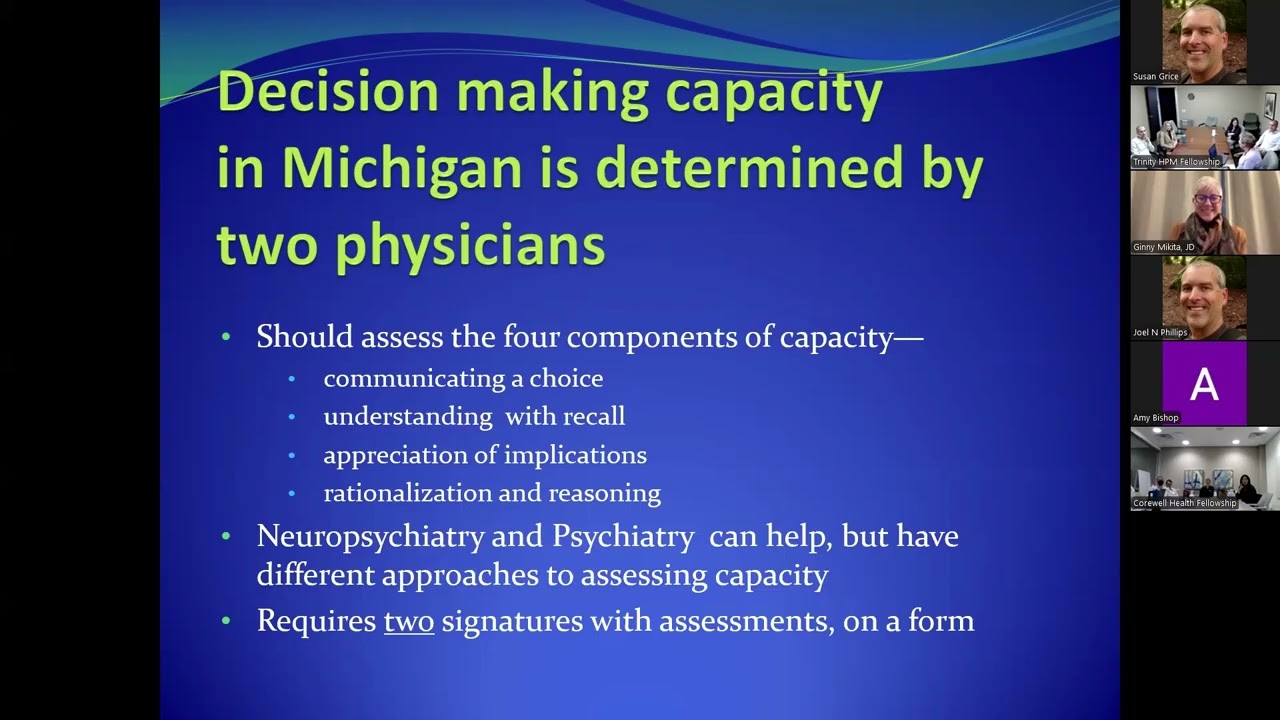
- Four components of capacity: communicate choice, understand risks/benefits, appreciate implications, reason through options.
- Michigan requirement: two physicians must determine capacity; NPs/PAs can assess but not declare.
- Comparison of capacity vs. competence: competence is a legal term determined by courts, leading to guardianship.
- Types of guardianship in Michigan: full, limited, guardian ad litem, temporary, and for developmentally disabled.
- Advanced directives: statutory requirements, non-binding wishes, and importance of naming alternates.
- Sample questions to initiate advance directive discussions and advice on handling completed forms.
Cited Sources
- Patient Self-Determination Act (1990) — Mentioned as federal legislation that incentivized hospitals to ask patients about advance directives.
- Five Wishes — Mentioned as an example of an advance directive form that requires payment.
- Michigan Physician Orders for Scope of Treatment (MyPost) — Referenced as a provider order form for end-of-life treatment, with state-specific variations.
Concurring Sources
- Five Wishes official site — The form mentioned in the lecture, structured as an advance directive recognized in many states.
- National Institute on Aging - Advance Care Planning — Supports the importance of advance directives and patient self-determination as discussed in the lecture.
Dissenting Sources
- In some states, nurse practitioners can independently determine capacity — The lecture states Michigan requires two physician signatures, but this may not apply in all states, implying a potential generalization.
Contribution & Novelties
This lecture offers a comprehensive, practical overview of capacity and surrogate decision-making in the context of palliative care, emphasizing the distinction between clinical capacity and legal competence, and the importance of advanced directives. The presenter provides actionable guidance for clinicians, including sample scripts for initiating conversations and checklists for verifying legal documents. It highlights the often-overlooked issue that spouses or partners do not automatically have decision-making authority without proper paperwork, and that advance directives must be accessible and up-to-date.
Pour aller plus loin :
- Advanced healthcare directive - Wikipedia — Explains the legal documents and their variations across jurisdictions.
- Patient Self-Determination Act - Wikipedia — Details the federal law’s requirements and impact on patient rights.
- Capacity (law) - Wikipedia — Discusses the legal concept of capacity and its assessment in medical contexts.
- Substituted judgment - Wikipedia — Describes the standard used when making decisions for incapacitated patients based on their known wishes.
152 words
Radar Profile
The radar profile shows high scores in information quantity and technical level, reflecting a dense, practice-oriented lecture. Quality and reliability are moderate, indicating solid practical content but with limited academic rigor. The global note aligns with the lecture's usefulness for clinicians seeking applied guidance.