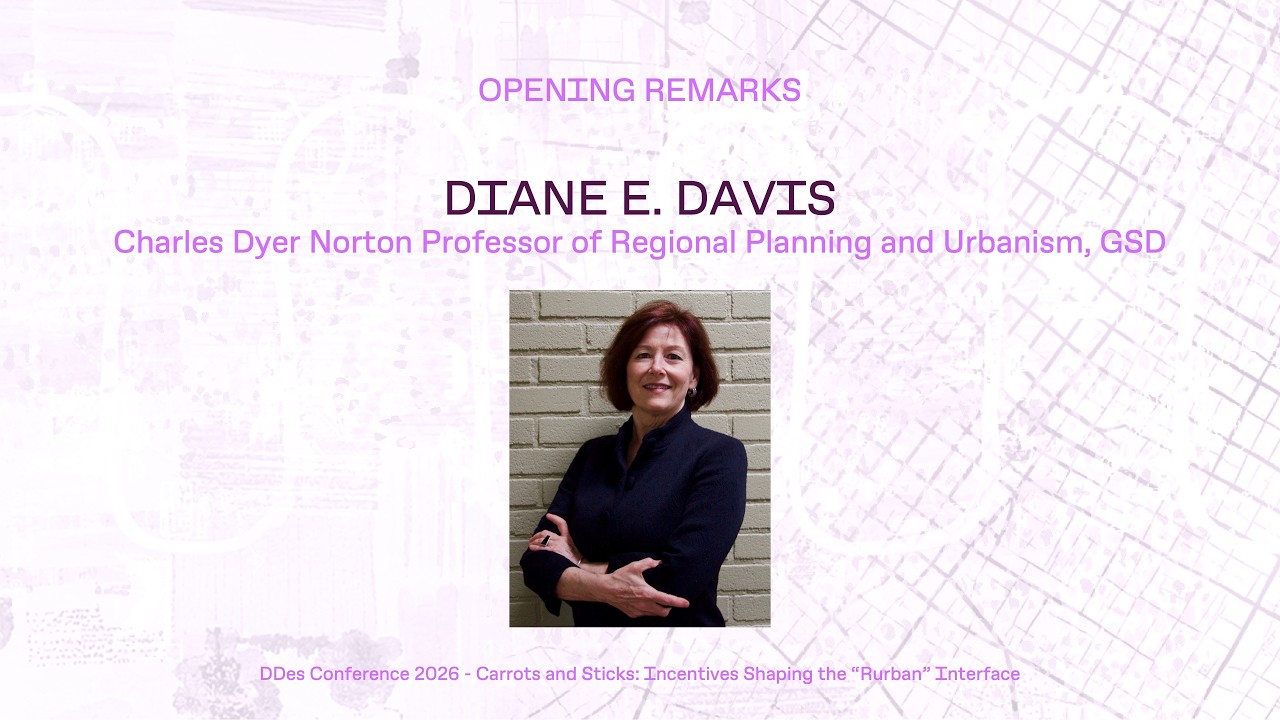
Carrots and Sticks: Incentives Shaping the “Rurban” Interface | Opening Remarks
Keywords
Summary
192 words
Critical Evaluation
Value of the Information & Strength of the Argument
VALUE: The video offers conceptual framing rather than empirical results. Its value lies in introducing the ‘rurban’ perspective and the ‘carrots and sticks’ incentive lens as analytical tools, which are useful for scholars studying urban-rural dynamics. The argumentation is well-structured: each speaker builds on the previous one, progressively layering the conceptual framework. Diane Davis’s use of three quotes from disciplines (archaeology, environmental activism, sociology) effectively illustrates how boundaries are understood differently. The emphasis on relationality and boundary-crossing is a valuable critical contribution to urban studies. However, the discussion remains at a high level of abstraction without concrete cases or evidence, limiting its immediate practical applicability.
Scientific Rigor, Source Quality, Title Accuracy
RIGOR AND SOURCES: The speakers are credible academics from Harvard GSD. No external sources are cited in the description, but the talk references academic works (Benjamin Vis, Andrew Abbott) and policy instruments (urban growth boundaries). The rigor is typical of a conference opening: it sets the stage without deep methodological detail. The title accurately reflects the content; it is specific and matches the event’s focus. The video itself is professionally produced with clear audio and slides. The information presented is conceptually sound but not fully developed, which is appropriate for an opening session. There is no obvious bias or unsupported claim, but the lack of specific data or case studies means the rigor is moderate.
235 words
Title / Content Match
The title accurately reflects the content: the opening remarks of a conference on incentives shaping urban-rural interfaces, with speakers setting the conceptual agenda.
Quality & Reliability
6/10
The video is an academic conference opening led by established scholars from Harvard GSD. The information is reliable but mostly introductory and lacks empirical data or detailed evidence. The speakers clearly frame themes and questions, but no specific research findings are presented.
Chapters
Contribution & Novelties
The video’s original contribution is the explicit framing of ‘rurbanity’ as a lens to understand the dissolution of urban-rural boundaries, and the ‘carrots and sticks’ metaphor to analyze incentive mechanisms shaping spatial outcomes. It challenges traditional binary thinking in urban planning and invites interdisciplinary relational analysis. The introduction of Andrew Abbott’s concept ‘boundaries come first, then entities’ offers a fresh methodological perspective for studying territorial change.
Pour aller plus loin :
- Urban growth boundary — Relevant policy tool mentioned in the talk; helps understand how cities are contained or expanded.
- Rural-urban fringe — Directly relates to the rurban interface concept, offering a geographical framework.
- Andrew Abbott — Key sociological thinker on boundaries; his work underpins the conceptual approach discussed by Davis.
121 words
Radar Profile
The radar profile shows moderate scores across information quantity, quality, technical level, and reliability, reflecting a conceptually sound but introductory presentation with no empirical depth.