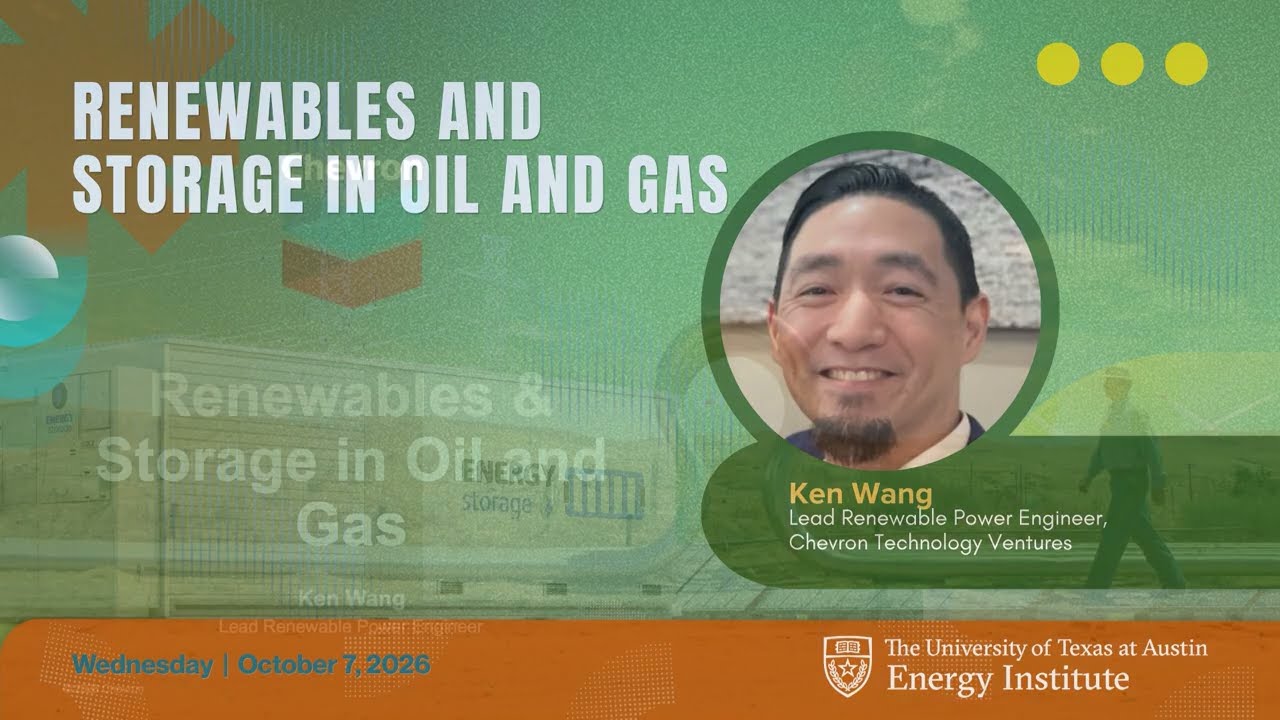
Renewables and Storage in Oil and Gas
Title history
- Renewables and Storage in Oil and Gas — observed on 20261030-0851 UTC (YouTube)
Keywords
Summary
188 words
Critical Evaluation
Value of the Information & Strength of the Argument
The value lies in firsthand insights into how a major oil and gas company approaches renewables, emphasizing the importance of bridging cultural and operational gaps between hydrocarbon-centric teams and new energy technologies. Wang argues that renewables and storage can be integrated by focusing on overlapping demand and resource potential, and by demonstrating projects that prove their viability. His argumentation is pragmatic, relying on corporate experience rather than theoretical frameworks. He does not present quantitative results but provides qualitative evidence from actual projects, which strengthens the practical relevance. The discussion of storage as a complement to solar, and the mention of real challenges like curtailment and utility restrictions, adds depth. However, the talk lacks detailed technical analysis or financial metrics, limiting its persuasive power for academic or investment-oriented audiences.
Scientific Rigor, Source Quality, Title Accuracy
The speaker does not cite external sources or provide references, relying solely on anecdotal evidence and his own experience at Chevron. The title is accurate and indicative of the content, with no clickbait. The talk’s scientific rigour is moderate: while the speaker is clearly knowledgeable, the absence of data, citations, or comparative analyses weakens its evidential basis. The Q&A touches on topics like IEEE papers and carbon capture but without specifics. Overall, the content is trustworthy as industry insight but not empirically rigorous. There are no comments provided to analyze public reception.
235 words
Title / Content Match
Title accurately reflects the content: the talk focuses on integrating renewables and storage into oil and gas operations, covering both strategic perspectives and practical project examples.
Quality & Reliability
7/10
Speaker is a lead renewable power engineer at Chevron Technology Ventures with direct field experience, but the talk is anecdotal and lacks verifiable data or citations. Credibility is moderate-high due to domain expertise.
Key Moments
Markers derived by PSI from the transcript: the creator did not define chapters.
- Introduction: speaker Ken Wang, role at Chevron, and overview of three topics.
- Overview of oil and gas operations: focus on molecules, process engineering, and power as supporting infrastructure.
- Bridging the divide: overlapping power consumption with renewable potential, and internal strategy to adopt renewables.
- Historical projects: early concentrating solar and PV demonstrations, transition to standard PV installations.
- Current projects and storage initiatives, including offshore solar and storage evaluations; Q&A begins.
Contribution & Novelties
The talk provides a practitioner’s perspective on renewable integration within oil and gas, highlighting internal barriers and practical methods to overcome them. It contributes to understanding how legacy energy companies can adapt to the energy transition, with specific examples from Chevron.
Pour aller plus loin :
- Photovoltaic system — Background on PV technology and project types relevant to the talk.
- Energy storage — General concepts and technologies, including batteries, that Wang discusses.
- Enhanced geothermal system — Explanation of a technology mentioned in the Q&A as an emerging interest.
88 words
Radar Profile
The radar profile shows balanced moderate scores across all dimensions, indicating a reasonably informative and reliable presentation, but with limited technical depth and citation quality. The lowest score is niveau_technique, reflecting the absence of detailed engineering data, while quantite_information and fiabilite_globale are consistent with an experienced professional's overview.