29 SETIEMBRE
29 SEPTEMBER
Keywords
Summary
228 words
Critical Evaluation
Value of the Information & Strength of the Argument
The value of the information lies in its clear, systematic presentation of fundamental ethical principles in research. The speaker effectively communicates the importance of honesty, transparency, and responsibility, using relatable examples like the pandemic and the concept of personal brand. The argumentation is coherent and practical, though it relies on general knowledge and personal experience rather than citing empirical studies or specific guidelines. The discussion on AI demonstrates awareness of emerging issues, but the treatment is superficial and lacks nuanced technical details. Overall, the content is valuable as an introductory guide for early-career researchers, providing a solid foundation without delving into complex ethical dilemmas.
Scientific Rigor, Source Quality, Title Accuracy
The scientific rigor is moderate; the talk is based on widely accepted principles but does not reference authoritative documents such as the European Code of Conduct for Research Integrity or COPE guidelines. Sources are not explicitly cited in the transcript or description, which weakens the ability to verify claims. The title is purely a date and does not hint at the topic, making it poorly aligned with the content. No external sources are provided, and the video’s credibility relies on the speaker’s professional background. The lack of citations and a misleading title detract from overall reliability, though the content itself aligns with standard research ethics frameworks.
225 words
Title / Content Match
The title '29 SEPTEMBER' does not reflect the content, which is about scientific integrity. The date likely refers to the session date, but it is misleading for viewers seeking topic-based content.
Quality & Reliability
7/10
The presentation is clear and well-structured, covering core principles of scientific integrity, but lacks rigorous sourcing and depth. The speaker's experience adds practical value, though the content is primarily introductory and relies on general knowledge rather than specific evidence.
Key Moments
Markers derived by PSI from the transcript: the creator did not define chapters.
- Introduction: speaker introduces herself and the topic of scientific integrity.
- Definition of scientific integrity and its importance for public trust.
- Presentation of six principles: honesty, rigor, transparency, responsibility, respect, and impartiality.
- The research cycle: from problem formulation to dissemination, emphasizing transparency.
- Distinction between diffusion (to peers) and divulgation (to general audience).
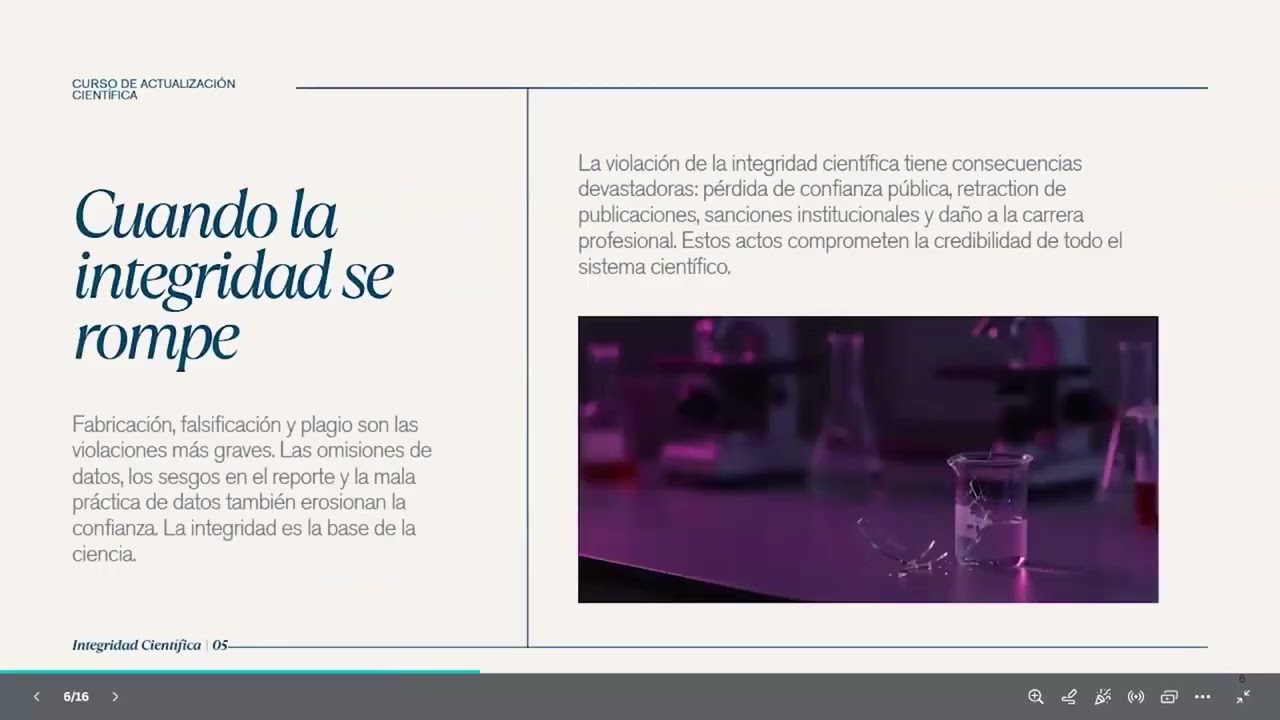
- Consequences of breaking integrity: fabrication, falsification, plagiarism, and loss of trust.
- Authorship criteria and the issue of ghost or gift authorships.
- Plagiarism, similarity detection, and proper paraphrasing.
- Data management, peer review, and conflict of interest declaration.
- Generative AI in research: declared use, risks, and verification.
- Role of medical librarians and promotion of open access.
Contribution & Novelties
The video provides a practical, accessible overview of scientific integrity tailored to a health research audience, with a strong emphasis on the librarian’s perspective. Its original contribution lies in integrating AI use and open access advocacy into the integrity discourse, albeit at an introductory level. The speaker’s personal touch and real-world examples make it relatable, but it does not advance novel theoretical or policy insights.
Pour aller plus loin :
- European Code of Conduct for Research Integrity — The primary European reference for research integrity principles, offering a more authoritative framework.
- COPE (Committee on Publication Ethics) — Guidelines on authorship, plagiarism, and ethical publishing practices.
- Scientific integrity (Wikipedia) — Overview of concepts, historical context, and major cases.
- Open access (Wikipedia) — Principles and benefits of open scholarly communication, central to the video’s advocacy.
133 words
Radar Profile
The radar profile shows moderate to high scores in quality and reliability, but lower in technical depth and quantity of information. This indicates a balanced, credible introductory lecture that lacks extensive detail or advanced technical content, making it suitable for beginners but not for experts.