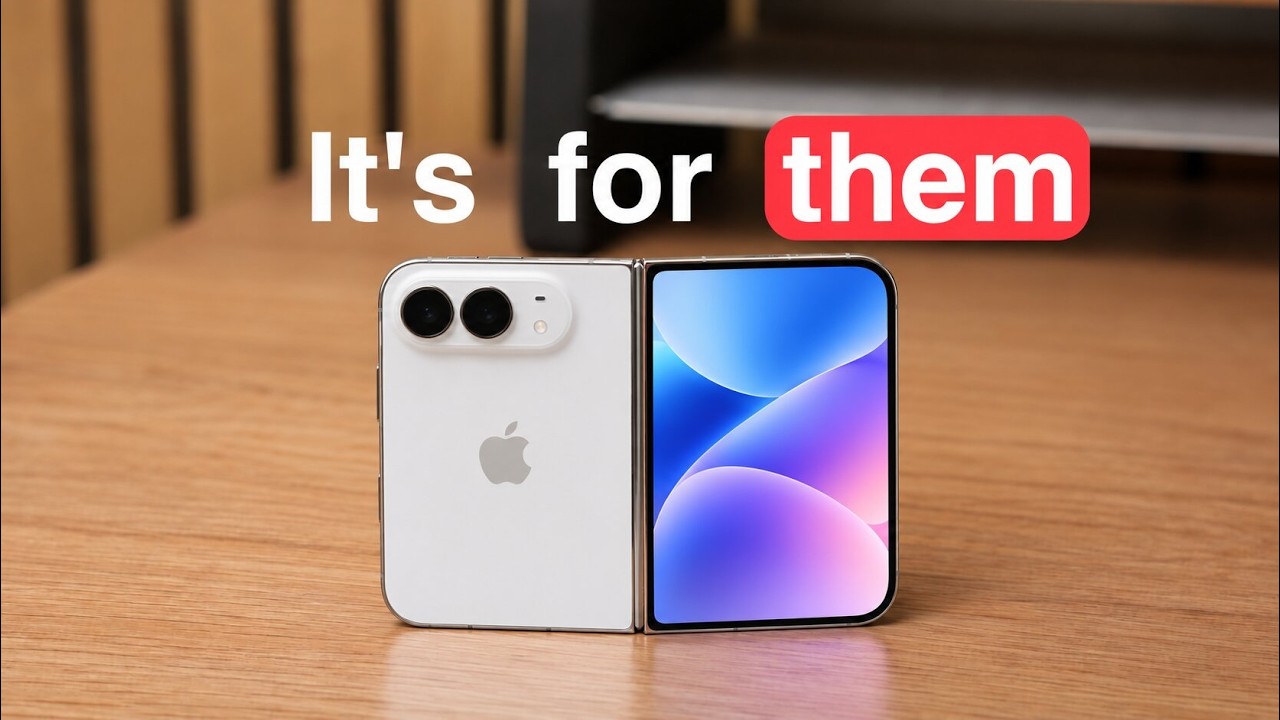
The iPhone Duo Isn’t For Me or You Anymore
Title history
- The iPhone Duo Isn’t For Me or You Anymore — observed on 20261104-1055 UTC (YouTube)
Keywords
Summary
163 words
Critical Evaluation
Value of the Information & Strength of the Argument
The video provides substantial quantitative data from reputable research firms, including shipment forecasts, price comparisons, and market share projections, giving it solid informational value. The argumentation is structured and persuasive—it moves from the personal anecdote of a Singaporean buyer to broader economic trends, then to targeted buyer segments and technical issues. The author effectively uses a narrative arc that ties together pricing, market dynamics, and consumer psychology. However, the argumentation is more journalistic than scientific: it relies on third-party analysis without primary data, and some claims (e.g., screen failures) are anecdotal. The strength lies in the coherent synthesis of multiple sources, though the lack of direct citations and the scarcity of opposing viewpoints slightly weaken its rigor.
Scientific Rigor, Source Quality, Title Accuracy
The video consistently cites named analysts and research firms (Bloomberg Intelligence, IDC, Counterpoint, TrendForce, JP Morgan, etc.) and specific incidents (e.g., scalping on eBay, screen cracking reports), which adds credibility. However, no direct URLs or links to these sources are provided, and the creator does not offer a reference list, making verification difficult. The title is apt and provocative, directly mirroring the core message. The content aligns well with the title, though the opening personal anecdote might seem tangential initially. The creator does not engage with the audience comments (none are provided in the input), so public reception is not addressed. Overall, the sourcing is extensive but lacks transparency and independent verification.
244 words
Title / Content Match
The title accurately conveys the central thesis that the new iPhone is not designed for the average consumer, supported throughout the narrative.
Quality & Reliability
7/10
The video synthesizes a wide range of market reports, analyst opinions, and anecdotes, but does not provide direct links to the cited sources and is presented by a small channel. The data points are consistent with known industry trends, yet the lack of transparent sourcing and the absence of primary data verification reduce overall reliability.
Key Moments
Markers derived by PSI from the transcript: the creator did not define chapters.
- Introduction: The iPhone once symbolized accessible luxury; the new Duo challenges that.
- Anecdote of Moit Chandel waiting overnight to buy a Duo for his father; pre-orders sell out.
- Price analysis: Duo starts at $1,999, more than a typical US monthly rent; compares to other Apple products.
- Economic backdrop: memory chip shortages, declining shipments, rising ASPs; collapse of sub-$100 phones.
- K-shaped economy and Apple's focus on premium customers; foldable market growth.
- Who buys: existing iPhone loyalists, status-driven buyers, and scalpers; examples from eBay, China, Hong Kong.
- Technical issues: no Face ID, no telephoto, early screen cracks; replacement screen costs $999.
- Apple's strategy: scarce supply and high price; market analysts discuss revenue impacts; Samsung's mocking campaign.
- Conclusion: The iPhone's democratic era is over; the future is reserved for the affluent.
Cited Sources
- Bloomberg Intelligence – iPhone Duo demand forecast — Cited for sales forecasts of 14 million units and $28 billion in Apple's next fiscal year.
- International Data Corporation (IDC – smartphone market projections — Cited for global shipment decline of 16.7% in 2026, average selling price jump, and foldable market data.
- Counterpoint Research – foldable shipments expectations — Cited for expecting Apple to sell ~6 million Duos by end of 2026 and foldable shipments of 12 million next year.
- TrendForce – foldable shipments forecast — Cited for projecting ~5 million Duos sold in 2026, making Apple the second largest foldable brand.
- MacRumors – scalping prices and aftermarket listings — Cited for describing resale prices on eBay and other platforms.
- CNET – editor's choice review of the iPhone Duo — Cited for positive review and everyday usability.
- JP Morgan – analysis of iPhone Duo buyers — Cited for asserting that Duo buyers will be existing iPhone users who trade up or buy as a second phone.
- Nikkei Asia – Apple's 2026 production strategy — Cited for reporting that Apple focuses on three high-end models and postpones the standard model.
- Bloomberg – Mark Gurman on Apple's foldable launch — Cited for noting the intentional limited supply and future second-generation Duo with Face ID.
- Marketplace (public radio) – K-shaped economy — Cited for highlighting the reliance on high-income spenders.
Concurring Sources
- Counterpoint Research – foldable shipment forecast — Expected 6 million Duos in 2026 (also cited in video).
- International Data Corporation – foldable market share — Projected ~7 million Duos in 2026; both agree on strong initial demand.
Dissenting Sources
- Reviewer Marques Brownlee — He calls the Duo a 'no' for most people but 'really fun' for those with $2,000 to spare, highlighting a divergence in value assessment.
- John Gruber — Describes it as an 'extraordinarily polished prototype', not a finished product, contradicting CNET's editor's choice award.
Contribution & Novelties
The video provides a coherent narrative that ties together pricing, market dynamics, and consumer psychology, going beyond typical product reviews. It introduces the concept of a K-shaped economy to explain Apple’s strategic positioning and uses real-world anecdotes to illustrate the shift. The synthesis of multiple research reports offers a comprehensive picture of the smartphone industry’s polarization.
Pour aller plus loin :
- K-shaped recovery — Explains the economic divergence that underlies the video’s analysis.
- Folding smartphone — Provides background on the technology and market evolution.
- Smartphone industry — Context on global trends and pricing.
- Average selling price — Metric used to describe the rise in smartphone prices.
106 words
Radar Profile
The radar chart would likely show high scores for quantity of information and level of technical detail, moderate scores for overall reliability due to lack of primary sources, and lower scores for scientific rigor, as the content is more journalistic than academic.