Lecture 3 Evanescent Wave (Spring 2021)
Title history
- Lecture 3 Evanescent Wave (Spring 2021) — observed on 20261026-1151 UTC (YouTube)
Keywords
Summary
162 words
Critical Evaluation
Value of the Information & Strength of the Argument
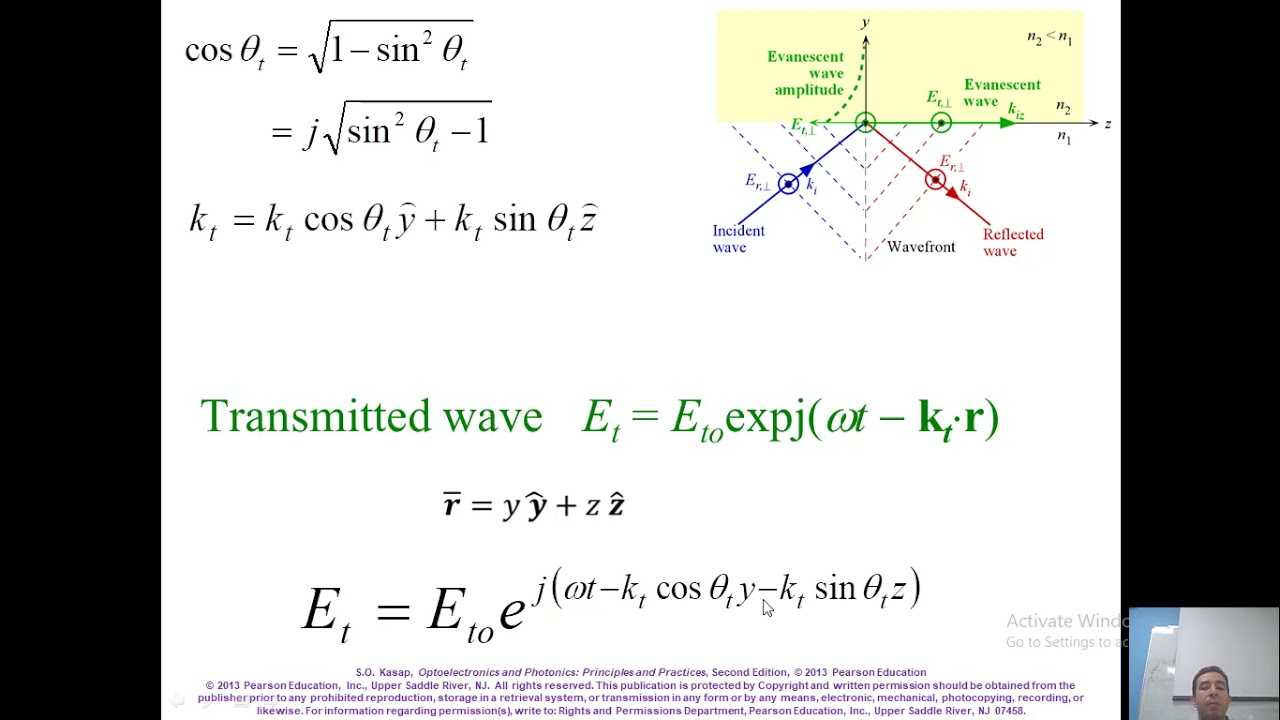
The lecture provides excellent pedagogical value, breaking down the complex mathematics of evanescent waves into digestible steps. The argumentation is solid: the instructor starts from the physical problem, derives the mathematical form of the wave, and explains the physical meaning of each term. He clearly distinguishes between the physically acceptable solution (negative imaginary unit) and the non-physical one, and justifies the choice based on decay requirements. The connection between the derived equations and practical applications (e.g., biomedical sensors) underscores the relevance of the material. The presentation is well-structured, building on previous lectures and clearly linking concepts.
Scientific Rigor, Source Quality, Title Accuracy
The scientific rigor is high for a pedagogical lecture. The instructor correctly applies Snell’s law and Maxwell’s boundary conditions, and the mathematical derivations are internally consistent. The video is based on course material shared via a Google Drive link, which serves as the primary reference. However, no external scientific sources are cited within the video, and the content is presented as authoritative without referencing peer-reviewed literature. The title is perfectly aligned with the content, describing it as a lecture on evanescent waves. No comments are available for analysis, so public reception cannot be assessed.
205 words
Title / Content Match
The title accurately reflects the content, which is a dedicated lecture on evanescent waves, including their mathematical form and physical implications.
Quality & Reliability
8/10
The lecture provides a rigorous mathematical derivation of evanescent waves in the context of total internal reflection, correctly handling complex wave vectors and boundary conditions. The instructor references a shared lecture notes PDF, and the explanation is coherent and didactic. Minor limitations include reliance on a single instructor perspective and no external citations within the video itself.
Key Moments
Markers derived by PSI from the transcript: the creator did not define chapters.
- Introduction to the boundary condition problem and the concept of evanescent wave
- Derivation of complex cosine theta_t and the evanescent wave vector
- Full expression of the evanescent field and identification of attenuation coefficient alpha_2
- Definition of penetration depth delta and its dependence on incidence angle
- Introduction to Poynting vector and intensity, then reflectance calculation examples
Cited Sources
- Lecture notes (PDF) - Evanescent Wave — Official course handout referenced by the lecturer in the video description.
Contribution & Novelties
This lecture offers a clear and detailed mathematical derivation of evanescent waves, emphasizing the physical interpretation of complex wave vectors and the significance of penetration depth. It bridges theory and applications, making it valuable for students of photonics. The instructor’s step-by-step approach clarifies a notoriously subtle topic.
Pour aller plus loin :
- Evanescent field - Wikipedia — Provides a broad overview and additional mathematical context.
- Total internal reflection - Wikipedia — Links the phenomenon to evanescent waves and related applications.
- Snell’s law - Wikipedia — Fundamental basis for the derivation of critical angle and total internal reflection.
97 words
Radar Profile
The profile shows balanced high scores across all dimensions, with qualitative depth and technical rigor standing out. The content is highly informative and reliable, suitable for advanced learners.