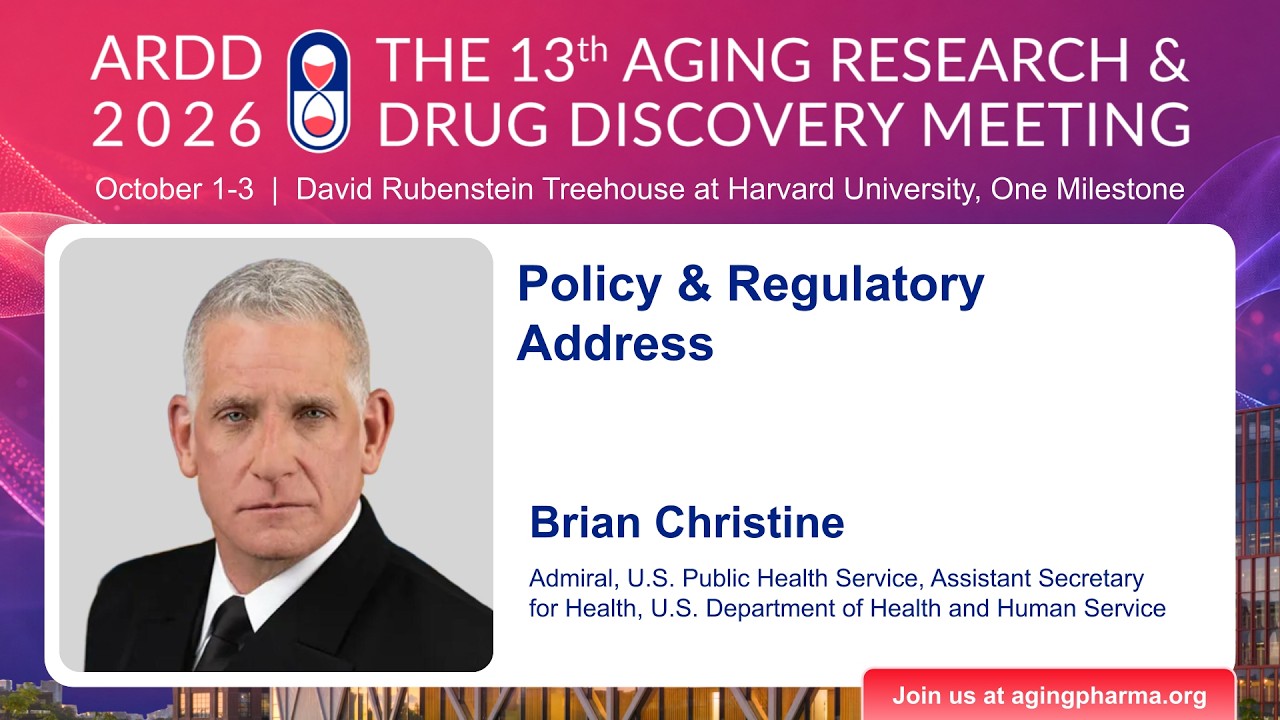
Brian Christine at ARDD2026: Policy & Regulatory Address
Keywords
Summary
174 words
Critical Evaluation
Value of the Information & Strength of the Argument
The talk provides high-level policy insight into the intersection of aging science and government health strategy. The value lies in the authoritative perspective of a high-ranking health official endorsing a paradigm shift from reactive treatment to proactive health preservation. The argument is well-structured, historically grounded, and cites concrete examples (e.g., TRAVERSE trial, FDA removal of black box warning) to illustrate the need for evidence-based evolution. However, some parts rely on personal opinion (e.g., peptides) and advocacy, which reduces the objectivity but adds practical resonance.
Scientific Rigor, Source Quality, Title Accuracy
The scientific rigor is moderate: the speaker references specific trials and regulatory changes without providing detailed citations, but the context suggests reliance on official sources. The description lists only the conference website and LinkedIn, lacking direct references to cited studies. The title is perfectly accurate, matching the purpose and content of the address. No comments are available to gauge public reception.
160 words
Title / Content Match
The title accurately reflects the speaker and the nature of the address as a policy and regulatory talk at the ARDD conference.
Quality & Reliability
8/10
The speaker is a high-ranking health official with medical training, offering policy perspectives grounded in references to FDA actions and clinical trials like TRAVERSE. Content is authoritative but includes personal opinions and advocacy elements.
Key Moments
Markers derived by PSI from the transcript: the creator did not define chapters.
- Introduction of Admiral Brian Christine and his role at HHS.
- Historical overview of life expectancy gains and the onset of chronic disease rise.
- Discusses the paradox of US medical capability versus population health; introduces healthspan concept.
- MAHA movement and the need for cross-agency collaboration to address chronic disease.
- Examples of testosterone and hormone therapy illustrating evidence-based changes and regulatory updates.
- Call to action for a unified approach to longevity and healthspan in policy, research, and practice.
Cited Sources
- Aging Pharma (ARDD official website) — Described as the official site of the Aging Research and Drug Discovery meeting.
- ARDD LinkedIn page — Listed in the description for updates on ARDD 2027.
Concurring Sources
- Aging Pharma (ARDD official website) — The conference's official site, which aligns with the event context.
- ARDD LinkedIn page — Provides further information about the conference and its community.
Contribution & Novelties
The address provides a governmental endorsement of healthspan as a policy priority, connecting aging science with federal health strategy. It emphasizes moving beyond lifespan and argues for a systemic approach to prevention across multiple levers. The novelty lies in integrating high-level policy statements with specific examples of evolving regulatory practices, which is valuable for aligning research and public health.
Pour aller plus loin :
- Healthspan — Related to the core concept discussed; a comprehensive overview of the term’s definition and research.
- Compression of morbidity — Discusses the idea of reducing the period of disability, directly linked to the speaker’s emphasis on extending healthy years.
- Aging biology and geroscience — A field central to the talk; no URL provided but can be explored via the National Institute on Aging (NIA) website.
130 words
Radar Profile
The profile shows strong scores in information quantity and quality, with a slightly lower technical level. Overall reliability is high, indicating a well-informed policy talk rather than a deep scientific exposition.